
Finding a comfortable bra can make a significant difference in your everyday confidence and comfort. However, choosing the right size is not always straightforward. Different brands use different sizing systems, and cup letters can sometimes be confusing, especially when shopping online.
A reliable cup size chart can help you understand how bra measurements work and identify a size that may fit your body more comfortably. Whether you are shopping for your first bra, replacing an everyday favorite, or exploring different lingerie styles, understanding measurements is an important first step.
Bra sizing generally involves two measurements: the band size and the cup size. Both work together to determine how a bra fits. Simply choosing a larger or smaller cup letter does not necessarily mean selecting a larger or smaller overall bra.
In this guide, we explain how to measure yourself, understand cup letters, compare US bra sizes, explore sister sizes, and find a comfortable fit.
What Is a Cup Size Chart?
A cup size chart is a reference guide that helps shoppers understand the relationship between bust measurements and bra cup sizes.
It generally compares the measurement around the fullest part of the bust with the measurement around the rib cage directly beneath the breasts.
The difference between these measurements helps estimate the cup letter.
For example, in many US sizing systems:
- A 1-inch difference generally corresponds to an A cup.
- A 2-inch difference generally corresponds to a B cup.
- A 3-inch difference generally corresponds to a C cup.
- A 4-inch difference generally corresponds to a D cup.
- A 5-inch difference generally corresponds to a DD or E cup, depending on the brand.
These are general guidelines rather than universal rules. Manufacturers may use different sizing conventions, and bra shape can influence the final fit.
A cup size chart is therefore a useful starting point, not a substitute for trying on a bra or checking a retailer’s specific size guide.
Understanding Bra Band Sizes and Cup Sizes
Before using a sizing guide, it is important to understand that bra sizes contain two separate elements.
1. Band Size
The band is the part of the bra that wraps around your rib cage.
In US sizing, common band sizes include 30, 32, 34, 36, 38, 40, and higher.
The band provides much of the support in a properly fitted bra.
A band that is too loose may ride up your back, while one that is too tight may cause discomfort or digging.
2. Cup Size
The cup holds and shapes the breast tissue.
Cup sizes are represented by letters, commonly A, B, C, D, DD, DDD, and larger sizes.
A common misunderstanding is that a D cup always represents the same volume. In reality, cup volume changes with band size.
For example, a 32D and a 38D do not have identical cup volumes.
3. How Band and Cup Sizes Work Together
A complete bra size combines both measurements.
Examples include:
- 32A
- 34B
- 36C
- 38D
- 40DD
Understanding this relationship makes a cup size chart much more useful when comparing different bras.
US Bra Cup Size Chart
The following reference explains approximate differences between bust and underbust measurements in a common US sizing system.
| Bust and Underbust Difference | Approximate Cup Size |
|---|---|
| 1 inch | A |
| 2 inches | B |
| 3 inches | C |
| 4 inches | D |
| 5 inches | DD / E |
| 6 inches | DDD / F |
| 7 inches | G |
| 8 inches | H |
| 9 inches | I |
| 10 inches | J |
These measurements are approximate. Some brands use different letter sequences, particularly for sizes above D.
Understanding Common Cup Sizes
A Cup: Often associated with a smaller difference between bust and underbust measurements.
B Cup: Represents a slightly larger measurement difference than an A cup.
C Cup: A common cup size found across many everyday bra collections.
D Cup: Represents a larger measurement difference, although actual volume depends on band size.
DD and DDD Cups: These sizes extend the cup sequence in many US sizing systems.
Larger Cup Sizes: G, H, I, J, and beyond may be available through specialty and extended-size lingerie collections.
Remember that cup letters are not standardized measurements of breast size across all band sizes.
How to Measure Your Bra Size at Home
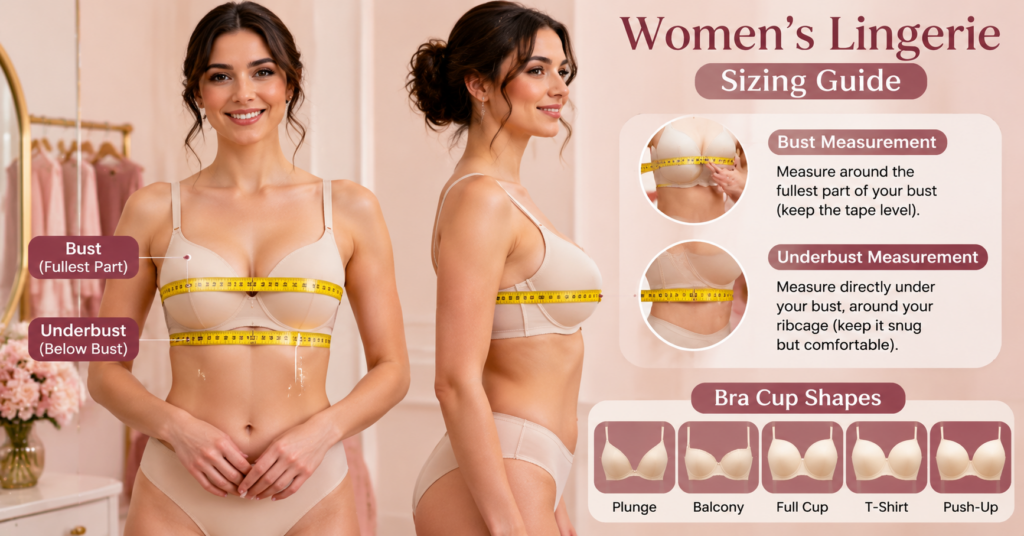
You do not need professional equipment to estimate your bra size. A soft measuring tape, mirror, and a few minutes are usually enough.
Follow these steps for a more accurate starting measurement.
Step 1: Measure Your Underbust
Stand naturally and wrap a flexible measuring tape around your rib cage directly beneath your breasts.
Keep the tape level and comfortably snug without pulling it too tightly.
Record the measurement in inches.
Step 2: Determine Your Band Size
In many US fitting methods, the underbust measurement is used to estimate the band size.
Depending on the measurement and the brand’s sizing method, you may need to round to a nearby even band size.
For example, an underbust measurement near 33 inches may lead you to compare 32 and 34 band sizes.
Always check the manufacturer’s fitting instructions because sizing methods vary.
Step 3: Measure Your Bust
Place the measuring tape around the fullest part of your bust.
Keep the tape level across your back and avoid compressing breast tissue.
Record the measurement in inches.
Step 4: Calculate the Difference
Subtract your underbust measurement from your bust measurement.
For example:
- Bust measurement: 36 inches
- Underbust measurement: 33 inches
- Difference: 3 inches
A 3-inch difference commonly suggests a C cup in traditional US sizing.
Step 5: Check the Brand’s Sizing Guide
Use the retailer’s measurement instructions to compare your results with its available sizes.
A cup size chart can help narrow down your options, but trying different sizes may still be necessary.
Example Bra Size Measurements
Here are a few simplified examples to show how the measurement process works.
| Underbust | Bust | Difference | Approximate Cup |
|---|---|---|---|
| 32 inches | 33 inches | 1 inch | A |
| 34 inches | 36 inches | 2 inches | B |
| 36 inches | 39 inches | 3 inches | C |
| 38 inches | 42 inches | 4 inches | D |
| 40 inches | 45 inches | 5 inches | DD |
These examples illustrate cup differences only. The correct band size should also be checked using the manufacturer’s sizing method.
What Are Sister Sizes in Bra Sizing?
Sister sizes are bra sizes with approximately similar cup volume but different band sizes.
They are useful when a bra feels slightly too tight or too loose around the rib cage.
For example:
- 34C and 36B are sister sizes.
- 34C and 32D are sister sizes.
When the band size increases by one step, the cup letter generally decreases by one step to maintain a similar cup volume.
When the band size decreases, the cup letter generally increases.
When Should You Try a Sister Size?
Consider trying a sister size when:
- The cups fit well, but the band feels too tight.
- The band feels loose, but the cup volume seems appropriate.
- A particular brand has slightly different sizing.
- You want to compare alternative fits.
Sister sizes are not always interchangeable because cup shape, wire width, and bra construction also affect comfort.
How to Know If Your Bra Fits Correctly
Measurements provide a starting point, but comfort and fit are equally important.
Here are some signs that your bra may fit properly.
1. The Band Stays Level
The band should sit horizontally around your body rather than riding up your back.
It should feel secure without restricting comfortable breathing.
2. The Cups Fit Smoothly
Breast tissue should sit comfortably inside the cups.
There should not be significant spillage, excessive wrinkling, or empty spaces.
3. The Center Gore Sits Comfortably
For many underwire bras, the center section between the cups should sit close to the chest.
The exact fit depends on the bra design and your body shape.
4. The Straps Stay in Place
Shoulder straps should remain comfortably positioned without digging into your shoulders.
They should not carry all the weight of the bra.
5. The Underwire Does Not Cause Discomfort
If your bra has underwires, they should sit around the breast tissue rather than pressing against it.
If the wire pokes, pinches, or feels painful, consider another size or design.
A useful cup size chart can help you identify a starting size, but the final decision should be based on how the bra actually fits.
Different Types of Bras and Their Fit
Different bra designs can fit differently, even when they carry the same size label.
1. T-Shirt Bras
T-shirt bras usually feature smooth cups designed to create a seamless appearance under fitted clothing.
They are popular for everyday wear.
2. Push-Up Bras
Push-up bras use padding or specially shaped cups to create additional lift and cleavage.
Because of their construction, they may feel different from lightly padded everyday bras.
3. Sports Bras
Sports bras are designed to provide support during physical activity.
Some use traditional bra sizing, while others use clothing-style sizes such as small, medium, and large.
4. Full-Coverage Bras
Full-coverage designs offer more coverage across the breast tissue.
They can be a comfortable option for people who prefer a secure everyday fit.
5. Wireless Bras
Wireless bras do not use traditional underwires.
They often prioritize flexibility and comfort, although support varies by design.
Common Bra Sizing Mistakes to Avoid
Even when using accurate measurements, some common mistakes can lead to an uncomfortable fit.
1. Choosing a Size Based Only on Cup Letters
A D cup does not represent the same volume across every band size.
Always consider the complete bra size.
2. Measuring Over Thick Clothing
Thick clothing can affect measurements.
Use a thin, non-padded bra or measure without clothing that adds unnecessary bulk.
3. Pulling the Measuring Tape Too Tightly
The measuring tape should be level and comfortably positioned.
Excessive pressure can produce inaccurate measurements.
4. Ignoring Brand Differences
Different manufacturers may use different sizing charts and construction methods.
Check each retailer’s size guide before ordering.
5. Keeping an Uncomfortable Bra
If a bra causes persistent pain, digging, or irritation, it may not be the right size or design.
Do not assume that discomfort is something you must accept.
Frequently Asked Questions
1. How do I find my correct bra cup size?
Measure your underbust and fullest bust measurements, calculate the difference, and compare the result with a retailer’s sizing guide. Try the suggested size to confirm the fit.
2. Is a D cup bigger than a C cup?
Within the same band size, a D cup generally represents a larger cup volume than a C cup. However, cup volume changes when the band size changes.
3. What is the difference between DD and DDD?
In many US sizing systems, DD comes after D, while DDD comes after DD. Some brands use E and F instead, so check the individual manufacturer’s chart.
4. Does a cup size chart work for every brand?
No. It provides a general reference, but manufacturers may use different measurement methods, cup sequences, and fits.
5. How often should I measure my bra size?
Recheck your measurements whenever your bras begin fitting differently or your body changes. You may also want to measure again when shopping for a new brand.
6. What are sister sizes?
Sister sizes are different band and cup combinations with approximately similar cup volumes. For example, 34C, 32D, and 36B are commonly considered sister sizes.
7. Should bra cups wrinkle or have gaps?
Ideally, cups should fit smoothly without significant wrinkling or gaps. However, small differences can depend on cup shape, padding, and breast shape.
8. Can I use a cup size chart when shopping online?
Yes. It is a helpful starting point when shopping online. Compare your measurements with the retailer’s specific sizing guide and review its return policy before ordering.
Conclusion
Finding a comfortable bra begins with understanding how band and cup measurements work together. Although bra sizing may initially seem complicated, learning how to measure your underbust and bust can make shopping much easier.
A cup size chart provides a useful reference for understanding cup differences, comparing sizes, and exploring suitable options. However, measurements are only the starting point. Brand variations, bra construction, and individual body shape all influence the final fit.
Take time to compare sizing guides, explore different bra styles, and pay attention to comfort. Whether you prefer T-shirt bras, sports bras, wireless designs, or full-coverage options, the right fit should feel supportive without causing unnecessary pressure or discomfort.
With accurate measurements and a little patience, you can make more confident lingerie choices and find bras that suit your everyday needs.