The marine industry is undergoing a significant transformation as boat owners, manufacturers, and commercial operators explore alternatives to traditional gasoline and diesel engines. Electric propulsion technology offers new opportunities to improve energy efficiency, reduce noise, and create more environmentally responsible boating experiences.
A 100 kW electric inboard motor provides a powerful propulsion solution for suitable yachts, sailing vessels, passenger boats, and commercial marine applications.
Across the United States, electric boating is attracting attention from individuals and businesses interested in modern marine technology and sustainable transportation.
This comprehensive guide explores how electric inboard motors work, their benefits, technical features, battery requirements, applications, installation considerations, and long-term ownership advantages.
What Is a 100 kW Electric Inboard Motor?
An electric inboard motor is a marine propulsion system installed inside a vessel that converts electrical energy into mechanical power to drive a propeller.
Unlike traditional combustion engines, electric motors receive energy from rechargeable batteries or another compatible electrical power source.
A 100 kW electric inboard motor delivers approximately 134 mechanical horsepower in terms of power conversion. However, actual vessel performance depends on hull design, displacement, propeller selection, and operating conditions.
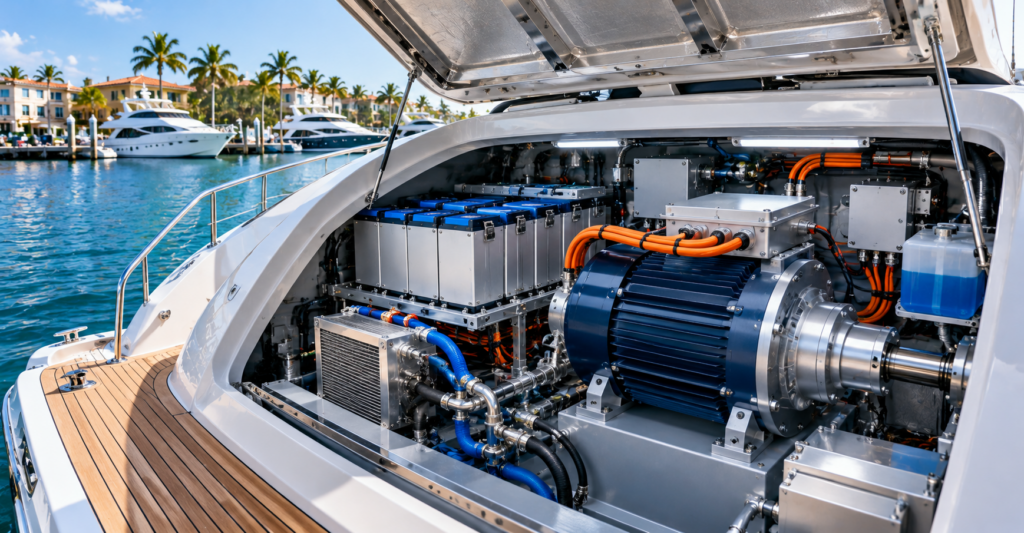
These propulsion systems typically include an electric motor, motor controller, marine battery system, cooling equipment, digital controls, and power management technology.
How Does Electric Marine Propulsion Work?
Electric marine propulsion relies on stored electrical energy to generate rotational movement.
The battery supplies electricity to the motor controller, which regulates power delivery according to the operator’s throttle input.
The motor converts electrical energy into mechanical rotation, transferring power to the vessel’s propeller through an appropriate drivetrain.
A 100 kW electric inboard motor can provide responsive torque delivery without relying on conventional fuel combustion.
Integrated monitoring systems may also allow operators to track battery capacity, energy consumption, motor temperature, and estimated operating range.
Key Benefits of a 100 kW Electric Inboard Motor
Electric propulsion systems offer several advantages for recreational boat owners and commercial marine operators.
1. Reduced Operational Emissions
Electric motors do not produce direct exhaust emissions during operation.
This makes them an attractive option for boaters seeking to reduce local air pollution and minimize dependence on conventional marine fuels.
The overall environmental impact still depends on electricity generation, battery manufacturing, equipment lifespan, and recycling practices.
2. Quieter Boating Experience
Traditional combustion engines can generate considerable noise and vibration.
A 100 kW electric inboard motor generally operates more quietly, helping create a peaceful environment for passengers and crew members.
Reduced propulsion noise may be particularly valuable for sailing yachts, wildlife observation vessels, recreational cruisers, and passenger boats.
3. Improved Energy Efficiency
Electric motors can convert electrical energy into mechanical power with relatively high efficiency.
Modern marine propulsion systems use sophisticated motor controllers to regulate energy consumption and support efficient operation.
Actual system efficiency depends on battery performance, motor design, drivetrain configuration, and vessel operating conditions.
4. Lower Routine Maintenance Requirements
A 100 kW electric inboard motor generally contains fewer moving components than a conventional diesel engine.
Electric propulsion eliminates certain engine-related maintenance tasks, including combustion-engine oil changes, spark plug replacements, and fuel filter servicing.
However, batteries, cooling systems, electrical connections, bearings, and drivetrain components still require appropriate inspections and maintenance.
5. Responsive Power Delivery
Electric motors can provide strong torque across a useful operating range.
This characteristic may support controlled acceleration and precise maneuvering, depending on the propulsion configuration.
Responsive throttle control can be particularly helpful when docking, navigating marinas, or operating in restricted waterways.
Exploring the ePropulsion H-100 Electric Motor
The ePropulsion H-100 is an example of a modern 100 kW electric inboard motor developed for larger marine vessels.
According to the manufacturer, its H-Series propulsion platform is designed for suitable sailing yachts and motor vessels measuring approximately 60 to 100 feet, with displacement capabilities depending on the system configuration.
The H-100 incorporates permanent magnet motor technology, water cooling, modular system architecture, and advanced digital monitoring capabilities. ePropulsion+1
Key Technical Features
| Specification | Details |
|---|---|
| Rated motor power | 100 kW |
| Approximate power conversion | 134 horsepower |
| Motor technology | Permanent magnet motor |
| Maximum reported motor efficiency | 96% |
| Maximum reported torque | 2,000 Nm |
| Cooling method | Water cooling |
| System architecture | Modular design |
| Direct exhaust emissions | Zero during electric operation |
The manufacturer reports these performance characteristics for its H-100 model. Complete propulsion efficiency and vessel suitability depend on the installed configuration. ePropulsion
Applications of a 100 kW Electric Inboard Motor
High-power electric propulsion technology supports several recreational and commercial marine applications.
Luxury Yachts
Electric propulsion can help yacht owners prioritize passenger comfort, quieter cruising, and modern onboard technology.
A properly engineered system can complement vessels designed for efficient displacement-speed operation.
Sailing Boats
Many sailing vessels require auxiliary propulsion for marina navigation, docking, and periods of limited wind.
A 100 kW electric inboard motor may be suitable for larger sailing vessels requiring substantial auxiliary power, subject to engineering assessments and battery capacity.
Passenger and Tourism Boats
Sightseeing vessels and passenger boats may benefit from reduced propulsion noise and the absence of direct exhaust fumes.
Electric systems can be particularly practical for predictable routes with access to dependable charging infrastructure.
Commercial Marine Vessels
Certain workboats, harbor service vessels, and commercial transportation boats can incorporate electric propulsion systems.
Operators must evaluate duty cycles, power demands, charging schedules, payload requirements, and regulatory obligations before adopting electric technology.
Battery Requirements for Electric Inboard Motors
Battery capacity is one of the most important considerations when selecting an electric propulsion system.
A 100 kW electric inboard motor requires an appropriately designed battery bank capable of supporting its operating voltage, power demands, and intended runtime.
Marine battery systems should incorporate suitable protection, monitoring, temperature management, and charging capabilities.
Understanding Battery Capacity and Runtime
Battery capacity is generally measured in kilowatt-hours (kWh), while motor power is measured in kilowatts (kW).
For illustration, a battery with 200 kWh of usable energy would theoretically provide the following operating times at constant electrical demand:
| Electrical demand | Theoretical runtime |
|---|---|
| 25 kW | 8 hours |
| 50 kW | 4 hours |
| 75 kW | 2 hours 40 minutes |
| 100 kW | 2 hours |
Actual runtime may be lower because of electrical losses, auxiliary loads, battery limitations, environmental conditions, and required energy reserves.
Electric Inboard Motors vs. Diesel Marine Engines
Understanding the differences between electric and combustion propulsion can help boat owners evaluate their available options.
| Feature | Electric Inboard Motor | Diesel Marine Engine |
|---|---|---|
| Energy source | Electricity | Diesel fuel |
| Operating noise | Generally lower | Generally higher |
| Direct exhaust emissions | None | Present |
| Routine engine maintenance | Generally reduced | More extensive |
| Energy replenishment | Battery charging | Fuel refilling |
| Operating range | Battery-dependent | Fuel-capacity-dependent |
| Power delivery | Responsive electric torque | Engine-speed-dependent |
A 100 kW electric inboard motor may be particularly practical for vessels with predictable operating requirements and reliable charging access.
Diesel propulsion may remain suitable for applications requiring extended offshore range and rapid refueling.
Important Installation Considerations
Installing a high-power marine propulsion system requires careful planning and professional engineering.
Vessel Compatibility
Before installing a 100 kW electric inboard motor, evaluate vessel displacement, hull characteristics, propeller requirements, available installation space, and intended cruising speed.
Replacing a diesel engine with an electric motor is not necessarily a direct horsepower-for-horsepower conversion.
Battery Placement and Weight Distribution
Marine battery banks can represent a substantial portion of the propulsion system’s weight.
Proper placement is essential for maintaining vessel stability, structural integrity, and balanced weight distribution.
Charging Infrastructure
Boat owners should evaluate charging availability at marinas, private docks, and intended destinations.
A 100 kW electric inboard motor paired with a large battery bank may require considerable charging time, depending on shore-power capacity and charging equipment.
Electrical Safety
High-voltage marine propulsion systems require specialized installation, protective equipment, and appropriate safety measures.
Work should be performed by qualified marine electrical professionals following applicable US Coast Guard requirements, relevant marine electrical standards, and manufacturer instructions.
How Much Does a 100 kW Electric Inboard Motor Cost?
The total cost of electric marine propulsion depends on the motor, battery capacity, controller, charging equipment, cooling system, installation labor, and necessary vessel modifications.
Battery storage can represent a significant portion of the overall investment.
Boat owners should request comprehensive quotations covering the complete installed propulsion system rather than comparing motor prices alone.
Long-term operating costs will depend on electricity prices, maintenance requirements, battery replacement needs, and annual vessel usage.
Frequently Asked Questions
How powerful is a 100 kW electric inboard motor?
It delivers approximately 134 horsepower in mechanical power terms. Actual boating performance depends on vessel design, propeller configuration, and operating conditions.
How long can an electric inboard motor run?
Runtime depends on usable battery capacity, electrical demand, cruising speed, environmental conditions, and onboard auxiliary power consumption.
Can a 100 kW electric inboard motor replace a diesel engine?
It can replace a diesel engine in suitable vessels. However, professional engineering assessments are necessary to determine propulsion requirements and system compatibility.
Are electric boat motors environmentally friendly?
Electric motors produce no direct exhaust emissions during operation. Their overall environmental impact depends on electricity sources, battery production, and equipment lifecycle management.
Is electric marine propulsion suitable for saltwater?
Marine-rated electric propulsion systems can operate in saltwater environments when properly designed, installed, protected against corrosion, and maintained according to manufacturer recommendations.
Does a 100 kW electric inboard motor require regular maintenance?
Yes. Although routine combustion-engine servicing is eliminated, electrical systems, cooling equipment, batteries, and mechanical drivetrain components still require scheduled maintenance.
Conclusion
A 100 kW electric inboard motor represents a significant advancement in modern marine propulsion, offering efficient power delivery, reduced operating noise, responsive performance, and zero direct exhaust emissions.
From luxury yachts and sailing vessels to passenger boats and commercial marine applications, electric propulsion provides new opportunities for sustainable boating.
However, selecting the right system requires careful consideration of vessel compatibility, battery capacity, charging infrastructure, installation requirements, and long-term operating expenses.
By investing in appropriate marine technology and professional installation, boat owners can enjoy a modern propulsion experience that balances performance, efficiency, and environmental responsibility.