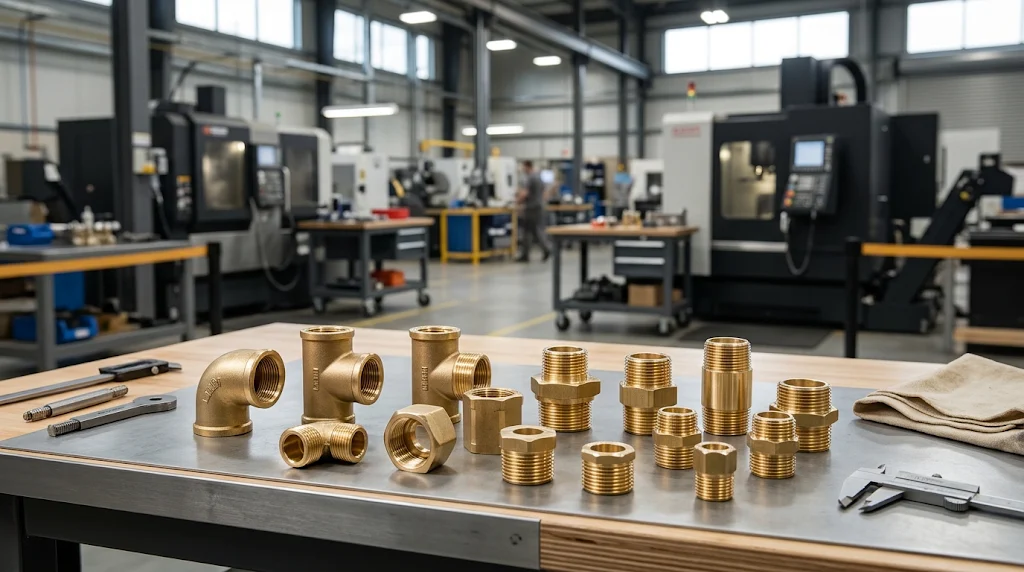
Brass fittings play an important role in plumbing, construction, manufacturing, automotive systems, and industrial applications. These small but essential components connect pipes, control fluid movement, and help create reliable connections between different parts of a piping system. Although they may appear simple, their material composition, manufacturing quality, dimensions, and performance specifications can significantly affect the reliability of an entire installation.
As industrial and construction requirements continue to evolve, businesses increasingly look for dependable brass fittings manufacturers that can provide consistent product quality, suitable materials, and a wide selection of fitting designs. From plumbing contractors and equipment manufacturers to industrial distributors, selecting the right manufacturing partner is an important purchasing decision.
However, not all brass fittings are manufactured to the same specifications. Differences in brass alloys, machining methods, thread accuracy, pressure ratings, and quality control can influence how a fitting performs in its intended application.
Understanding these factors can help American buyers make informed sourcing decisions, reduce installation problems, and identify manufacturers capable of meeting their technical and commercial requirements.
What Are Brass Fittings?
Brass fittings are connection components manufactured primarily from brass, an alloy of copper and zinc. They are used to connect, extend, redirect, reduce, or terminate pipes and tubing in different fluid and gas systems.
Brass is widely used because it offers a useful combination of machinability, strength, corrosion resistance, and durability.
These fittings are available in different configurations depending on their intended applications. Common examples include elbows, tees, couplings, adapters, reducers, nipples, plugs, and threaded connectors.
Brass fittings are commonly found in:
- Residential and commercial plumbing
- Water distribution systems
- Heating and cooling equipment
- Industrial machinery
- Automotive components
- Agricultural irrigation
- Compressed air systems
- Refrigeration equipment
- Manufacturing and processing facilities
Their versatility makes them valuable across multiple industries. However, selecting the correct product requires understanding the operating conditions, material compatibility, and applicable technical standards.
Different Types of Brass Pipe Fittings
Professional brass fittings manufacturers typically produce different fitting configurations to support specific connection requirements.
Understanding these products helps buyers identify the components needed for their projects.
1. Brass Elbow Fittings
Brass elbows are designed to change the direction of a pipe or tubing connection.
Common configurations include 45-degree and 90-degree elbows. They are used in plumbing installations, industrial piping, heating systems, and equipment connections.
The correct elbow depends on the required direction, connection type, dimensions, and operating pressure.
2. Brass Tee Fittings
Brass tees allow a piping system to divide into two branches or combine connections.
They generally feature three openings and are available in different sizes and thread configurations.
These fittings are useful in water distribution, irrigation systems, compressed air installations, and industrial equipment.
3. Brass Couplings
Brass couplings connect two compatible pipe sections.
Depending on the design, they may feature internal threads, compression connections, or other joining arrangements.
Full couplings, reducing couplings, and specialized configurations are available for different installation requirements.
4. Brass Adapters
Brass adapters connect components with different connection configurations.
For example, an adapter may connect a male-threaded component to a female-threaded connection or transition between different tubing systems.
Buyers should verify thread standards carefully, particularly when working with imported equipment.
5. Brass Reducers and Bushings
Reducers and bushings allow connections between pipes or components with different diameters.
They are frequently used when a piping system needs to transition from a larger connection to a smaller one.
Accurate sizing is essential for maintaining proper compatibility and avoiding installation difficulties.
6. Brass Plugs and Caps
Plugs and caps are used to close unused pipe openings or terminate connections.
They are available in different shapes, thread configurations, and dimensions for plumbing and industrial applications.
How Brass Fittings Are Manufactured
The manufacturing process plays an important role in determining the quality, dimensional accuracy, and performance of brass fittings.
Experienced manufacturers use different production techniques depending on the product design, required quantities, and material specifications.
Brass Forging
Forging involves shaping heated brass material using controlled pressure.
This process is commonly used to produce fitting bodies that require particular shapes and mechanical characteristics.
Forged components can provide consistent structural properties when produced using appropriate manufacturing controls.
CNC Machining
Computer numerical control machining allows manufacturers to produce accurately dimensioned components using automated equipment.
It is particularly useful for threaded fittings, adapters, precision connectors, and customized brass components.
CNC machining helps maintain dimensional consistency and repeatability during production.
Brass Casting
Casting involves pouring molten brass into prepared molds to create specific component shapes.
It can be suitable for products with more complicated geometries.
Depending on the manufacturing process, cast components may require additional machining and finishing before they are ready for use.
Thread Cutting and Finishing
Thread quality is essential for reliable pipe connections.
Manufacturers must produce accurate threads according to the required specifications. Poorly formed threads can create installation difficulties, inadequate sealing, or damaged connections.
Finishing operations may include deburring, cleaning, polishing, and surface treatment.
Why Material Quality Matters When Choosing Brass Fittings Manufacturers
The brass alloy used during production directly influences the properties of the finished fitting.
Different applications require different material characteristics, making alloy selection an important part of the purchasing process.
Understanding Common Brass Alloys
Some brass alloys are selected for their machining characteristics, while others are used for forging, forming, or specialized applications.
For example, C36000 is commonly associated with free-machining brass components. Other brass compositions may be selected according to strength, forming requirements, corrosion resistance, or environmental considerations.
Buyers should request material specifications rather than relying only on general descriptions such as premium brass or high-quality brass.
Corrosion Resistance
Brass generally offers good corrosion resistance in many suitable environments.
However, its performance depends on the alloy, water chemistry, temperature, and operating conditions.
Some environments can contribute to dezincification, a corrosion process in which zinc is selectively removed from the alloy.
For demanding applications, buyers should ask whether a dezincification-resistant brass grade is appropriate.
Lead-Free Brass Requirements
Lead content is particularly important when fittings are intended for drinking water applications in the United States.
Under the federal Safe Drinking Water Act requirements, lead-free plumbing products must have a weighted average lead content of no more than 0.25% across their wetted surfaces.
Products intended for potable water applications must also meet applicable certification requirements. NSF/ANSI/CAN 372 addresses lead content, while NSF/ANSI/CAN 61 addresses health effects associated with drinking water system components. US EPA+2
Manufacturers and importers should be able to provide appropriate documentation and product certification information.
Importantly, a brass fitting should not automatically be considered suitable for drinking water simply because it is described as low-lead or lead-free.
Applications of Brass Fittings Across Different Industries
The versatility of brass allows manufacturers to supply components for numerous industrial and commercial applications.
Plumbing and Water Distribution
Brass fittings are used in plumbing systems to connect pipes, valves, faucets, and other equipment.
Their machinability and availability in different configurations make them useful for residential and commercial installations.
For drinking water applications, buyers must verify the applicable lead-free requirements and product certifications.
HVAC and Refrigeration
Heating, ventilation, air conditioning, and refrigeration equipment use different fittings for connecting pipes, tubing, and mechanical components.
The selected brass fitting must be compatible with the operating pressure, temperature, fluid, and system design.
Not every brass fitting is suitable for every refrigerant or HVAC application.
Automotive and Transportation
Brass fittings can be found in certain automotive and transportation components, including specialized connectors, hose connections, and air system components.
Their suitability depends on the vehicle application, pressure requirements, vibration exposure, and relevant industry specifications.
Agriculture and Irrigation
Agricultural systems use fittings to connect water distribution lines, irrigation equipment, pumps, and other components.
Brass fittings can provide practical connection solutions for suitable irrigation applications.
However, compatibility with fertilizers, chemicals, and water conditions should always be evaluated.
Industrial Manufacturing
Manufacturing facilities use brass fittings in different equipment connections, compressed air arrangements, fluid systems, and machinery.
Selecting products with appropriate material specifications and pressure ratings helps support reliable operation.
How to Choose Reliable Brass Fittings Manufacturers
Finding the right manufacturing partner requires evaluating more than product prices.
Businesses should consider production capabilities, quality control, technical documentation, and the manufacturer’s ability to meet ongoing supply requirements.
1. Evaluate Product Range
Look for manufacturers offering the fitting configurations required for your application.
A suitable product range may include elbows, tees, adapters, couplings, reducers, nipples, and custom connectors.
A broad catalog can simplify sourcing when multiple fitting types are required.
2. Check Manufacturing Capabilities
Ask whether the manufacturer uses forging, casting, CNC machining, or other production methods.
The manufacturing process should be appropriate for the component’s design, dimensions, and intended performance.
3. Request Material Certificates
Reliable manufacturers should be able to identify the brass alloy used in their products.
Material certificates and relevant technical documentation help buyers verify that the supplied products match their requirements.
4. Examine Quality Control Procedures
Quality assurance should cover important production characteristics, including:
- Dimensional accuracy
- Thread quality
- Material composition
- Surface finish
- Pressure performance where applicable
- Visual inspection
- Product consistency
For specialized applications, additional testing and traceability may be necessary.
5. Compare Pricing and Production Capacity
Price is an important purchasing consideration, but it should not be the only selection factor.
Compare quotations based on material grade, manufacturing method, product specifications, minimum order quantities, delivery schedules, and quality requirements.
A low-priced fitting may create higher costs if it results in installation problems or premature failure.
Why Consider Honda Valve for Brass Pipe Fittings?
Honda Valve is a company associated with brass pipe fitting products. Its brass fitting product category provides a relevant starting point for businesses researching different types of brass pipe connection components.
When evaluating Honda Valve or other potential manufacturers and suppliers, buyers should examine the available product configurations, material specifications, dimensions, connection standards, and technical documentation.
For American businesses, it is especially important to confirm whether products meet the requirements of their intended applications.
Before placing a bulk order, consider requesting:
- Product catalogs and dimensional drawings
- Brass alloy specifications
- Thread and connection details
- Pressure and temperature ratings
- Lead-free certification where required
- Quality inspection documentation
- Sample products for evaluation
- Manufacturing and delivery information
These checks can help establish whether a supplier is suitable for your purchasing requirements.
Important Factors When Importing Brass Fittings into the USA
American companies sourcing brass fittings internationally should consider additional commercial and regulatory requirements.
First, verify that product specifications match the intended US application. Thread compatibility is particularly important because American NPT connections and international BSP connections are different standards and should not be assumed interchangeable.
Second, review applicable lead-free requirements for products intended for potable water applications.
Third, confirm the manufacturer’s ability to provide consistent production quality, packaging, labeling, and documentation.
Finally, consider shipping costs, customs requirements, delivery schedules, and the supplier’s ability to support repeat orders.
A properly evaluated sourcing arrangement can help businesses reduce procurement risks and maintain a dependable supply of brass components.
Frequently Asked Questions
1. What do brass fittings manufacturers produce?
They manufacture different pipe and tubing connection components, including elbows, tees, couplings, adapters, reducers, plugs, caps, and customized brass connectors.
2. What is the best brass alloy for pipe fittings?
The appropriate alloy depends on the application. C36000 is commonly used for machining, while other alloys may be selected for forging, forming, or specialized performance requirements.
3. Are brass pipe fittings suitable for drinking water?
Suitable certified lead-free brass fittings can be used in drinking water applications. Buyers must verify applicable federal requirements and product certifications before selecting them.
4. What are the common types of brass pipe fittings?
Common types include elbows, tees, couplings, adapters, reducing bushings, nipples, plugs, and caps.
5. How are brass fittings manufactured?
Manufacturing methods include forging, casting, CNC machining, thread cutting, and finishing. The selected process depends on the component design and production requirements.
6. How can I check the quality of brass fittings?
Review material certificates, dimensional drawings, thread specifications, inspection reports, applicable certifications, and pressure test documentation where relevant.
7. Are brass fittings corrosion-resistant?
Brass generally offers good corrosion resistance in suitable environments. However, performance depends on the alloy, fluid chemistry, temperature, and operating conditions.
8. What should US buyers check before importing brass fittings?
Check material specifications, thread compatibility, lead-free compliance where applicable, pressure ratings, product documentation, supplier reliability, shipping costs, and delivery arrangements.
Conclusion
Selecting the right brass fittings manufacturers is essential for businesses that depend on reliable pipe connections across plumbing, construction, automotive, HVAC, agriculture, and industrial applications.
Although brass fittings are relatively small components, their material composition, manufacturing accuracy, and connection quality can influence the performance of an entire system.
By evaluating manufacturing capabilities, brass alloy specifications, product certifications, quality control procedures, and delivery arrangements, American buyers can make more confident sourcing decisions.
Whether you require standard brass pipe fittings or customized industrial connectors, choosing a manufacturer that understands your technical requirements is an important step toward maintaining product quality, operational reliability, and long-term business value.