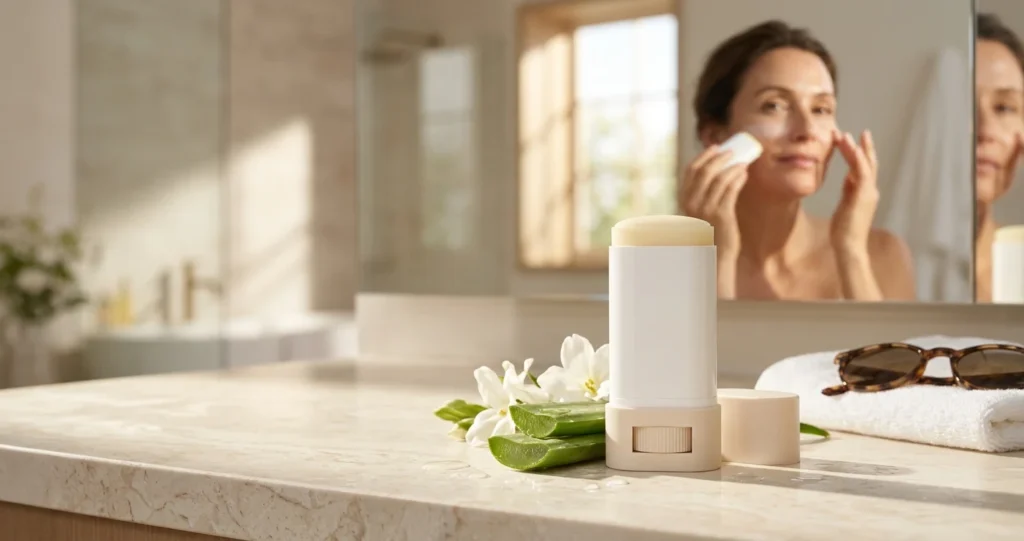
Protecting your skin from the sun is one of the most important parts of maintaining a healthy skincare routine. Whether you are commuting to work, spending time outdoors, traveling, or enjoying a summer vacation, daily sun protection can help reduce the effects of harmful ultraviolet radiation.
Traditional lotions and creams remain popular choices, but modern skincare products offer more convenient alternatives. One product gaining attention among beauty enthusiasts is the sunscreen stick.
A sunscreen stick provides a portable way to apply sun protection without squeezing lotion from a bottle or dealing with messy hands. Its compact packaging makes it easy to carry in a handbag, backpack, or travel case.
From mineral formulas to lightweight everyday options, there are different products available for different skin types and preferences.
In this guide, we explore how sunscreen sticks work, their benefits, application techniques, SPF ratings, and what to consider before choosing one for your daily skincare routine.
What Is a Sunscreen Stick?
A sunscreen stick is a solid skincare product formulated to protect the skin against ultraviolet radiation.
It usually comes in a twist-up container similar to a deodorant or lip balm. The product contains sunscreen ingredients blended into a solid or semi-solid base that can be applied directly to the skin.
Depending on the formulation, sunscreen sticks may contain mineral filters, chemical filters, or a combination of both.
Common ingredients include:
- Zinc oxide.
- Titanium dioxide.
- Avobenzone.
- Octisalate.
- Octocrylene.
- Homosalate, where permitted.
- Moisturizing ingredients such as shea butter and plant oils.
The main purpose is to provide convenient sun protection in a compact format.
A sunscreen stick is particularly useful for applying product to smaller areas, including the nose, cheeks, forehead, ears, and around the hairline.
However, it must be applied generously and evenly to provide the level of protection indicated on its label.
Why Are Sunscreen Sticks Becoming Popular?
Skincare products are increasingly designed around convenience and everyday usability.
Many people understand the importance of sun protection but find traditional sunscreen lotions inconvenient to carry or reapply throughout the day.
This is where stick-based products offer an alternative.
Here are several reasons for their popularity.
1. Convenient Application
A major advantage of a sunscreen stick is its simple application process.
You can glide the product directly over the skin without dispensing lotion into your hands.
This can be particularly convenient when you are traveling, walking outdoors, or spending time away from home.
2. Travel-Friendly Packaging
Most stick formulas come in compact containers that fit easily into everyday bags.
They are useful for people who want to keep sun protection available throughout the day.
For air travel, remember that solid sunscreen sticks generally do not have the same liquid-container restrictions as lotions, although travelers should always check current airline and airport rules.
3. Less Messy Application
Unlike traditional sunscreen creams, a sunscreen stick does not usually spill or drip during application.
This makes it convenient for quick touch-ups.
However, the product should still be applied carefully to avoid missing areas.
4. Useful for Targeted Areas
Certain areas of the body receive frequent sun exposure but are sometimes overlooked.
These include:
- Nose.
- Ears.
- Forehead.
- Cheekbones.
- Hairline.
- Back of the neck.
- Hands.
The compact design makes it easier to focus on these smaller areas.
5. Different Formula Options
Modern sunscreen sticks are available in different formulations.
Some contain mineral filters, while others use chemical filters. Certain products also include moisturizing ingredients that help improve the skin’s feel.
This variety allows consumers to compare products based on their preferences.
Understanding SPF and Broad-Spectrum Protection
Before choosing any sun protection product, it is important to understand what SPF actually means.
SPF stands for Sun Protection Factor. It primarily measures protection against UVB radiation, which is responsible for sunburn.
However, ultraviolet exposure also includes UVA radiation, which contributes to premature skin aging and other skin damage.
This is why broad-spectrum protection matters.
What Does Broad-Spectrum Mean?
A product labeled broad-spectrum in the United States has met FDA requirements for protection against both UVA and UVB radiation.
When shopping, look for:
- Broad-spectrum labeling.
- SPF 30 or higher for routine outdoor use.
- Water-resistance information when needed.
- Clear application instructions.
- An expiration date.
The American Academy of Dermatology recommends broad-spectrum, water-resistant sunscreen with SPF 30 or higher.
Remember that higher SPF does not eliminate the need for proper application or reapplication.
Mineral vs. Chemical Sunscreen Sticks
Understanding the difference between mineral and chemical sunscreen can help you choose a suitable product.
1. Mineral Sunscreen Sticks
Mineral sunscreens commonly use zinc oxide, titanium dioxide, or both as active ingredients.
They work by absorbing and scattering ultraviolet radiation, with absorption being an important part of their protective action.
Some people prefer mineral formulas because they are often suitable for sensitive-skin routines, although individual reactions can still occur.
Mineral products may sometimes leave a visible white cast, particularly on deeper skin tones.
2. Chemical Sunscreen Sticks
Chemical sunscreens use organic UV filters that absorb ultraviolet radiation.
They are available in different textures and formulations.
Some products are designed to spread smoothly and leave minimal visible residue.
However, the experience depends on the specific ingredients and product formulation.
3. Which One Should You Choose?
Neither type is automatically the best choice for everyone.
Consider your skin preferences, product texture, active ingredients, and how comfortably you can apply the product in sufficient quantities.
The best sunscreen is one that provides appropriate broad-spectrum protection and that you are willing to use consistently.
How to Apply a Sunscreen Stick Correctly
Application technique is extremely important because applying too little sunscreen can reduce the protection you receive.
Although a sunscreen stick is convenient, its solid format can make it easier to miss certain areas.
Follow these steps for better coverage.
Step 1: Start with Clean Skin
Apply your regular skincare products first.
If you use a moisturizer, allow it to settle before applying sun protection.
Step 2: Apply Generously
Glide the product across the exposed skin using slow, overlapping strokes.
Make multiple passes over each area according to the manufacturer’s directions.
Avoid assuming that one quick swipe provides adequate coverage.
Step 3: Cover Commonly Missed Areas
Pay attention to your nose, ears, forehead, hairline, and sides of the face.
If your neck and hands are exposed, remember to protect them as well.
Step 4: Follow the Product Instructions
Different formulations may have different application recommendations.
Use the quantity and technique specified on the label.
Step 5: Reapply Regularly
The American Academy of Dermatology recommends reapplying sunscreen approximately every two hours when outdoors and immediately after swimming or sweating, or after towel drying.
A sunscreen stick can make these touch-ups more convenient.
However, it should not replace careful initial application.
Is a Sunscreen Stick Suitable for Every Skin Type?
Different skin types may prefer different sunscreen formulations.
Understanding your skin’s needs can make shopping easier.
Dry Skin
People with dry skin may prefer formulas containing moisturizing ingredients such as shea butter, glycerin, or plant-based oils.
These ingredients can help create a more comfortable skin feel.
Oily Skin
If you have oily skin, consider lightweight or matte-finish products.
Some stick formulas have richer textures, so check product descriptions before purchasing.
Sensitive Skin
People with sensitive skin may prefer fragrance-free mineral formulations.
However, mineral filters do not guarantee that a product will never cause irritation.
Check the full ingredient list and patch-test new products.
Combination Skin
Combination skin may benefit from a formula that offers comfortable coverage without feeling excessively heavy.
Consider your preferences across different facial areas.
A sunscreen stick can be useful for targeted application, but make sure the entire exposed area receives adequate protection.
Can You Apply Sunscreen Stick Over Makeup?
Yes, some people use stick sunscreen for daytime touch-ups over makeup.
However, this requires care because rubbing the product across the face may disturb foundation, concealer, or powder.
For better results:
- Choose a formula designed for comfortable facial application.
- Use gentle, controlled strokes.
- Avoid excessive pressure.
- Check that the product provides broad-spectrum protection.
- Follow the label’s reapplication instructions.
Do not assume that a light swipe over makeup provides the same protection as a properly applied sunscreen layer.
If makeup makes adequate reapplication difficult, consider other sun-protection options such as shade and a wide-brimmed hat.
How to Choose the Best Sunscreen Stick
With so many products available, comparing a few important features can help you make a better decision.
1. Check the SPF Rating
For everyday outdoor protection, look for broad-spectrum SPF 30 or higher.
2. Review Active Ingredients
Check whether the product uses zinc oxide, titanium dioxide, or chemical UV filters.
3. Consider the Texture
Some sticks feel creamy, while others have a drier or more matte finish.
Choose a formula that feels comfortable on your skin.
4. Look for Water Resistance
If you plan to swim or exercise, consider a water-resistant product.
In the United States, water-resistance claims generally specify either 40 or 80 minutes.
No sunscreen is completely waterproof or sweatproof.
5. Check the Packaging
A secure twist-up container helps keep the product protected during travel.
Also check the expiration date and storage recommendations.
Where to Buy Sunscreen Sticks in the USA
American shoppers can find sun protection products at pharmacies, beauty retailers, department stores, and established online skincare stores.
When comparing options, review the product label rather than relying entirely on advertising claims.
Consider checking:
- SPF rating.
- Broad-spectrum protection.
- Active ingredients.
- Water-resistance duration.
- Skin-type recommendations.
- Product size and price.
- Expiration date.
- Customer reviews.
A sunscreen stick should be selected based on its protective properties and suitability for your routine, not simply its packaging or popularity.
Frequently Asked Questions (FAQs)
1. What is a sunscreen stick used for?
It is used to provide topical sun protection in a convenient solid format. It can be applied to the face and other exposed areas of the body.
2. Is a sunscreen stick as effective as sunscreen lotion?
It can provide comparable labeled SPF protection when applied correctly and in sufficient quantity. The main challenge is applying enough product evenly.
3. Can I use a sunscreen stick every day?
Yes. Daily broad-spectrum sun protection is recommended, including on days when you spend time outdoors during ordinary activities.
4. How often should I reapply a sunscreen stick?
Generally, reapply every two hours when outdoors and after swimming, sweating, or towel drying, following the product’s directions.
5. Is a mineral sunscreen stick better for sensitive skin?
Some people with sensitive skin prefer mineral formulas, but individual reactions vary. Check ingredients and test new products before regular use.
6. Can I use a sunscreen stick on my lips?
Only if the product is specifically labeled for lip use. Otherwise, choose a dedicated lip balm with broad-spectrum SPF protection.
7. Does a sunscreen stick leave a white cast?
Some mineral formulas can leave a white cast, particularly on darker skin tones. Tinted and differently formulated products may reduce this effect.
8. Can I use a sunscreen stick over makeup?
Yes, but apply carefully because repeated rubbing may disturb makeup. Make sure you still achieve adequate coverage.
Conclusion
Protecting your skin from ultraviolet radiation is an important part of maintaining a consistent skincare routine. Although traditional lotions and creams remain effective options, modern formats offer additional convenience.
A sunscreen stick provides a portable way to apply sun protection throughout the day, particularly when traveling or touching up smaller areas of exposed skin.
Before choosing one, compare its SPF rating, broad-spectrum labeling, active ingredients, texture, and water-resistance claims. Most importantly, apply it generously and reapply according to the product instructions.
With the right product and consistent sun-protection habits, you can make daily skincare more convenient while helping protect your skin from the effects of UV exposure.