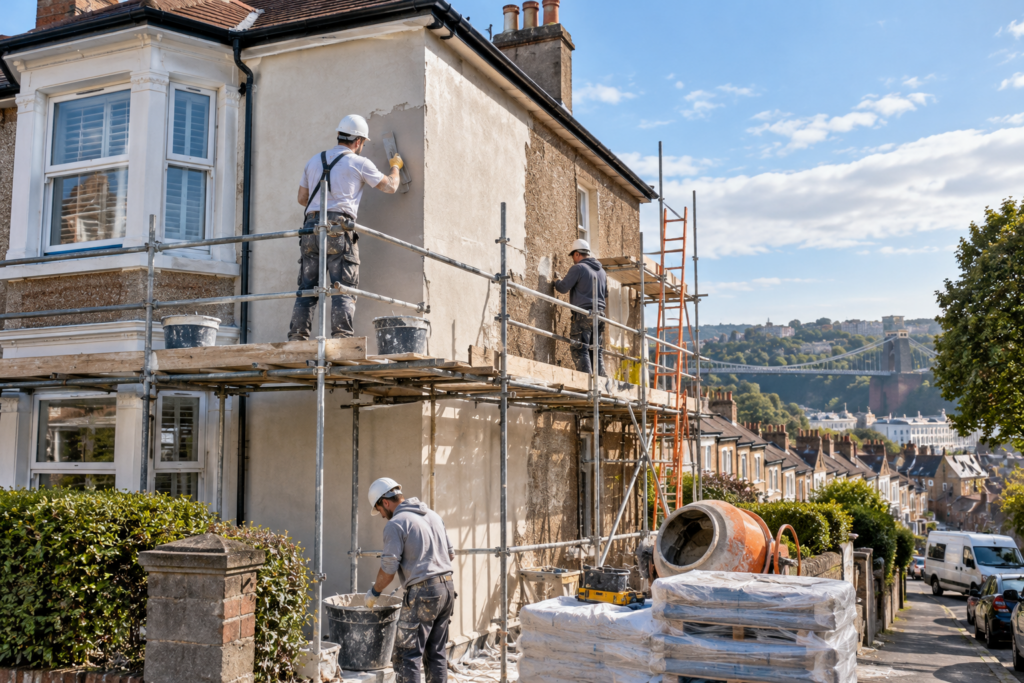
A property’s exterior has two important jobs. It creates the first impression of the building, but it also protects the structure against weather and everyday environmental exposure. When exterior walls become cracked, stained, dated, or difficult to maintain, rendering can provide a practical way to improve both their appearance and protection.
For homeowners considering external rendering in Bristol, there are now numerous systems and finishes available. Traditional sand-and-cement render is no longer the only option. Modern silicone, acrylic, mineral, and monocouche systems provide different combinations of flexibility, appearance, breathability, weather resistance, and maintenance requirements.
Bristol’s climate makes exterior protection particularly important. Regular rainfall, damp periods, wind, seasonal temperature changes, and exposure can gradually affect exterior walls. A properly specified and professionally installed render system can create an additional protective layer while transforming the appearance of a home.
However, choosing the right system requires more than selecting a color.
The condition and construction of the existing wall, desired finish, exposure, budget, insulation requirements, and maintenance expectations should all be considered. This guide explains the major options, advantages, installation process, costs, maintenance considerations, and questions homeowners should ask before starting a rendering project.
What Is External Rendering?

External rendering involves applying one or more specialist coating layers to the outside walls of a property. Depending on the system, the render may protect the substrate while creating a smooth, textured, or colored decorative finish.
Render can be applied to suitable masonry and other compatible backgrounds, although preparation and system requirements vary.
Exterior rendering may be considered when a homeowner wants to:
- Refresh an old or unattractive façade
- Cover suitable damaged or uneven masonry
- Improve weather protection
- Change the architectural appearance of a property
- Reduce ongoing exterior painting requirements with certain systems
- Incorporate an external wall insulation system
- Repair or replace deteriorating existing render
The appropriate approach depends heavily on the property.
A modern masonry house may require a different product and installation method from an older solid-wall property. This is why a professional assessment should normally take place before materials are selected.
Why External Rendering Is Popular in Bristol
Bristol contains a broad mix of housing, from period terraces and traditional masonry properties to suburban homes and contemporary developments.
This diversity means there is no single rendering solution suitable for every building.
Protection From the British Climate
Rain and moisture are important considerations for exterior walls throughout the UK.
A suitable external rendering system can provide an additional protective finish that helps shield the underlying wall from direct exposure.
However, render should not simply be viewed as a way to cover an existing damp problem. The underlying cause of moisture, cracks, defective gutters, leaking pipes, or other problems should be identified before rendering begins.
Improving an Aging Exterior
A house can be structurally sound while still looking tired from the street.
Discoloration, old repairs, mismatched masonry, dated render, and weathered surfaces can significantly affect the appearance of a façade.
New rendering can create a much cleaner and more consistent finish.
Modernizing the Property
Smooth or lightly textured rendered façades are widely used in contemporary residential architecture.
Rendering can therefore be particularly effective when homeowners want to modernize an older property without completely rebuilding the exterior.
Popular External Rendering Systems
One of the most important decisions when planning external rendering in Bristol is selecting an appropriate system.
Different products behave differently, so the choice should be based on the wall construction and desired performance rather than appearance alone.
Silicone Render
Silicone render is a modern thin-coat rendering option widely used for residential façades.
Its popularity comes from its combination of decorative appearance, flexibility, and water-repellent properties.
Benefits of Silicone Render
Depending on the specific system, advantages can include:
- Good water resistance
- Flexible performance
- A wide choice of colors
- Modern textured finishes
- Good vapor permeability
- Reduced need for repainting when using through-colored systems
Silicone render is particularly attractive to homeowners who want a contemporary finish with relatively straightforward maintenance.
It must still be installed as part of a compatible system and applied to a properly prepared substrate.
Monocouche Render
Monocouche is a through-colored render system typically designed to provide both protection and a decorative finish.
“Monocouche” comes from the French term for “single layer,” although installation requirements depend on the specific manufacturer’s system.
Why Homeowners Choose Monocouche
Its advantages can include:
- Attractive uniform appearance
- Multiple finish options
- Through-colored material
- Good durability when properly installed
- Reduced need for exterior painting
It can be particularly effective on homes where owners want a clean rendered appearance without regularly repainting the entire façade.
Traditional Sand and Cement Render
Sand-and-cement rendering has been used on British buildings for generations.
A traditional mix generally creates a strong exterior coating that can then be painted or finished appropriately.
It remains useful in certain situations, but modern alternatives may offer greater flexibility or different moisture-management characteristics.
Older buildings require particular care. Using an excessively hard or unsuitable render on certain traditional wall constructions can create problems rather than solving them.
Lime Render
Lime-based render can be particularly relevant for older and traditional properties.
One of its major characteristics is vapor permeability. In suitable wall constructions, this can help moisture move through the building fabric rather than becoming trapped behind an inappropriate impermeable finish.
Lime render may therefore be considered for some period properties where compatibility with the original construction is important.
Acrylic Render
Acrylic render incorporates acrylic resins and can provide an attractive, durable finish.
Depending on the chosen system, it may offer:
- Good adhesion
- Flexibility
- Various textures
- Multiple colors
- Durable decorative performance
As with other systems, compatibility with the existing substrate must be checked.
External Wall Insulation and Rendering
Rendering can also form the visible finish of an external wall insulation system.
External wall insulation, commonly abbreviated as EWI, involves fixing suitable insulation material to the outside of a building before applying reinforcing and protective finishing layers.
This can be particularly relevant for certain properties with solid external walls.
How External Wall Insulation Works
Although systems vary, an installation may involve:
- Preparing the existing exterior wall.
- Installing insulation boards.
- Applying reinforcing layers and mesh.
- Adding appropriate base coats.
- Applying the decorative render finish.
The completed system can change both the thermal performance and appearance of the exterior.
Because EWI is a complete building-envelope intervention, proper design, detailing, product compatibility, ventilation considerations, and professional installation are particularly important.
Benefits of External Rendering
A properly designed rendering project can offer several benefits beyond simply changing the color of a house.
Improved Kerb Appeal
Exterior appearance is one of the first things people notice about a property.
Fresh render can transform walls that previously looked:
- Weathered
- Patchy
- Stained
- Uneven
- Outdated
A consistent finish can create a much more polished façade.
Additional Weather Protection
The exterior walls of a building are continuously exposed to the environment.
An appropriate render system creates another layer between the underlying wall and direct weather exposure.
Correct detailing around windows, doors, roof junctions, pipes, and ground level is essential to achieving effective protection.
Concealing Suitable Surface Imperfections
Rendering can help create a consistent appearance where exterior masonry contains visually distracting repairs or variations.
However, significant cracks should not simply be covered.
The cause of structural movement or recurring cracking should be investigated before a new finish is installed.
Design Flexibility
Modern render systems offer many design possibilities.
Homeowners can choose between:
- Smooth-looking finishes
- Textured surfaces
- Traditional appearances
- Contemporary façades
- Different colors
Render can also be combined with brick, timber-style cladding, stone, or other exterior materials to create architectural contrast.
What Happens During an External Rendering Project?
Professional rendering involves considerably more preparation than simply applying material to a wall.
Step 1: Property Inspection
The existing exterior should first be inspected.
Contractors may look for:
- Cracks
- Loose existing render
- Damaged masonry
- Damp-related problems
- Contamination
- Weak surfaces
- Areas requiring repair
This stage helps determine whether the wall is ready for rendering.
Step 2: Surface Preparation
Good preparation is essential.
Loose materials and unsuitable coatings may need to be removed. Repairs may also be required before the rendering system is installed.
Poor preparation can contribute to adhesion problems and premature failure.
Step 3: Protecting Surrounding Features
Windows, doors, paving, roof details, pipes, and other areas should be protected during installation.
Scaffolding may be necessary to provide safe access to upper elevations.
Step 4: Installing the Render System
The exact process depends on the product.
It may involve primers, base coats, reinforcing mesh, beads, and finishing coats.
Manufacturer instructions should be followed carefully because the layers are designed to work together as a complete system.
Step 5: Applying the Final Finish
The finishing stage creates the visible appearance.
For colored systems, the finish may already contain the desired color. Other render types may require suitable exterior paint after curing.
How Much Does External Rendering in Bristol Cost?
There is no reliable single price for every property.
The cost of external rendering in Bristol can vary substantially based on the house and chosen system.
Important factors include:
- Total wall area
- Render type
- Existing wall condition
- Amount of preparation required
- Scaffolding requirements
- Number of windows and architectural details
- Access around the property
- Required repairs
- Insulation requirements
- Selected finish
A simple, accessible façade in good condition may require significantly less labor than a large property with failing existing render and complicated architectural details.
For that reason, homeowners should obtain a property-specific quotation rather than relying solely on generic square-meter estimates found online.
Choosing a Rendering Contractor in Bristol
The installer can be just as important as the material.
Even a premium rendering system may perform poorly when the substrate is inadequately prepared or important details are incorrectly installed.
Ask About Experience
A contractor should have relevant experience with the type of system being proposed.
If silicone render is recommended, for example, ask about previous silicone rendering projects.
Request Examples of Previous Work
Completed projects can provide useful evidence of workmanship and finishing quality.
Look closely at:
- Corners
- Window surrounds
- Transitions
- Surface consistency
- Architectural details
Ask What System Will Be Used
Instead of accepting a vague description such as “modern render,” ask what products and system are being proposed.
Understanding the specification makes it easier to compare quotations.
Compare the Scope, Not Just the Price
Two quotations may appear to describe the same project while including very different levels of preparation.
Check whether the quotation includes:
- Scaffolding
- Existing render removal
- Surface repairs
- Beading
- Reinforcement
- Primers and base coats
- Final finish
- Waste removal
A detailed quotation helps prevent misunderstandings.
Common External Rendering Mistakes to Avoid
Rendering is a significant exterior renovation, so shortcuts can become expensive.
Rendering Over Existing Problems
Cracks, damp, loose coatings, and damaged masonry should be investigated first.
Covering a problem does not necessarily fix it.
Selecting Render Based Only on Appearance
A render may look attractive in a brochure but still be unsuitable for a particular wall.
Material compatibility should come first.
Ignoring Water Details
Rainwater must be managed properly around the building.
Gutters, downpipes, sills, roof junctions, and other details should be considered before installation.
Choosing the Cheapest Quote Automatically
Price matters, but the cheapest proposal may not include the same preparation, materials, or installation process.
Compare complete specifications.
Maintaining a Rendered Exterior
Modern render systems can be relatively low maintenance, but no exterior surface is completely maintenance-free.
Regular visual inspections can help identify minor problems before they become larger repairs.
Look for:
- Cracks
- Local staining
- Impact damage
- Algae or biological growth
- Problems around openings
- Defective sealants
- Leaking gutters or downpipes
Cleaning requirements depend on the render system. Homeowners should follow the manufacturer’s recommendations rather than using aggressive pressure washing or chemicals without checking suitability.
Does External Rendering Need Planning Permission?
Many rendering projects may fall within permitted development, but this should never be assumed for every property.
Restrictions can apply depending on factors such as:
- Listed building status
- Conservation areas
- Existing planning conditions
- Significant changes to appearance
- Local requirements
Building regulations may also become relevant, particularly when renovation work affects thermal performance or includes external wall insulation.
Homeowners should check the requirements that apply to their individual property before work starts.
How to Decide Which Render System Is Right for Your Bristol Home
There is no universal “best” render.
The correct solution depends on the building.
Start by considering the following questions:
What Is the Existing Wall Made From?
Solid masonry, cavity construction, blockwork, and traditional walls can have different requirements.
Is There Existing Render?
Its condition may determine whether it can remain, requires preparation, or needs to be removed.
Is Insulation a Priority?
If thermal improvement is a major goal, external wall insulation may deserve consideration rather than render alone.
What Appearance Do You Want?
Think about color, texture, architectural style, and whether you want the render to complement existing brick or other materials.
How Much Maintenance Are You Comfortable With?
Some finishes may require periodic painting, while through-colored systems can reduce this requirement.
A professional survey can bring these considerations together and help identify an appropriate specification.
Frequently Asked Questions About External Rendering in Bristol
What is the best external render for a Bristol home?
There is no single best option. Silicone, monocouche, lime, acrylic, and traditional systems have different characteristics. The right choice depends on the building’s construction, condition, exposure, desired appearance, and budget.
Is silicone render suitable for houses in Bristol?
Silicone render can be suitable for many properties because modern systems offer water resistance, flexibility, and decorative finishes. Suitability should still be assessed against the existing wall and complete system specification.
Can you render over old render?
Sometimes, but only when the existing surface is sufficiently stable and compatible with the proposed system. Loose, hollow, badly cracked, or unsuitable render may need removal.
Does rendering stop damp?
Rendering may improve protection from external weather when correctly specified, but it should not be treated as a universal cure for damp. The source of moisture should be identified first.
How long does external rendering take?
Project duration varies according to property size, preparation, weather, access, render system, and repairs. Contractors should provide an estimated schedule after inspecting the property.
Can external rendering improve insulation?
Render alone should not be confused with insulation. However, rendering can form the outer finish of an external wall insulation system designed to improve thermal performance.
Can I choose different render colors?
Many modern systems are available in broad color ranges. Availability depends on the manufacturer and selected product.
Does a rendered house require maintenance?
Yes. Although some modern systems can be relatively low maintenance, periodic inspection and appropriate cleaning are still recommended.
Conclusion
External rendering in Bristol can do much more than refresh a tired façade. When the right system is selected and correctly installed, it can provide a durable exterior finish, improve weather protection, modernize the appearance of a property, and potentially form part of a broader external wall insulation upgrade.
The key is choosing a solution that suits the building rather than selecting render based on appearance or price alone. Silicone, monocouche, lime, acrylic, and traditional render systems each have different characteristics, and older properties may require particularly careful material selection.
Before starting a project, have the existing walls assessed, investigate any cracks or moisture problems, compare complete contractor specifications, and check whether planning or building requirements apply.
With careful preparation, suitable materials, and professional installation, external rendering can become a long-term investment in both the appearance and protection of a Bristol property.