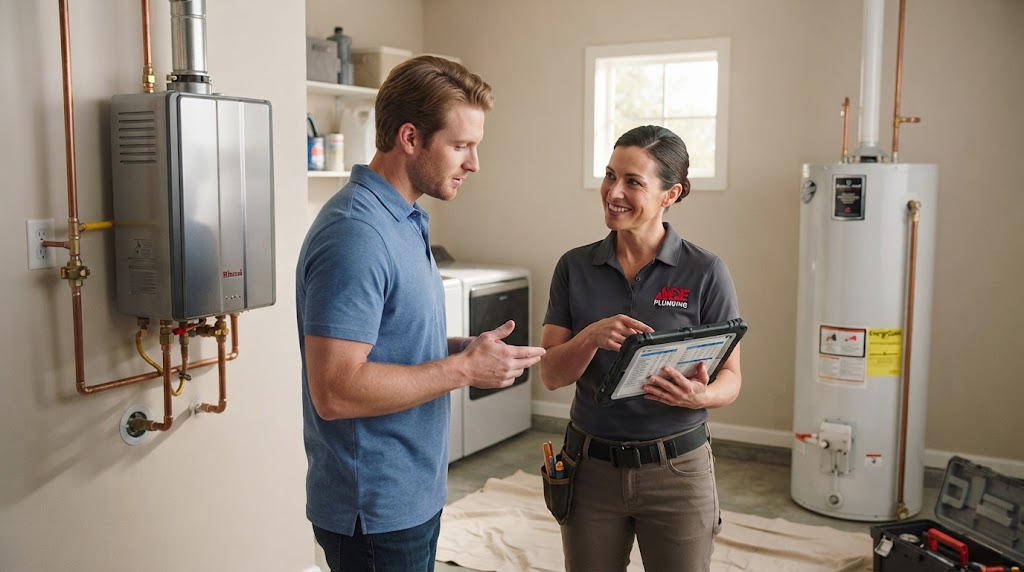
Hot water is something most homeowners rarely think about until it suddenly disappears. From morning showers and washing dishes to laundry and cleaning, a reliable water heater plays an important role in everyday comfort.
When an older unit starts leaking, producing inconsistent temperatures, or requiring frequent repairs, homeowners usually face an important decision: tankless vs conventional water heater.
Both systems can provide dependable hot water, but they work in very different ways.
A conventional water heater stores a large amount of heated water inside a tank. A tankless system heats water as it flows through the unit when someone opens a hot-water faucet.
Neither option is automatically best for every household.
The right choice depends on household size, hot-water demand, available space, energy source, installation requirements, budget, and long-term priorities.
If you are comparing water-heater options through a professional plumbing company such as Stewart Plumbing, understanding these differences before installation can help you make a more informed decision.
This guide compares the most important factors so you can decide which system makes sense for your home.
What Is a Conventional Water Heater?
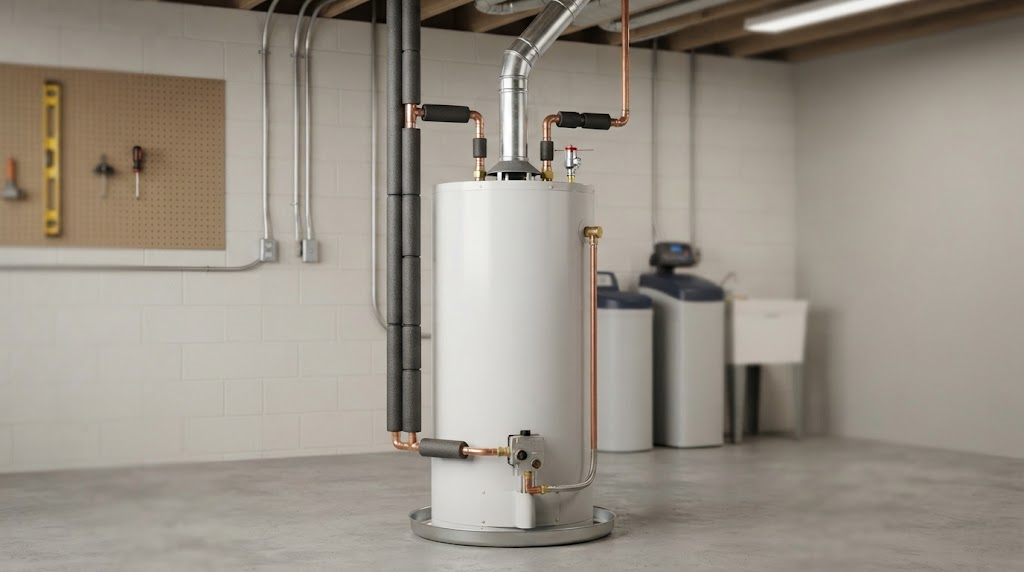
A conventional water heater, also called a storage or tank water heater, heats water and stores it inside an insulated tank until you need it.
Common residential tanks may hold several dozen gallons of water.
When someone turns on a hot-water faucet, heated water leaves the top of the tank and cold water enters to replace it. The system then heats the incoming water so the tank is ready for future use.
Conventional water heaters can operate using:
- Natural gas
- Electricity
- Propane
- Other energy sources depending on the home
Storage water heaters have been used in American homes for decades because they are familiar, widely available, and relatively straightforward to install.
What Is a Tankless Water Heater?
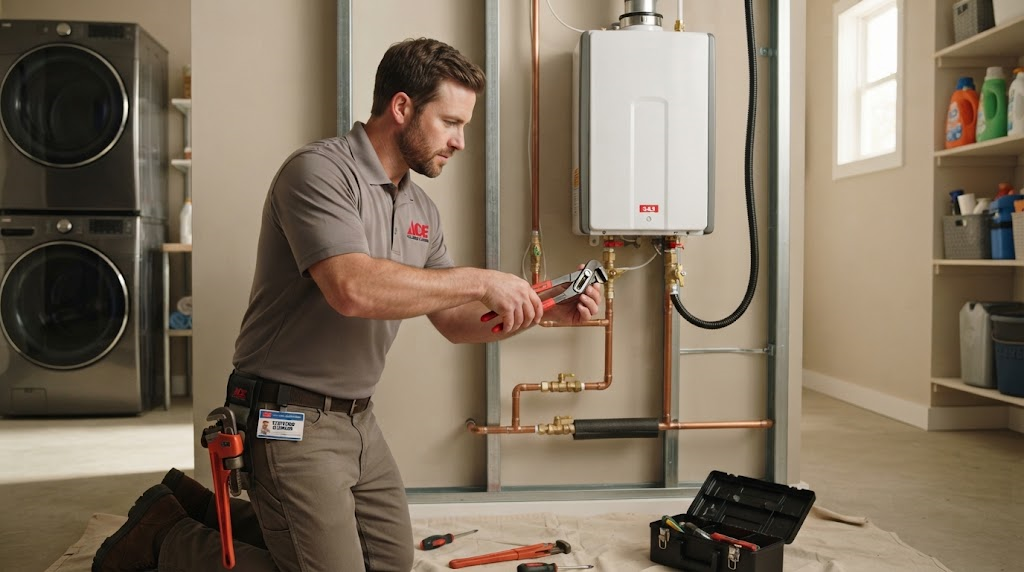
A tankless water heater is sometimes called an on-demand water heater.
Instead of keeping a large tank of water hot throughout the day, it begins heating water when hot-water demand is detected.
When you turn on a faucet, cold water enters the unit and passes through a heat exchanger. The heater raises the water temperature before sending it toward the fixture.
Once the hot-water demand stops, the heating process stops as well.
ENERGY STAR explains that whole-home gas tankless systems heat water only when needed rather than continually maintaining a tank of hot water, which eliminates the standby energy associated with traditional storage.
This fundamental difference influences almost every aspect of the tankless vs conventional water heater comparison.
Tankless vs Conventional Water Heater: Quick Comparison
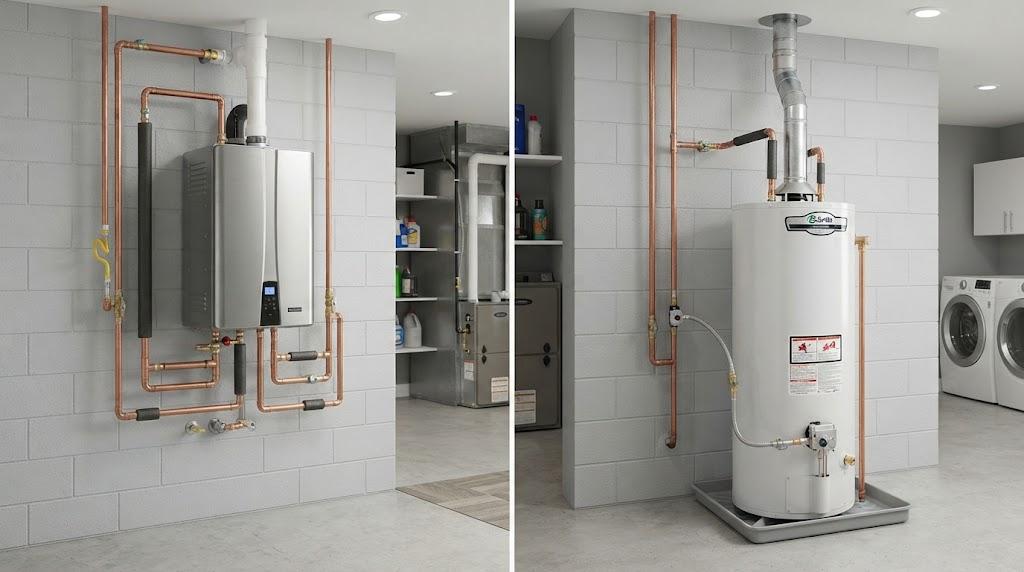
Before looking at each factor in detail, here is the basic difference.
Conventional Water Heater
A conventional unit generally offers:
- Lower initial installation cost
- Familiar technology
- A stored supply of hot water
- Simple replacement in many existing homes
- Wider technician familiarity
- Larger equipment footprint
- Standby heat loss
- Limited hot-water capacity before recovery is required
Tankless Water Heater
A tankless system generally offers:
- On-demand water heating
- Compact wall-mounted design
- Potentially greater energy efficiency
- No large tank that can run empty
- Longer service potential with proper maintenance
- Higher initial installation cost
- Specific gas, electrical, and venting requirements
- Flow-rate limitations if undersized
The best choice depends on which of these characteristics matter most to your household.
Energy Efficiency: Which System Uses Less Energy?
Energy efficiency is one of the main reasons homeowners consider tankless technology.
A storage water heater must maintain the temperature of the water inside its tank, even during periods when nobody is using hot water.
This creates standby energy loss.
Tankless systems avoid much of this issue because they activate only when there is hot-water demand.
ENERGY STAR currently recognizes qualifying high-efficiency gas storage heaters and whole-home gas tankless heaters under separate efficiency standards.
However, actual energy savings depend on several factors.
These include:
- Household hot-water usage
- Fuel prices
- Equipment efficiency
- Water heater size
- Installation quality
- Incoming water temperature
- Maintenance
- Local climate
A highly efficient storage unit may be a better choice than an incorrectly sized or poorly installed tankless system.
Always compare the specific models rather than assuming every tankless unit will automatically deliver dramatic savings.
Hot Water Supply: Tank vs On-Demand
This is one of the biggest practical differences between the two systems.
Conventional Water Heater Capacity
A traditional unit has a limited amount of hot water available at one time.
Imagine a home with several family members taking showers one after another while the dishwasher is running.
Eventually, the stored hot water may be depleted.
Once that happens, the heater needs time to heat incoming cold water.
This is commonly described as “running out of hot water.”
Tankless Hot Water Supply
A properly sized tankless unit can continue producing hot water as long as demand remains within its operating capacity.
That makes tankless systems attractive to households that regularly use hot water for extended periods.
However, “endless hot water” does not mean unlimited simultaneous usage.
Every tankless heater has a maximum flow rate.
ENERGY STAR notes that tankless capacity is measured in gallons per minute rather than storage gallons.
If multiple showers, faucets, and appliances demand more hot water than the unit can produce at once, performance may decline.
Correct sizing is therefore extremely important.
Installation Cost
For many homeowners, initial cost becomes the deciding factor.
Conventional Water Heater Installation
Replacing an existing tank with a similar model is often relatively straightforward.
If the existing gas, electric, plumbing, and venting connections are compatible, installation may require fewer modifications.
That generally makes conventional replacement more affordable upfront.
Tankless Water Heater Installation
Switching from a storage system to tankless can require additional work.
Depending on the home and equipment, installation may involve:
- Gas line upgrades
- Electrical upgrades
- New venting
- Condensate drainage
- Water-line changes
- Relocating equipment
- New shutoff valves or service connections
This can increase the initial investment.
Tankless technology may offer long-term benefits, but homeowners should compare total installed cost instead of only the equipment price.
Space Requirements
Tankless systems clearly have an advantage when space is limited.
A conventional storage water heater requires enough floor area for a large cylindrical tank.
In smaller homes, townhouses, utility closets, or renovation projects, that footprint can become valuable.
Tankless heaters are typically mounted on a wall and occupy considerably less floor space.
That may allow homeowners to use the former water-heater area for storage or other mechanical equipment.
However, installation location still needs to meet safety, clearance, ventilation, and service-access requirements.
Lifespan and Long-Term Ownership
Water-heater lifespan depends heavily on water quality, maintenance, installation, usage, and equipment design.
Tankless units often have the potential for longer service because major components can sometimes be maintained or replaced individually.
Traditional tanks eventually face deterioration of the tank itself.
Once the storage vessel develops a significant leak, replacement is usually required.
That does not mean every tankless heater will necessarily last longer than every conventional unit.
Poor water quality, mineral buildup, neglected maintenance, incorrect installation, or unsuitable sizing can shorten the life of either system.
When comparing costs, consider both initial installation and expected long-term ownership.
Maintenance Requirements
Every water heater benefits from maintenance.
Conventional Water Heater Maintenance
Depending on the system and water conditions, maintenance may include:
- Checking for leaks
- Inspecting the temperature and pressure relief valve
- Examining the anode rod where applicable
- Flushing accumulated sediment
- Checking burners or electrical components
- Inspecting venting
- Looking for corrosion
Sediment can collect at the bottom of storage tanks over time, particularly in areas with mineral-rich water.
Tankless Water Heater Maintenance
Tankless systems can also develop mineral scale inside their heat exchangers.
Periodic flushing or descaling may be recommended, especially in hard-water areas.
Maintenance may include:
- Flushing mineral deposits
- Cleaning filters
- Checking burners
- Inspecting venting
- Checking condensate systems
- Inspecting connections
Tankless does not mean maintenance-free.
Regular professional service can help maintain performance and efficiency.
Which System Is Better for a Large Family?
Large families often generate substantial hot-water demand.
A tankless heater can be attractive because it does not rely on a fixed reservoir.
However, the unit must be correctly sized for peak demand.
Consider a morning when two showers are running while someone uses hot water in the kitchen.
A smaller tankless system may struggle to supply all fixtures simultaneously.
In some large homes, homeowners may need:
- A higher-capacity tankless unit
- Multiple tankless units
- Point-of-use heaters
- A large high-recovery storage heater
A plumber can calculate expected simultaneous flow and temperature rise to determine the best option.
Which Water Heater Is Better for a Smaller Household?
A smaller household may have different priorities.
If one or two people use relatively little hot water, a compact tankless system may reduce standby energy use.
On the other hand, replacing an existing conventional heater with another efficient tank model may provide a much lower upfront cost.
Usage habits matter.
Someone who takes one short shower each morning has very different requirements from a household that regularly fills large bathtubs, runs multiple showers, and washes several loads of laundry.
Gas vs Electric Water Heaters
Fuel type also affects the comparison.
Gas Tankless Systems
Gas tankless units are common for whole-home applications because they can produce substantial heat quickly.
However, adequate gas supply and correct venting are essential.
Electric Tankless Systems
Whole-home electric tankless heaters can require significant electrical capacity.
Some homes may need electrical-panel or service upgrades before installation.
Electric Storage Systems
Standard electric tank water heaters are widely available and relatively simple.
Homeowners should also be aware of heat pump water heaters, which use a different technology and can be significantly more energy efficient than conventional electric resistance systems.
The best decision is not always simply “tankless versus tank.” Fuel type and specific technology matter too.
Environmental Considerations
Reducing energy consumption can reduce the environmental impact associated with water heating.
Tankless technology may help by avoiding standby heating losses.
However, environmental performance should be considered across the whole system.
A homeowner should think about:
- Fuel type
- Equipment efficiency
- Household usage
- Equipment lifespan
- Manufacturing
- Local electricity generation
- Maintenance
An ENERGY STAR-certified system can provide a useful starting point when comparing efficient models.
Common Myths About Tankless Water Heaters
Myth 1: Tankless Means Instant Hot Water
Tankless means the heater produces hot water on demand.
It does not mean hot water will immediately appear at a distant faucet.
Water still needs to travel through the plumbing between the heater and fixture.
A recirculation system may help reduce waiting time in certain homes.
Myth 2: Tankless Systems Never Run Out of Hot Water
They do not run out of stored water because they do not have a tank.
However, every model has a flow limit.
Exceeding that limit can affect temperature or performance.
Myth 3: Tankless Water Heaters Require No Maintenance
They still require inspection and, depending on water quality, periodic descaling.
Myth 4: Conventional Water Heaters Are Always Inefficient
Modern high-efficiency storage models can perform much better than older equipment.
The specific model’s efficiency rating matters.
When a Conventional Water Heater Makes More Sense
A traditional storage heater may be the better choice when:
- Your upfront budget is limited
- You want a straightforward replacement
- Your existing system works well for your household
- Your home would require expensive upgrades for tankless installation
- Hot-water usage is predictable
- You prefer simpler equipment
For many American households, modern storage water heaters remain practical and reliable.
When a Tankless Water Heater Makes More Sense
Tankless may be worth considering when:
- You frequently run out of hot water
- You want to reduce standby energy consumption
- Floor space is limited
- You expect to remain in the home long enough to value long-term benefits
- You are renovating or building a new home
- Your gas or electrical system can support the equipment
- You want continuous hot water within a properly sized flow capacity
A professional assessment can determine whether your home is a good candidate.
Questions to Ask Before Choosing a Water Heater
Before purchasing either type, ask your plumber:
What size does my household need?
Sizing should reflect peak hot-water demand, not just the number of people living in the home.
Will my gas or electrical system need upgrades?
This can significantly affect installation cost.
What is the total installed price?
Ask for equipment, labor, permits, venting, disposal, and any required upgrades.
What maintenance is required?
Understanding ongoing maintenance helps you estimate long-term cost.
What warranty is included?
Compare coverage for parts, tanks, heat exchangers, and labor.
Is the system easy to service locally?
Parts availability and technician experience can matter years after installation.
Stewart Plumbing states that it installs and services both traditional and tankless water heaters for homeowners in its Memphis-area service region.
Frequently Asked Questions About Tankless vs Conventional Water Heater Systems
Is tankless better than a conventional water heater?
Not always. Tankless systems offer space savings, on-demand heating, and potential efficiency advantages, while conventional tanks usually cost less to install and can be simpler to replace.
Do tankless water heaters really provide endless hot water?
A properly sized system can continue heating water without emptying a storage tank. However, it has a maximum flow rate, so simultaneous demand still matters.
Which type costs less upfront?
Conventional storage water heaters usually have a lower initial installation cost, particularly when replacing an existing similar unit.
Which system saves more space?
Tankless units typically require much less floor space because they are wall mounted.
Can I replace my tank water heater with a tankless model?
Usually, but the home may require modifications to gas supply, electrical service, venting, plumbing, or drainage.
Is a tankless water heater good for a large family?
It can be, provided it is sized correctly for peak simultaneous hot-water demand.
Do tankless water heaters need flushing?
Mineral scale can accumulate inside heat exchangers, so periodic descaling may be recommended depending on local water quality and manufacturer instructions.
Can a conventional water heater supply several fixtures at once?
Yes, provided sufficient hot water remains in the tank and the system has adequate capacity and recovery rate.
How do I compare water heater efficiency?
Look at the Uniform Energy Factor, or UEF, along with fuel type, household usage, and installation requirements. ENERGY STAR uses UEF requirements when certifying qualifying residential water heaters.
Should I choose my water heater without a professional assessment?
A professional evaluation is helpful because sizing, gas capacity, electrical requirements, venting, local codes, and installation conditions can substantially affect performance.
Conclusion
Choosing between a tankless vs conventional water heater is not simply about deciding which technology is newer.
Both systems have advantages.
A conventional storage water heater usually offers a lower initial cost, straightforward replacement, and a familiar supply of stored hot water. It can be an excellent solution for homeowners who value affordability and simplicity.
A tankless water heater eliminates the need to continuously store hot water, saves valuable floor space, and can provide continuous hot water when properly sized. The tradeoff is often a higher initial installation cost and more specific utility and maintenance requirements.
The right choice depends on your household’s hot-water habits, available energy sources, home layout, budget, and long-term plans.
If you are considering a replacement, working with an experienced plumbing professional such as Stewart Plumbing can help you evaluate the existing system, calculate household demand, understand installation requirements, and compare suitable conventional and tankless options.
Rather than selecting a water heater based only on price or advertising claims, consider the complete cost of ownership, energy performance, maintenance requirements, available space, and the amount of hot water your household actually uses.
With proper sizing, professional installation, and regular maintenance, either type can provide reliable hot water and comfortable everyday living for years to come.