
Running a healthcare organization involves far more than seeing patients.
Every appointment creates administrative work. Phones need to be answered. Insurance eligibility must be checked. Prior authorizations may need follow-up. Claims have to be submitted. Denials require attention. Patients need reminders, records must be updated, and staff members often spend significant time handling repetitive tasks.
For many U.S. healthcare organizations, healthcare bpo services provide another way to manage this workload.
Healthcare business process outsourcing, commonly called healthcare BPO, allows a medical practice, health system, dental group, home-care organization, or other healthcare business to delegate selected administrative processes to an outside team.
These services can range from appointment scheduling and patient calls to medical billing, claims follow-up, insurance verification, prior authorizations, and virtual medical assistance.
HelpSquad currently offers a healthcare BPO model covering both front-office and back-office workflows. Its listed services include virtual medical assistants, call-center teams, medical billing and claims, front-desk scheduling, prior authorizations, patient outreach, insurance verification, denial management, telehealth coordination, and medical scribing.
The key is not simply outsourcing tasks. It is choosing processes that can be handled securely, consistently, and with clear accountability.
What Are Healthcare BPO Services?

Healthcare BPO means transferring defined operational processes to an external service provider rather than keeping every task inside the organization’s own workforce.
Examples can include:
- Patient appointment scheduling
- Inbound and outbound phone support
- Patient intake
- Insurance verification
- Eligibility checks
- Prior authorization support
- Medical billing
- Claims submission
- Denial management
- Accounts receivable follow-up
- Payment posting
- Referral coordination
- Medical scribing
- Telehealth coordination
- Patient reminders
- Recall campaigns
- Administrative EHR work
The goal is usually to reduce administrative pressure on internal teams while maintaining reliable service for patients.
HelpSquad describes its healthcare outsourcing model as a managed service rather than a freelance marketplace. Its teams work within documented workflows, with account management and quality oversight included in the engagement.
Why Healthcare Organizations Use BPO

Healthcare administration can consume a large amount of staff time.
A receptionist may be answering phones while checking patients in. A billing specialist may be handling denials while trying to post payments. Providers may spend evenings completing documentation.
When workloads increase, delays can affect both employees and patients.
Reduce Administrative Pressure
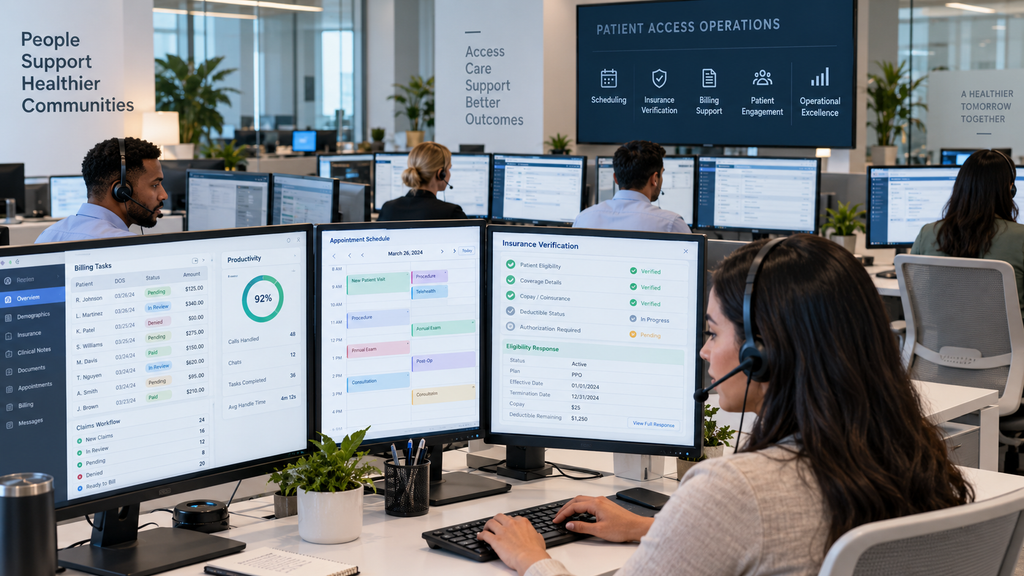
Outsourcing repeatable workflows can allow internal staff to focus on higher-priority work.
A practice might keep complex patient issues in-house while outsourcing appointment reminders, insurance verification, or routine scheduling.
Extend Patient Support Hours
Some organizations need coverage beyond normal office hours.
A healthcare call-center partner may provide evening, weekend, or 24/7 support depending on the service arrangement.
HelpSquad currently advertises 24/7 call-center coverage for inquiries, scheduling, and other patient-facing workflows.
Scale Without Building a Large Internal Team
Growth can create sudden administrative pressure.
Opening a second location, expanding a specialty group, or increasing patient volume may require more scheduling, billing, and insurance support.
BPO can allow organizations to add operational capacity without immediately creating the same number of in-house positions.
Front-Office Healthcare BPO Services
The patient experience often begins before a patient enters the building.
Phone calls, appointment scheduling, registration, and insurance questions can strongly influence how patients view a medical practice.
Appointment Scheduling
Scheduling teams can:
- Book new appointments
- Reschedule visits
- Confirm appointments
- Manage cancellations
- Fill waitlist openings
- Handle routine scheduling questions
HelpSquad lists new-patient scheduling, reminder workflows, same-day cancellation backfilling, and waitlist management among its current healthcare services.
Patient Intake
Patient intake may include gathering demographic information, insurance details, consent information, and other required administrative data before a visit.
Accurate intake can reduce unnecessary delays at check-in.
Healthcare Call Center Support
Healthcare call centers may handle:
- General inquiries
- Appointment requests
- Location information
- Referral questions
- Routine billing inquiries
- Follow-up calls
- After-hours coverage
The best model should include clear escalation rules so that clinical or urgent matters are transferred to appropriate personnel rather than handled as ordinary customer-service issues.
Medical Billing and Revenue Cycle Support
Revenue cycle work is one of the most common areas for healthcare outsourcing.
Medical billing involves many steps between the patient visit and final payment.
Claims Submission
A billing team can review information, prepare claims, and submit them to payers.
Errors in coding, patient information, eligibility, or documentation can delay payment.
Denial Management
A denied claim should not simply be written off.
Denial teams can review the reason, correct errors where appropriate, submit additional information, and follow payer appeal processes.
HelpSquad currently lists denial management, resubmissions, appeals, accounts-receivable follow-up, payment posting, coding support, and patient responsibility workflows as part of its healthcare BPO services.
Accounts Receivable Follow-Up
Unpaid claims can accumulate quickly.
An outsourced AR team can identify outstanding balances, follow up with payers, document responses, and move claims toward resolution.
This can free internal billing staff to focus on more complicated financial issues.
Insurance Verification and Eligibility
Insurance verification is another time-consuming but important administrative process.
Before a scheduled visit, staff may need to confirm:
- Active coverage
- Plan details
- Deductible information
- Copay requirements
- Coinsurance
- Service-specific benefits
- Referral requirements
Completing verification before the visit can reduce surprises for both the patient and the practice.
HelpSquad lists real-time eligibility checks, benefit breakdowns, coverage verification, and related payer workflows as part of its healthcare outsourcing offering.
Prior Authorization Outsourcing
Prior authorization can involve repeated communication between providers, health plans, pharmacies, and patients.
The process may include:
- Gathering clinical documentation
- Submitting authorization requests
- Checking payer requirements
- Monitoring status
- Responding to requests for additional information
- Following up on pending cases
Outsourcing the administrative parts of this process can reduce the workload on front-office and clinical staff.
However, clinical judgment and required provider decisions should remain with appropriately qualified personnel.
HelpSquad currently offers payer-specific prior authorization support, including documentation collection and status tracking.
Virtual Medical Assistants
A virtual medical assistant is an external team member who supports healthcare staff remotely.
Depending on the role, tasks may include:
- Scheduling
- Patient follow-up
- EHR updates
- Administrative chart work
- Insurance verification
- Referral coordination
- Scribing
- Document management
Virtual medical assistants can be especially useful for smaller practices that need dedicated administrative help but do not need every role physically located in the clinic.
HelpSquad states that its healthcare virtual assistants can work directly within major EHR and practice-management systems and are trained for healthcare workflows before beginning client work.
HIPAA and Healthcare Outsourcing
Privacy and security require special attention when outsourcing healthcare operations.
Under HIPAA, an outside organization that performs certain services involving protected health information may qualify as a business associate.
The U.S. Department of Health and Human Services explains that business associates can include organizations performing functions such as claims processing, billing, data analysis, practice management, and other activities involving protected health information.
Business Associate Agreements
When required, covered entities need appropriate written arrangements with business associates.
HHS explains that a business associate agreement, or BAA, defines permitted uses and disclosures of protected health information and requires the business associate to appropriately safeguard that information. Business associates can also have direct liability for certain HIPAA requirements.
HelpSquad states that it signs a company-level BAA and uses encrypted channels, secure virtual desktops, access logging, documented HIPAA training, and internal auditing for its healthcare engagements. These are vendor claims that healthcare organizations should review during their own due-diligence process.
HIPAA Compliance Is Shared Responsibility
Hiring a vendor that advertises HIPAA-compliant services does not eliminate the healthcare organization’s own responsibilities.
HHS advises covered entities and business associates to understand the technology and services being used, conduct appropriate risk analysis, implement risk-management policies, and enter into required agreements.
Organizations should therefore review security controls, access policies, subcontractors, incident-response procedures, workforce training, data handling, and contract terms before outsourcing PHI-related processes.
Healthcare BPO vs. Hiring More Employees
Both outsourcing and internal hiring can work well.
The right choice depends on the organization.
In-House Teams May Offer
- Direct daily supervision
- Physical presence
- Deep familiarity with local workflows
- Easier handling of tasks requiring on-site access
Healthcare BPO May Offer
- Faster access to additional staffing
- Extended support hours
- Specialized billing or payer teams
- Easier scaling
- Reduced recruiting workload
- Coverage for repetitive operational processes
Some organizations use a hybrid model.
For example, a clinic may keep its patient-facing front desk on-site while outsourcing after-hours calls, verification, billing follow-up, and denial management.
Healthcare Organizations That Can Use BPO
Healthcare bpo services can support organizations of different sizes.
Primary Care Practices
Smaller practices may outsource phones, scheduling, insurance verification, billing, or administrative EHR work.
Specialty Practices
Specialties with complex prior authorization and payer workflows may benefit from dedicated administrative support.
Dental Groups and DSOs
Multi-location dental organizations can centralize patient calls, insurance verification, scheduling, billing, and reporting.
Hospitals and Health Systems
Larger organizations may use BPO for contact-center overflow, revenue-cycle support, referral coordination, and other high-volume functions.
Behavioral Health
Behavioral health organizations may outsource intake, scheduling, telehealth assistance, and administrative support while maintaining appropriate privacy and escalation procedures.
Home Health, Home Care, and Hospice
These organizations often manage scheduling, intake, eligibility, billing, and coordination across large patient and caregiver networks.
HelpSquad currently identifies all of these groups among the healthcare organizations its BPO teams support.
How to Choose a Healthcare BPO Provider
Selecting a vendor should involve more than comparing hourly rates.
Review Healthcare Experience
Ask whether the provider has experience with your specialty, payer mix, EHR, and workflows.
Evaluate Security and HIPAA Processes
Request information about:
- BAAs
- HIPAA training
- Access controls
- Encryption
- Logging
- Secure work environments
- Incident response
- Subcontractors
Understand Quality Assurance
Ask how calls, claims, scheduling accuracy, and other work are reviewed.
There should be clear performance metrics and escalation procedures.
Confirm EHR Compatibility
If outsourced staff will work directly in your software, confirm their experience with the system and define permissions carefully.
Ask About Management
A managed BPO relationship should have clear ownership.
Know who manages the team, who handles performance issues, and who your organization contacts when workflows need to change.
HelpSquad says its healthcare teams are managed by U.S.-based account leadership from Doylestown, Pennsylvania, while staffing is distributed internationally depending on function.
Measuring Healthcare BPO Performance
Outsourcing should produce measurable operational improvements.
Useful metrics may include:
Patient Access Metrics
- Average answer time
- Abandonment rate
- Scheduling conversion
- Call resolution
- Waitlist fill rate
Revenue Cycle Metrics
- Clean claim rate
- Denial rate
- Days in accounts receivable
- Payment posting time
- Appeal resolution
Administrative Metrics
- Prior authorization turnaround
- Eligibility verification completion
- Referral processing time
- Documentation accuracy
Organizations should establish baseline performance before outsourcing so they can determine whether the new workflow is actually improving operations.
Common Mistakes to Avoid
Healthcare outsourcing can create problems when it is implemented without clear processes.
Outsourcing a Broken Workflow
A vendor cannot automatically fix a process that has unclear rules and inconsistent ownership.
Document the workflow first.
Giving Excessive System Access
Use role-based access and provide only the permissions required for assigned tasks.
Focusing Only on Cost
The lowest hourly price is not always the lowest total cost.
Poorly handled calls, inaccurate claims, or repeated errors can create more work later.
Failing to Monitor Results
BPO should not mean losing visibility.
Review performance reports, audit work, hold regular meetings, and update procedures when necessary.
Frequently Asked Questions
What are healthcare BPO services?
Healthcare BPO services involve outsourcing repeatable healthcare business processes such as scheduling, patient calls, insurance verification, billing, claims, prior authorizations, and other administrative work to an external provider.
What does BPO mean in healthcare?
BPO stands for business process outsourcing. In healthcare, it generally refers to delegating operational or administrative workflows to a specialized outside company.
Can healthcare BPO providers handle medical billing?
Yes. Medical billing, claims submission, denial management, payment posting, and AR follow-up are common healthcare BPO functions.
Can BPO teams schedule patient appointments?
Yes. Outsourced healthcare teams can manage new appointments, rescheduling, reminders, cancellations, waitlists, and other routine scheduling workflows.
Does HIPAA apply to healthcare outsourcing?
It can. HHS states that outside organizations performing functions involving PHI may qualify as business associates and may need appropriate business associate agreements and safeguards.
What is a healthcare business associate agreement?
A BAA is a written agreement defining how a business associate may use or disclose protected health information and requiring appropriate safeguards and other HIPAA-related obligations.
Does HelpSquad provide healthcare BPO services?
Yes. HelpSquad currently offers virtual medical assistants, healthcare call centers, billing and claims support, scheduling, prior authorizations, insurance verification, patient outreach, and other healthcare operational services.
Is healthcare BPO only for large hospitals?
No. Healthcare BPO can be used by solo practices, medical groups, dental groups, hospitals, behavioral health organizations, home-care providers, and healthcare startups.
Conclusion
Administrative work is essential to healthcare, but it can also consume time that organizations would rather devote to patients and clinical operations.
Healthcare bpo services provide a way to move selected repeatable workflows to specialized external teams.
Scheduling, patient intake, phone coverage, insurance verification, prior authorizations, medical billing, denial management, AR follow-up, telehealth coordination, and virtual medical assistance are among the processes that can be outsourced.
HelpSquad currently offers these services through a managed healthcare BPO model with U.S.-based account oversight and internationally distributed operational teams. The company also states that its healthcare engagements include a company-level BAA, secure access controls, workforce training, and healthcare-specific workflows.
For U.S. healthcare organizations, however, outsourcing decisions should never be based on staffing cost alone.
Security, patient experience, process quality, EHR access, performance reporting, payer knowledge, escalation procedures, and HIPAA responsibilities all matter.
HHS makes clear that covered entities remain responsible for understanding how business associates handle protected health information and for putting required agreements and safeguards in place.
The strongest approach is to begin with a clearly defined workflow.
Identify the tasks consuming staff time. Establish current performance. Determine which activities can safely and effectively move outside the organization. Then evaluate healthcare BPO providers based on compliance processes, experience, management, technology, and measurable service quality.
Used carefully, healthcare bpo services can give medical organizations more operational capacity while helping internal teams spend less time on repetitive administrative work and more time on the activities that require their direct attention.