
Kitchen cabinets take up a large amount of visual space, but some of the smallest details can have the biggest impact on how the finished room feels.
Kitchen door handles are a perfect example.
Changing cabinet hardware can make a traditional kitchen look more current, give simple cabinetry a more luxurious appearance, or introduce contrast into an otherwise neutral room. Handles also serve a practical purpose every day, so they need to feel comfortable, work with the proportions of the cabinets, and stand up to repeated use.
For homeowners in the United States, the number of options can feel overwhelming. There are bar pulls, lip pulls, half-moon handles, knobs, T-bars, appliance pulls, sculptural designs, and many different finishes.
Lo & Co Interiors, for example, currently offers cabinet hardware in solid brass and natural stone, with finishes including brass, aged brass, bronze, nickel, tumbled nickel, matte black, white, polished brass, polished nickel, oil-rubbed bronze, and other variations. Its current handle collection includes contemporary, mid-century, Art Deco-inspired, sculptural, and traditional-influenced designs.
The best choice, however, is not simply the handle that looks attractive in a product photo.
You need to consider the cabinetry, dimensions, finish, grip, installation, and overall design of the kitchen.
Why Kitchen Door Handles Matter So Much

Hardware is sometimes described as the jewelry of a kitchen.
That comparison makes sense because handles are often the final element added to cabinetry, but they can completely change its character.
Imagine the same white shaker cabinet with three different hardware choices.
Polished nickel gives it a cleaner, more classic appearance.
Aged brass adds warmth.
Matte black creates sharper contrast.
The cabinet itself has not changed, yet the overall design feels different.
Handles Are Also High-Touch Components
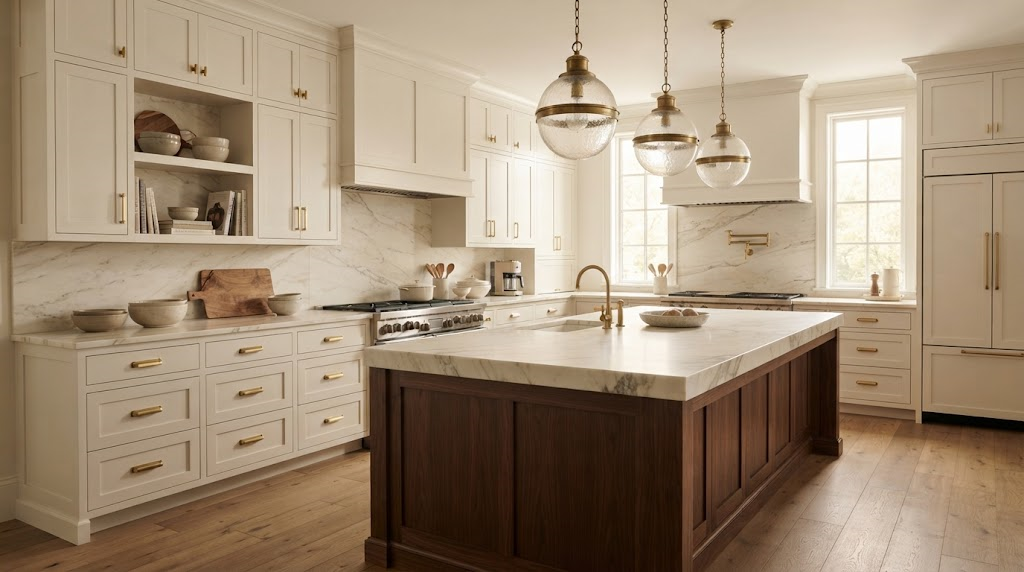
Kitchen hardware is used constantly.
A decorative detail that looks beautiful but feels uncomfortable every time you open a drawer may eventually become frustrating.
Good hardware should combine:
- Attractive proportions
- Comfortable grip
- Durable materials
- Appropriate projection
- Easy cleaning
- Reliable mounting
Lo & Co’s current cabinet-handle range is designed for frequent use in spaces such as kitchens and bathrooms and includes a five-year warranty against structural defects, with separate coverage for certain finish, material, and workmanship issues.
Start With Your Kitchen Style
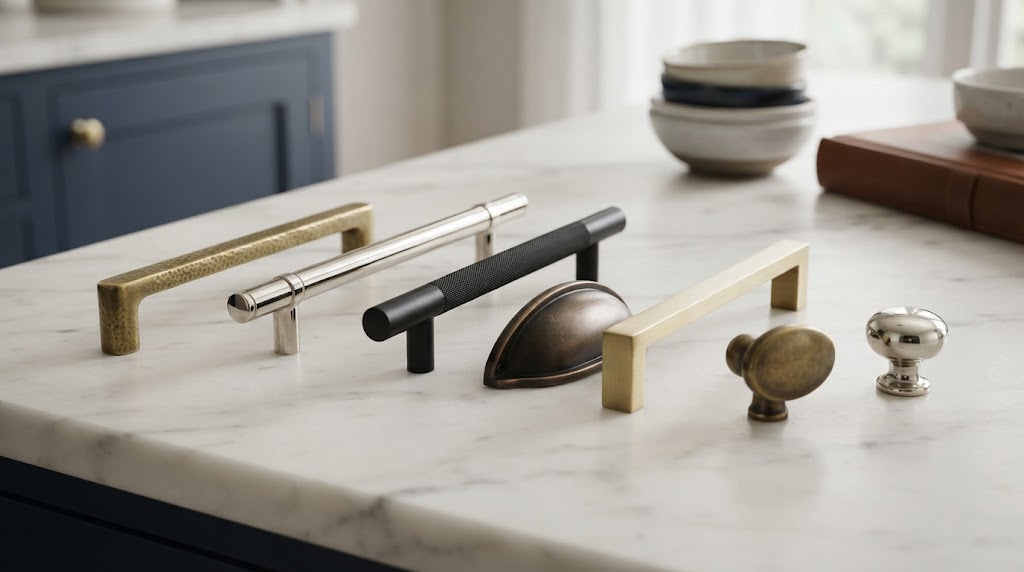
Hardware should support the room rather than compete with everything around it.
Before shopping, identify the broad style of your kitchen.
Modern and Minimalist Kitchens
Modern kitchens often use flat-panel cabinetry, simple lines, restrained color palettes, and minimal ornamentation.
Good hardware options include:
- Slim linear pulls
- Long bar handles
- T-bar pulls
- Matte black hardware
- Brushed nickel
- Minimal lip pulls
Lo & Co’s Linear collection, for example, uses solid brass, refined proportions, and knurled detailing. The collection is available in finishes ranging from brass and black to nickel and bronze and is designed for cabinetry, wardrobes, pantries, vanities, and integrated appliances.
Longer handles can also emphasize the clean vertical or horizontal lines found in contemporary cabinetry.
Traditional Kitchens
Traditional kitchens usually benefit from slightly more decorative hardware.
Consider:
- Aged brass
- Bronze
- Polished nickel
- Curved pulls
- Classic knobs
- Handles with backplates
These finishes work especially well with shaker doors, detailed millwork, natural stone, and warmer cabinetry colors.
Lo & Co currently describes tumbled nickel, aged brass, and bronze as finishes that can work particularly well in traditional interiors.
Transitional Kitchens
Transitional design mixes traditional structure with cleaner modern details.
This makes it one of the easiest styles for hardware selection.
You might pair white shaker cabinetry with streamlined brass pulls, or combine natural wood cabinets with polished nickel hardware.
The goal is balance rather than strict adherence to one design period.
Choose Between Knobs and Pulls
One of the first decisions is whether you want knobs, handles, or both.
Cabinet Knobs
Knobs are compact and visually light.
They can work particularly well on:
- Upper cabinet doors
- Small drawers
- Traditional kitchens
- Furniture-style cabinetry
They also require only one mounting hole, which can make installation simpler on new cabinetry.
Cabinet Pulls
Pulls provide more gripping space and tend to feel more substantial.
They are useful for:
- Drawers
- Pantry doors
- Lower cabinets
- Large cabinet fronts
- Frequently used storage
Longer pulls can make oversized drawers easier to operate.
Mixing Knobs and Pulls
You do not have to choose only one.
A common approach is to use knobs on cabinet doors and pulls on drawers.
Another option is to use one handle family throughout the room but vary the size according to the cabinet.
This creates consistency without making every door and drawer look identical.
Consider Sculptural Kitchen Door Handles
Hardware does not have to disappear into the cabinetry.
Sculptural handles can become deliberate design features.
Lo & Co’s current collections include designs influenced by Brutalist architecture, Art Deco geometry, mid-century styling, Mediterranean forms, spherical detailing, and natural stone. The brand’s Prism collection, for example, combines marble or travertine with angular forms inspired by faceted stones.
This type of hardware works particularly well when the cabinetry itself is simple.
A flat cream cabinet can provide the perfect background for an unusual marble or brass pull.
How to Choose the Right Handle Size
Handle size has a major effect on proportion.
A very small pull can look lost on a large drawer.
An oversized handle can overpower a narrow cabinet.
Use Cabinet Width as a Guide
There is no single universal rule, but the width of the cabinet is a useful starting point.
Lo & Co recommends that horizontally installed handles can often look proportionate at approximately one-third the width of a drawer. For vertically installed handles, a similar proportional approach can be used relative to the cabinet-door height.
Treat this as a design guideline rather than a strict requirement.
For example, a contemporary kitchen may intentionally use much longer pulls for a dramatic architectural effect.
Oversized Appliance Pulls
Integrated refrigerators, freezers, and large pantry doors need hardware with enough scale.
Standard cabinet pulls may look undersized on these large surfaces.
Appliance pulls are longer and more substantial, creating a better visual relationship with tall doors.
Lo & Co currently offers dedicated appliance-pull versions within several handle collections, allowing homeowners to coordinate large appliances with smaller cabinet hardware.
Measure Existing Holes Before Ordering
This step is critical when updating an existing kitchen.
If your cabinets already have handles, measure the center-to-center distance between the screw holes.
In the United States, this measurement is often discussed in inches, while international hardware brands may display dimensions in millimeters.
Do not assume that a replacement handle will fit simply because it appears similar.
Why Center-to-Center Measurement Matters
If the new handle uses the same hole spacing, installation may be straightforward.
If it does not, you may need to:
- Drill new holes
- Fill old holes
- Refinish the cabinet front
- Use a backplate to cover existing holes
Lo & Co notes that its hardware includes the required installation fixings, but U.S. customers should still confirm the exact dimensions of each product against their existing cabinetry before ordering.
Measure twice before purchasing an entire kitchen’s worth of hardware.
Popular Kitchen Handle Finishes
The finish can connect the cabinets to lighting, faucets, appliances, and other metal details in the room.
Brass Kitchen Handles
Brass remains one of the most versatile options.
It can warm up white, cream, green, black, navy, or natural-wood cabinetry.
Lo & Co currently offers multiple brass treatments rather than one uniform gold tone, including brass, aged brass, polished brass, tumbled brass, and live brass.
Lacquered vs. Living Brass
This distinction is important.
A protected brass finish is designed to maintain its appearance more consistently.
A living finish is intended to change.
Lo & Co’s Live Brass is left unlacquered so oxidation and handling can gradually create a natural patina. Its Oil Rubbed Bronze is also described as a living finish that develops warmer highlights in frequently touched areas over time.
If you want every handle to remain visually uniform, a living finish may not be the best choice.
If you appreciate aging and character, it may be exactly what you want.
Matte Black Handles
Black hardware creates strong contrast.
It works especially well with:
- White cabinets
- Light oak
- Soft gray
- Beige
- Green cabinetry
- Industrial interiors
Lo & Co’s matte-black range uses a solid-brass base with an electroplated black finish and protective treatment.
Black also coordinates easily with black appliances, faucets, window frames, and light fixtures.
Nickel Kitchen Hardware
Nickel offers a softer alternative to chrome.
Brushed or satin-style nickel can feel understated, while polished nickel produces more reflection.
Lo & Co’s polished nickel is created by electroplating solid brass for a brighter silver-toned finish, while its standard nickel finish has a softer brushed appearance.
Nickel works particularly well in kitchens with stainless steel appliances because the metals can complement one another without needing to match perfectly.
Bronze and Oil-Rubbed Bronze
Bronze introduces depth and warmth without the brightness of polished brass.
It can work beautifully with:
- Natural timber
- Cream cabinets
- Stone countertops
- Moody kitchens
- Traditional interiors
Oil-rubbed bronze can be even more characterful because the appearance evolves with use.
Marble and Travertine Handles
Natural stone hardware creates a different effect from metal.
Instead of matching appliances or faucets, it can connect visually with countertops and backsplashes.
Lo & Co’s marble and travertine hardware uses natural stone, meaning grain and color naturally vary from piece to piece. The stone is finished with a soft honed surface rather than a high-gloss polish.
That variation is part of the appeal.
If you want every handle to look absolutely identical, natural stone may not provide that uniformity.
Should All Kitchen Hardware Match?
Not necessarily.
Mixing metals has become a normal part of interior design.
Your cabinet handles do not have to be identical to your faucet, lighting, or appliance finish.
The key is repetition.
If brass appears only once in the entire room, it can feel accidental.
If it appears in the cabinet pulls and pendant lights, the choice feels intentional.
Keep the Number of Finishes Controlled
Two main metal finishes are usually easier to coordinate than four or five unrelated finishes.
For example:
- Brass handles + stainless steel appliances
- Black handles + polished nickel faucet
- Bronze hardware + brass lighting
A mixed-metal room should still feel connected.
Think About Grip and Projection
Beautiful hardware has to work with real hands.
Check how far the handle projects from the cabinet.
A shallow handle may look minimal but provide limited finger clearance.
A deeply projecting handle may be easier to grip but can catch clothing in a narrow walkway.
Textured handles can improve grip as well. Lo & Co’s knurled Linear designs, for example, use surface detailing that creates additional tactile grip.
If possible, order a sample before committing to dozens of handles.
Installation Tips for Kitchen Cabinet Handles
New cabinets require precise placement.
A cabinet-hardware jig can help keep holes consistent.
For existing cabinets, reuse current holes whenever possible if you want to minimize refinishing.
Before drilling:
- Confirm the handle orientation.
- Measure the center-to-center spacing.
- Check alignment with neighboring doors.
- Use a template or jig.
- Test one cabinet before drilling the rest.
A few millimeters of error can become obvious when handles are lined up across a long kitchen.
Caring for Premium Cabinet Hardware
Different finishes require different care.
Lo & Co recommends a soft, damp cloth for most of its brass, nickel, bronze, black, marble, and travertine hardware and advises against harsh chemicals or abrasive cleaning products.
That is good advice for premium hardware generally.
Aggressive cleaners can damage protective coatings and alter finishes.
Clean handles regularly before grease and cooking residue become difficult to remove.
Ordering Kitchen Handles in the United States
U.S. homeowners considering international design brands should check shipping, returns, dimensions, and lead times before ordering.
Lo & Co currently ships within the United States using carriers including UPS and FedEx, with some orders potentially shipping from its Australian distribution center via DHL Express. The company states that most U.S. orders arrive within approximately four to ten business days, depending on stock and handling.
Its current U.S. policy provides complimentary standard shipping on orders over $300 and a 30-day return period for eligible unused and uninstalled items.
Because installed hardware generally cannot simply be treated like an unused sample, double-check measurements and finishes before installing a full order.
Frequently Asked Questions About Kitchen Door Handles
What are the best kitchen door handles?
The best handles depend on your cabinet style, budget, finish preference, and comfort needs. Solid-brass pulls are popular for durability, while knobs, linear pulls, lip pulls, and sculptural handles suit different design styles.
Should kitchen handles match the faucet?
No. They can match, but they do not have to. Mixing two coordinated metal finishes can create a more layered interior.
What size handles should I use for kitchen cabinets?
Choose a size that feels proportional to the cabinet. Larger drawers generally look better with longer pulls, while small doors can work with shorter handles or knobs. Always verify mounting-hole dimensions before ordering.
Are brass kitchen handles durable?
Quality solid-brass hardware can be highly durable. The finish applied to the brass affects how it looks and how it ages.
Does unlacquered brass change color?
Yes. Unlacquered or “living” brass naturally develops patina as it reacts to air, humidity, oils, and repeated handling.
Are black handles good for kitchens?
Yes. Matte-black handles work with both contemporary and transitional kitchens and provide strong contrast against light cabinetry. Lo & Co’s current black cabinet hardware is suitable for kitchen and bathroom applications.
Can I replace cabinet handles without drilling new holes?
Yes, if the replacement handle has the same center-to-center screw spacing as the existing hardware. Always measure before purchasing.
Where can I find designer kitchen cabinet hardware?
Homeowners looking for premium kitchen door handles can explore Lo & Co Interiors’ current collection, which includes solid-brass, marble, and travertine designs in finishes such as brass, bronze, nickel, black, white, and other specialty treatments.
Conclusion
Kitchen door handles may be small, but they influence both the appearance and everyday usability of a kitchen.
The best hardware should feel comfortable in your hand, suit the scale of your cabinets, coordinate with the broader interior, and remain practical after years of regular use.
Start by identifying your kitchen style.
A contemporary kitchen may benefit from slim linear or T-bar pulls. Traditional cabinetry can work beautifully with aged brass, bronze, polished nickel, or more decorative shapes. Transitional interiors offer even more flexibility.
Then consider material and finish.
Solid brass provides weight and durability. Matte black creates contrast. Nickel offers a cooler, understated look. Marble and travertine can transform hardware into a sculptural design feature.
Also think about how the finish will age. Lacquered metal is intended to remain more stable, while living finishes such as unlacquered brass and oil-rubbed bronze naturally develop patina.
Most importantly, measure carefully.
When replacing existing hardware, confirm the center-to-center hole spacing before ordering. U.S. cabinets and internationally designed hardware may use different measurement conventions, so never rely on appearance alone.
For a full renovation, consider the kitchen as one complete composition. Handles should relate to cabinetry, appliances, lighting, faucets, stone, flooring, and architectural details without necessarily matching every element.
Collections such as Lo & Co Interiors demonstrate how far cabinet hardware has moved beyond basic utility. Its range now includes simple linear forms, half-moon pulls, knurled designs, sculptural handles, natural stone pieces, appliance pulls, and collections influenced by architectural and interior-design movements.
You do not need the most elaborate handle to create an impressive kitchen.
You need the right handle.
Choose something that looks intentional, feels comfortable every day, works with your cabinetry, and adds the finishing detail that makes the entire room feel complete.