
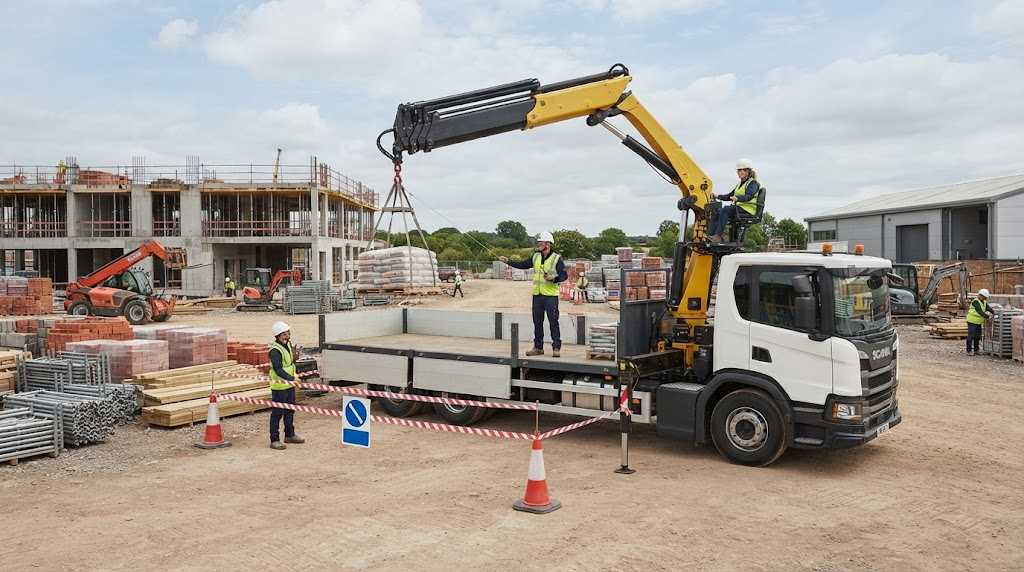
Truck-mounted cranes are common across construction, transport, logistics, utilities, building supply, landscaping, and heavy equipment industries. They allow workers to transport materials to a jobsite and then use a crane mounted on the vehicle to load or unload them.
Because these machines combine heavy vehicles, suspended loads, hydraulic systems, and crane movement, proper training is essential.
In Australia, operators working with certain larger vehicle loading cranes may need a vehicle loading crane licence, commonly known as a CV High Risk Work Licence.
Under Safe Work Australia’s current high-risk work licence classifications, the vehicle loading crane class covers cranes with a capacity of 10 metre tonnes or more, including the use of load-estimation and slinging techniques to move loads.
For American readers, it is important to understand that the Australian CV licence is not the same as U.S. crane operator certification. The United States uses different federal and state requirements, including OSHA rules for operator training, certification, and employer evaluation when those requirements apply.
This guide explains what the Australian licence involves, what training commonly covers, how operators obtain it, and how the system compares with crane qualification requirements in the United States.
What Is a Vehicle Loading Crane?
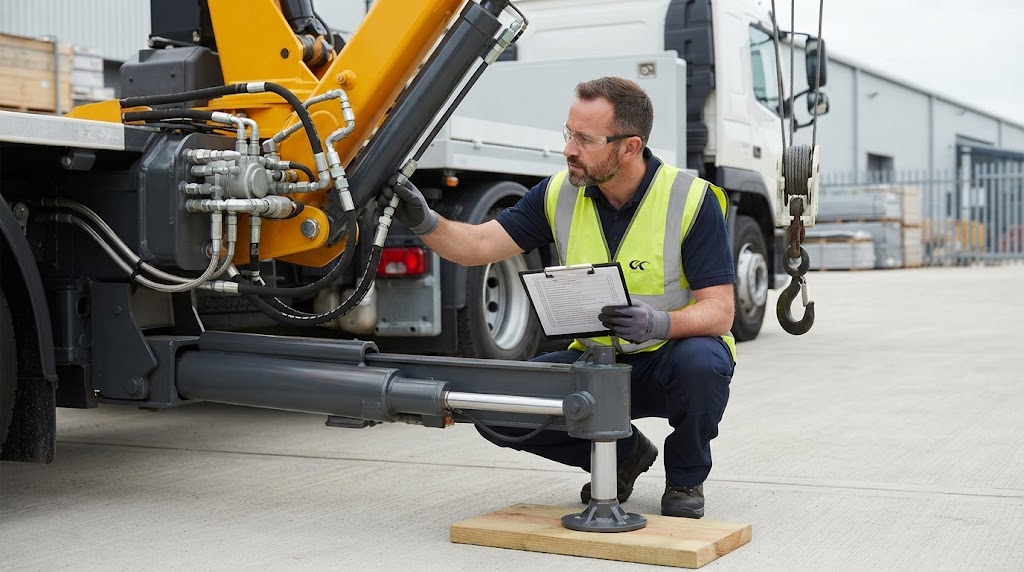
A vehicle loading crane is a crane mounted on a truck or another vehicle and primarily designed to move loads onto or off that vehicle.
Typical applications include moving:
- Building materials
- Machinery
- Timber
- Landscaping products
- Pipes
- Equipment
- Pallets
- Construction supplies
These cranes are often called truck-mounted cranes, loader cranes, knuckle-boom cranes, or by well-known equipment names such as Hiab and Palfinger.
Safe Work Australia defines a vehicle loading crane as a crane mounted on a vehicle for loading and unloading items from that vehicle. Modern units may also perform more complex lifting operations depending on their design and applicable licensing rules.
What Is a Vehicle Loading Crane Licence?
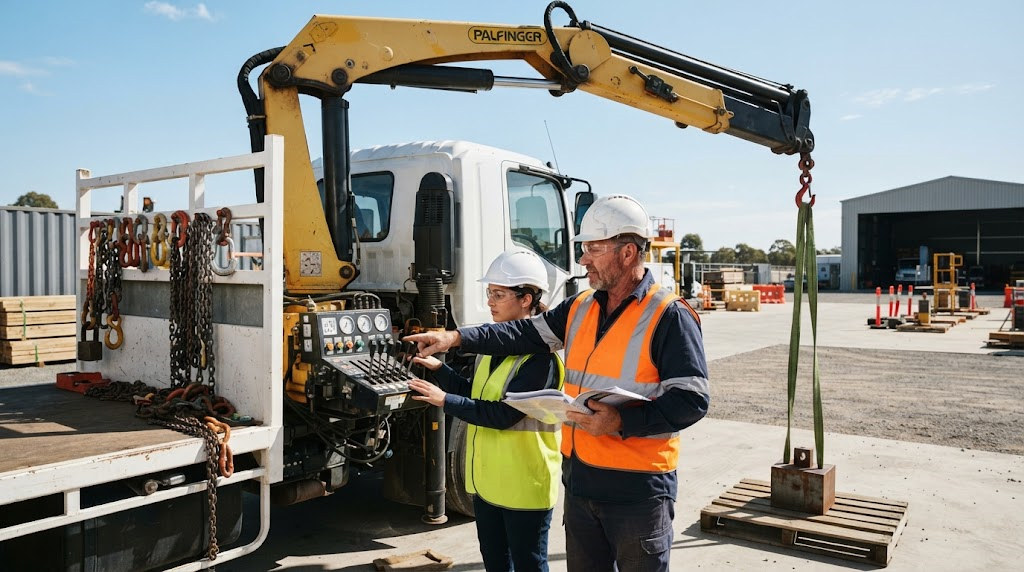
In Australia, the relevant High Risk Work Licence class is commonly identified as CV.
Under the current model WHS framework, a CV licence covers operation of a vehicle loading crane rated at 10 metre tonnes or more.
The licence is part of Australia’s broader High Risk Work Licence system, which also covers work such as:
- Forklift operation
- Dogging
- Rigging
- Certain mobile cranes
- Tower cranes
- Scaffolding
- Reach stackers
Safe Work Australia develops the model framework, but it does not actually issue individual licences. State and territory WHS regulators administer licensing in their own jurisdictions.
What Does “10 Metre Tonnes” Mean?
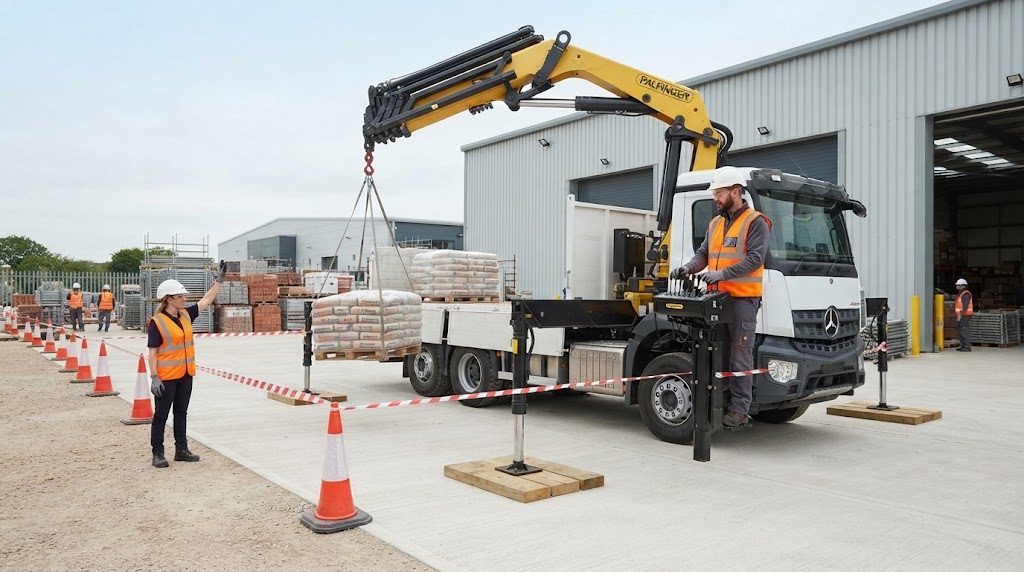
Metre tonnes describe crane capacity using a combination of load weight and horizontal distance.
For example, lifting a heavier load close to the crane can create a different loading condition than lifting a smaller load farther away.
This is one reason crane operators need formal training in load charts, crane configuration, stability, and lifting limits.
Operators should always follow the manufacturer’s rated-capacity information for the exact crane being used.
Who Needs a CV Licence?
Under the current Safe Work Australia model classification, an operator generally needs the appropriate High Risk Work Licence to operate a vehicle loading crane with a capacity of 10 metre tonnes or more.
SafeWork NSW likewise describes a CV vehicle loading crane as a crane mounted on a vehicle for moving loads onto or from the vehicle when capacity is 10 metre tonnes or more.
The actual legal requirements that apply to an individual operator depend on the state or territory where the work takes place.
That distinction matters because Australian WHS laws are administered at jurisdictional level.
Smaller Vehicle Loading Cranes
A crane below the CV licensing threshold may not require the CV High Risk Work Licence under the current model classification.
That does not mean anyone should operate it without training.
Employers still have duties to provide appropriate information, instruction, training, supervision, and safe systems of work.
Competency requirements may therefore apply even when a particular HRW licence class does not.
Understanding the TLILIC0024 Course
One nationally recognized unit associated with the CV licence is:
TLILIC0024 – Licence to operate a vehicle loading crane (capacity 10 metre tonnes and above).
Safety Australia Training currently offers this vehicle loading crane course as a four- or five-day program combining theory and practical assessment. Its course page currently lists no prior experience as a prerequisite for enrolment.
The course is designed around the skills required to safely prepare, operate, and shut down a vehicle loading crane.
What Does the Course Cover?
The current Safety Australia Training program includes instruction in:
- Planning crane operations
- Identifying hazards
- Conducting pre-operational inspections
- Setting up the crane
- Positioning outriggers
- Configuring the boom
- Selecting and using lifting equipment
- Moving loads
- Applying slinging techniques
- Shutting down the crane safely
The provider currently offers the course in locations including Sydney, Brisbane, and Melbourne, with fees varying by training location and session.
Theory and Practical Assessment
Crane competency cannot be established through classroom learning alone.
The TLILIC0024 course includes both theory and practical components.
The theory portion helps candidates understand topics such as:
- Workplace hazards
- Crane capacity
- Site conditions
- Communication
- Load control
- Operating procedures
- Emergency considerations
- Regulatory responsibilities
The practical assessment evaluates whether the candidate can apply those principles safely around real equipment.
Why Hands-On Training Matters
A vehicle loading crane operates in a dynamic environment.
Ground conditions change.
Loads differ in shape and weight.
Clearances vary between worksites.
Weather can affect operations.
A competent operator must know how to assess these conditions rather than simply memorize controls.
How Do You Get the Licence?
Completing training is an important step, but the training provider itself is generally not the authority that grants the High Risk Work Licence.
Safe Work Australia explains that candidates who pass the national assessment instrument receive a Statement of Attainment or equivalent documentation and then apply to the relevant state or territory WHS regulator for the High Risk Work Licence.
Under the model framework, the application must generally be lodged within 60 days of receiving the Statement of Attainment.
The licence is generally valid for five years.
Examples of Licensing Authorities
The authority depends on where the worker is located.
Examples include SafeWork or WorkSafe regulators operating within individual Australian states and territories.
Operators should check the regulator for the jurisdiction in which they intend to work rather than assuming one application process applies everywhere.
Vehicle Loading Crane Safety Starts Before the Lift
Passing a course is not the end of crane safety.
Every lifting operation requires planning.
Safe Work Australia identifies major crane hazards that include:
- Structural failure
- Crane overturning
- Collision with people or structures
- Loads striking workers
- Falling objects
These hazards can have severe consequences.
Pre-Operational Inspection
Before work begins, the operator should follow the equipment manufacturer’s inspection requirements and workplace procedures.
Checks may involve the general condition of the crane, hydraulic systems, controls, lifting equipment, safety systems, and vehicle setup.
The exact inspection procedure must be based on the specific crane and applicable workplace instructions.
Crane Stability
Truck-mounted cranes can create major overturning forces.
Proper setup, including use of outriggers where required, is therefore a central part of training.
SafeWork NSW emphasizes that vehicle loading cranes should be level and operated within their rated capacity.
Operators must also consider ground conditions and follow the manufacturer’s instructions for the particular machine.
Load Estimation and Slinging
Knowing how to operate crane controls is only one part of the job.
Operators may also need to understand the load.
That includes recognizing factors such as:
- Weight
- Shape
- Center of gravity
- Attachment points
- Lifting equipment
- Load movement
Safe Work Australia’s CV classification specifically includes the application of load-estimation and slinging techniques.
Improperly secured loads can shift unexpectedly, create instability, or fall.
Communication During Crane Operations
The operator must know what is happening around the crane.
Visibility can be limited by the vehicle, load, structures, or jobsite layout.
SafeWork NSW safety guidance says operators should have an unobstructed view of the load during a lift, and operations outside the operator’s view may require direction from appropriately qualified personnel.
Clear communication is particularly important around busy construction and logistics sites where workers, vehicles, and equipment may be moving simultaneously.
Why Formal Crane Training Matters
Vehicle loading cranes may appear straightforward because they are mounted on familiar commercial vehicles.
That familiarity can create false confidence.
A crane can generate significant forces even when the load does not appear unusually heavy.
Formal training teaches operators how to think about the entire lifting system rather than only the crane controls.
Training Helps Operators Recognize Hazards
Proper training can improve awareness of issues such as:
- Overloading
- Poor ground conditions
- Incorrect crane configuration
- Unsafe load attachment
- People entering lifting areas
- Obstructions
- Power lines
- Mechanical defects
- Improper shutdown
This type of hazard recognition is a major reason crane work is treated as high-risk work.
Employer Responsibilities
A licence does not remove the employer’s responsibility for workplace safety.
Safe Work Australia states that businesses must ensure workers have the correct current High Risk Work Licence where required and must provide any additional training, information, instruction, and supervision necessary to control workplace risks.
Employers should therefore ensure that:
- Operators are appropriately licensed
- Equipment is suitable for the task
- Cranes are maintained
- Workplace hazards are assessed
- Safe procedures are established
- Operators are familiar with the specific machine
A licence demonstrates a defined level of competency, but site-specific training remains important.
Licence Requirements Are Changing
Crane licensing rules should always be checked against the latest jurisdictional guidance.
Safe Work Australia published amendments to the model WHS Regulations in December 2025 as part of its crane licensing review. It has also been considering further reforms, including possible changes to the licensing threshold for vehicle loading cranes.
Because model law changes are not necessarily implemented identically or simultaneously by every jurisdiction, workers and employers should confirm the current rules with their state or territory regulator.
This is especially important when relying on older training materials or industry advice.
Vehicle Loading Crane Licence vs. U.S. Crane Certification
For a USA audience, terminology can cause confusion.
The Australian vehicle loading crane licence is not a U.S. federal licence.
American crane requirements are governed through OSHA rules along with applicable state and local regulations.
Under OSHA’s construction crane standard, operators covered by the rule may need formal training, certification or licensing through an accepted route, and employer evaluation. OSHA specifies requirements for accredited testing organizations, including written and practical examinations.
Do Australian Credentials Transfer to the United States?
Workers should not assume that an Australian CV licence automatically satisfies U.S. requirements.
Likewise, U.S. crane credentials should not automatically be assumed to satisfy Australian High Risk Work Licence requirements.
Anyone moving between the two countries should verify requirements with the relevant safety regulator and employer before operating equipment.
Industries That Use Vehicle Loading Cranes
Truck-mounted cranes are widely used because one vehicle can transport and unload its own cargo.
Common industries include:
Construction
Vehicle loading cranes can deliver timber, steel, equipment, and building materials directly to jobsites.
Transport and Logistics
Transport companies use them where freight must be unloaded at locations without dedicated lifting equipment.
Utilities
Utilities may use truck-mounted lifting equipment for infrastructure work and transporting specialized components.
Landscaping
Large trees, stone, machinery, and landscaping materials can require mechanical lifting.
Building Supply
Suppliers often use loader cranes to deliver materials directly from the truck.
Choosing a Vehicle Loading Crane Course
Not every training option should be judged by price alone.
Look for nationally recognized training delivered through an appropriate Registered Training Organisation arrangement.
You should also consider:
- Practical training time
- Equipment used
- Trainer experience
- Assessment structure
- Training location
- Course duration
- Regulatory recognition
Safety Australia Training’s current vehicle loading crane licence course covers TLILIC0024 for cranes rated at 10 metre tonnes and above and includes theory and practical assessment. The provider currently lists four- to five-day programs in multiple Australian locations.
Frequently Asked Questions About a Vehicle Loading Crane Licence
What licence do I need to operate a vehicle loading crane in Australia?
For a vehicle loading crane with capacity of 10 metre tonnes or more under the current model classification, the relevant High Risk Work Licence is the CV class.
What does CV stand for?
CV is the High Risk Work Licence class used for vehicle loading cranes.
What course is used for the CV licence?
TLILIC0024 is the nationally recognized unit for operating a vehicle loading crane with capacity of 10 metre tonnes and above.
How long does vehicle loading crane training take?
Safety Australia Training currently lists its TLILIC0024 course as four or five days, depending on the scheduled program.
Is there a practical test?
Yes. The current course includes both theory and practical assessment.
Do I receive the licence immediately after training?
Successful completion generally provides the documentation needed to apply to the relevant WHS regulator. Safe Work Australia states that successful candidates receive a Statement of Attainment or equivalent and then apply for their High Risk Work Licence through the local regulator.
How long is an Australian High Risk Work Licence valid?
Under the model framework, it is generally valid for five years.
Is the Australian CV licence valid in the USA?
It should not be assumed to satisfy U.S. crane operator requirements. OSHA and applicable state rules use a different certification and evaluation framework.
Conclusion
Operating a truck-mounted crane safely requires much more than knowing how to move a boom or raise a load.
Operators need to understand crane capacity, setup, stability, lifting equipment, site hazards, load control, inspections, communication, and safe shutdown.
In Australia, the vehicle loading crane licence provides a formal competency pathway for workers operating vehicle loading cranes that fall within the applicable High Risk Work Licence class.
Under the current model WHS classification, the CV class applies to vehicle loading cranes with a capacity of 10 metre tonnes or more.
Training such as TLILIC0024 combines theoretical knowledge with hands-on assessment. Safety Australia Training currently delivers the course over four or five days and covers operational planning, inspections, crane setup, outriggers, lifting equipment, load transfers, and shutdown procedures.
Successful training is only part of the licensing process. Candidates normally use their Statement of Attainment to apply through the relevant state or territory regulator, and current rules should always be confirmed with that authority.
For U.S. readers, the biggest point to remember is that Australian and American systems are different. A CV High Risk Work Licence is an Australian credential, while U.S. crane operators may be subject to OSHA certification, training, and employer-evaluation requirements depending on the equipment and work being performed.
Regardless of country, the principle is the same: cranes should only be operated by people who have the training, competence, and authorization required for the job.
When suspended loads and heavy machinery are involved, proper training is not simply a box to check. It is a core part of protecting the operator, nearby workers, equipment, and everyone else on the jobsite.

