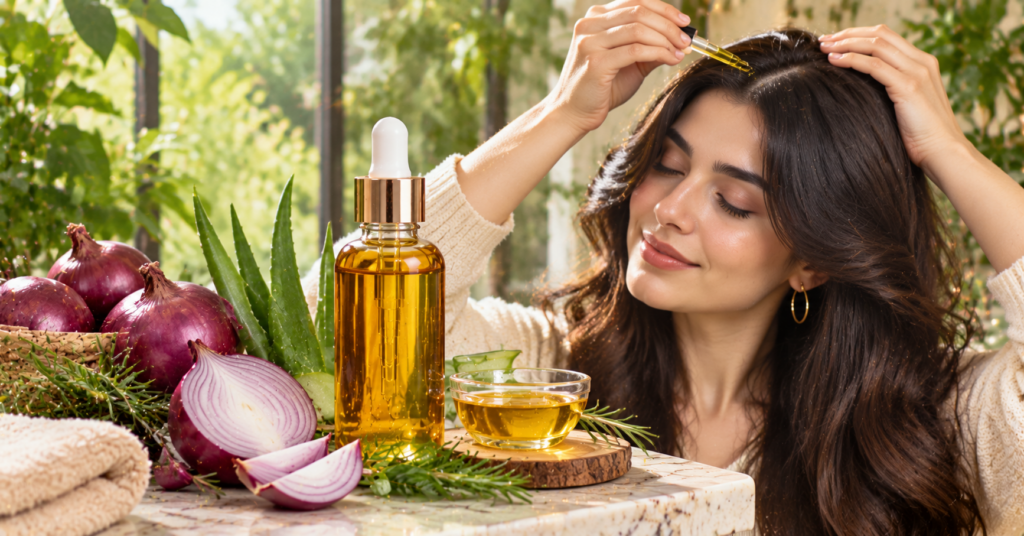
Healthy, shiny, and manageable hair is something many people want to achieve. However, factors such as heat styling, environmental exposure, improper hair care, and chemical treatments can affect hair texture and appearance.
As consumers become more interested in botanical beauty products, traditional ingredients are receiving renewed attention. Onion is one such ingredient that has become popular in hair care formulations.
Onion hair oil is commonly marketed as a nourishing treatment that supports scalp care, improves hair manageability, and helps maintain healthier-looking strands.
Whether you are dealing with dry hair, breakage, or an uncomfortable scalp, understanding the ingredients and proper application methods can help you decide whether onion-based hair products belong in your routine.
This guide explores its potential benefits, ingredients, application techniques, and practical hair care recommendations for American consumers.
What Is Onion Hair Oil?
Onion hair oil is a hair care product formulated with onion-derived ingredients, usually onion extract or onion-infused oil, combined with a carrier oil or other botanical ingredients.
Red onions are particularly popular in commercial hair care formulations because they contain naturally occurring sulfur-containing compounds and antioxidant substances.
Depending on the formulation, other ingredients may include:
- Coconut oil
- Castor oil
- Almond oil
- Olive oil
- Rosemary extract
- Aloe vera
- Vitamin E
- Jojoba oil
These ingredients are used to create products designed for scalp conditioning and hair nourishment.
It is important to understand that different formulations have different properties. Scientific evidence supporting the benefits of onion oil itself for hair growth remains limited.
Why Is Onion Hair Oil Becoming Popular?
Natural hair care products have become increasingly popular among consumers interested in botanical ingredients and traditional beauty practices.
Onion-based formulations have attracted attention for several reasons.
1. Interest in Natural Ingredients
Many consumers prefer products containing plant-derived ingredients.
Onion extracts, coconut oil, rosemary, and aloe vera are frequently included in botanical hair care formulations.
2. Traditional Hair Care Practices
Onions have been used in various traditional beauty practices.
Modern cosmetic brands have incorporated onion-derived ingredients into ready-to-use products, making them easier to include in everyday routines.
3. Focus on Scalp Care
A healthy scalp provides the environment in which hair grows.
Many people use conditioning oils as part of scalp massage routines to improve comfort and reduce dryness.
4. Convenient Application
Pre-formulated hair oils are generally easier to apply than preparing homemade onion mixtures.
They may also include additional ingredients that improve texture, fragrance, and application.
5. Growing Interest in Botanical Beauty
Consumers increasingly explore products that combine traditional ingredients with modern cosmetic formulations.
Onion-based oils fit into this broader interest in plant-inspired hair care.
Potential Benefits of Onion Hair Oil
The benefits of onion hair oil depend on its formulation and the individual’s hair and scalp condition.
Here are some commonly discussed uses.
1. Helps Condition Dry Hair
Some formulations contain carrier oils that help soften hair strands.
Ingredients such as coconut oil, almond oil, and jojoba oil can improve hair feel and manageability.
Regular conditioning may make dry hair easier to comb and style.
2. Supports Scalp Moisture
A suitable oil formulation can help reduce dryness and improve the feeling of scalp comfort.
However, people with oily scalps or certain scalp conditions may find heavy oils uncomfortable.
Choose products according to your individual needs.
3. Helps Reduce Friction During Hair Care
Hair can experience mechanical damage when it is brushed, detangled, or styled.
Conditioning oils may help reduce friction between strands, making hair easier to manage.
This can be particularly useful for people with dry or textured hair.
4. Provides Antioxidant-Rich Botanical Ingredients
Onions contain naturally occurring antioxidant compounds.
Depending on the extraction process, onion-derived cosmetic ingredients may retain some of these compounds.
However, the antioxidant content of a finished hair oil varies by formulation.
5. Supports a Relaxing Scalp Massage Routine
Massaging the scalp gently while applying hair oil can create a relaxing self-care experience.
Use light pressure and avoid scratching or aggressively rubbing the scalp.
6. Improves Hair Appearance
Conditioning ingredients may help create a smoother, shinier appearance.
This cosmetic benefit should not be confused with proven improvements in hair growth or hair density.
Important Ingredients Found in Onion Hair Oil
Understanding the ingredient list can help you choose a suitable product.
1. Red Onion Extract
Red onion extract is a common ingredient in botanical hair care products.
It contains naturally occurring plant compounds, including sulfur-containing substances and antioxidants.
Some limited research has investigated topical onion juice for particular types of hair loss, but those findings should not be assumed to prove that commercial onion oils promote hair growth.
2. Coconut Oil
Coconut oil is widely used in hair conditioning products.
Research suggests that it can reduce protein loss from hair when used appropriately.
It may be particularly useful for conditioning dry or damaged strands.
3. Castor Oil
Castor oil is a thick vegetable oil commonly included in hair care formulations.
It can provide lubrication and conditioning, although strong clinical evidence that it directly increases hair growth is lacking.
4. Rosemary Extract
Rosemary-derived ingredients are used in various hair care products.
Some research has examined rosemary oil in relation to certain hair loss conditions, but results from specific formulations cannot automatically be applied to every commercial hair oil.
5. Aloe Vera
Aloe vera is commonly included in cosmetic products designed to condition and soothe the skin.
Its suitability depends on the formulation and individual skin sensitivity.
6. Vitamin E
Vitamin E is an antioxidant ingredient frequently used in cosmetic formulations.
It may help protect product formulations from oxidation, depending on the product’s composition.
How to Use Onion Hair Oil Correctly
Proper application helps you incorporate hair oil into your routine without unnecessary product buildup.
Step 1: Read the Product Instructions
Different formulations have different application recommendations.
Check whether the product is designed for scalp application, hair lengths, or both.
Step 2: Perform a Patch Test
Before using a new product, test a small amount on an appropriate area of skin according to the manufacturer’s instructions.
Monitor for redness, itching, burning, or irritation.
Stop using the product if a reaction develops.
Step 3: Apply a Small Amount
Take a small quantity of oil and distribute it according to the product directions.
Avoid applying excessive amounts, particularly if you have an oily scalp.
Step 4: Massage Gently
If the product is suitable for scalp use, massage gently using your fingertips.
Avoid scratching or applying excessive pressure.
Step 5: Leave It On as Directed
Some products are intended for pre-wash treatments, while others are designed to remain on the hair.
Follow the specific instructions rather than assuming every oil should be left overnight.
Step 6: Wash When Necessary
If the formulation is intended for pre-wash use, cleanse your hair with a suitable shampoo.
Make sure you remove excess oil without aggressively scrubbing your scalp.
How Often Should You Use Onion Hair Oil?
There is no universal application schedule.
Frequency depends on the product formulation, hair type, scalp condition, and personal tolerance.
| Hair Type | General Consideration |
|---|---|
| Dry hair | May benefit from occasional conditioning |
| Oily hair | Use smaller amounts and avoid heavy buildup |
| Normal hair | Follow product instructions |
| Curly hair | Focus on conditioning and manageability |
| Sensitive scalp | Seek fragrance-free or gentle formulations |
Start conservatively and adjust according to how your hair and scalp respond.
Onion Hair Oil for Different Hair Types
1. Dry Hair
People with dry hair may prefer formulations containing coconut, almond, or jojoba oil.
These ingredients can help condition the hair and improve softness.
2. Oily Hair
If your scalp produces excess oil, use lightweight formulations sparingly.
Avoid applying large amounts directly to the scalp.
3. Curly Hair
Curly hair can experience dryness and tangling.
A suitable conditioning oil may help reduce friction and improve manageability.
4. Chemically Treated Hair
Hair that has undergone coloring, bleaching, or chemical straightening may require additional conditioning.
Choose products specifically suited to treated hair and follow the manufacturer’s instructions.
5. Sensitive Scalp
People with sensitive skin should be particularly careful with fragranced oils and concentrated botanical ingredients.
If you have an existing scalp condition, seek advice from a dermatologist before introducing unfamiliar treatments.
Onion Hair Oil vs. Other Hair Oils
Different hair oils serve different cosmetic purposes.
| Hair Oil | Common Hair Care Use |
|---|---|
| Onion oil | Botanical hair care formulations |
| Coconut oil | Conditioning and reducing protein loss |
| Argan oil | Softness and shine |
| Jojoba oil | Lightweight conditioning |
| Castor oil | Rich conditioning |
| Almond oil | Hair softening |
The best option depends on your hair texture, preferences, and product formulation.
Common Mistakes to Avoid When Using Onion Hair Oil
Even botanical products can cause problems when used incorrectly.
Avoid these common mistakes:
- Applying excessive amounts.
- Ignoring product instructions.
- Using concentrated onion juice directly on sensitive skin.
- Skipping patch testing.
- Leaving products on longer than recommended.
- Applying oil to an irritated or broken scalp.
- Expecting guaranteed hair growth.
- Ignoring persistent hair loss or scalp symptoms.
Remember that natural ingredients can still cause allergic reactions or irritation.
Frequently Asked Questions
Does onion hair oil help hair growth?
Some research has investigated topical onion juice for specific hair loss conditions, but evidence for commercial onion oil products is limited. It should not be considered a proven hair growth treatment.
Can onion hair oil reduce hair fall?
Hair shedding has many possible causes, including genetics, hormonal changes, nutritional deficiencies, and medical conditions. Conditioning oils may help reduce breakage-related damage, but they do not treat every cause of hair loss.
How long should I leave onion hair oil in my hair?
Follow the manufacturer’s instructions. Some formulations are designed for short pre-wash treatments, while others can remain on the hair longer.
Can I use onion hair oil every day?
Daily use is not necessary for everyone. Follow the product directions and monitor your scalp for irritation or buildup.
Is onion hair oil suitable for all hair types?
Different formulations may suit different hair types. People with sensitive scalps should check the ingredients and perform a patch test before use.
Can onion hair oil cause irritation?
Yes. Onion-derived ingredients, fragrances, essential oils, and other components may cause irritation or allergic reactions in some individuals.
Can I apply onion hair oil overnight?
Only if the manufacturer specifically recommends overnight application. Longer exposure does not automatically produce better results.
Conclusion
Onion hair oil has become an interesting option in the growing market for botanical hair care products.
With formulations containing onion extracts, coconut oil, castor oil, and other conditioning ingredients, these products can complement a personal hair care routine.
Their most practical benefits may include conditioning, improving manageability, and supporting a comfortable scalp care routine.
However, it is important to separate traditional beauty claims from established scientific evidence. Onion oil has not been proven to treat every type of hair loss or guarantee faster hair growth.
Before choosing a product, examine its ingredients, consider your hair type, and follow appropriate application instructions.
With informed product selection and consistent hair care habits, you can build a routine that supports healthier-looking, softer, and more manageable hair.