
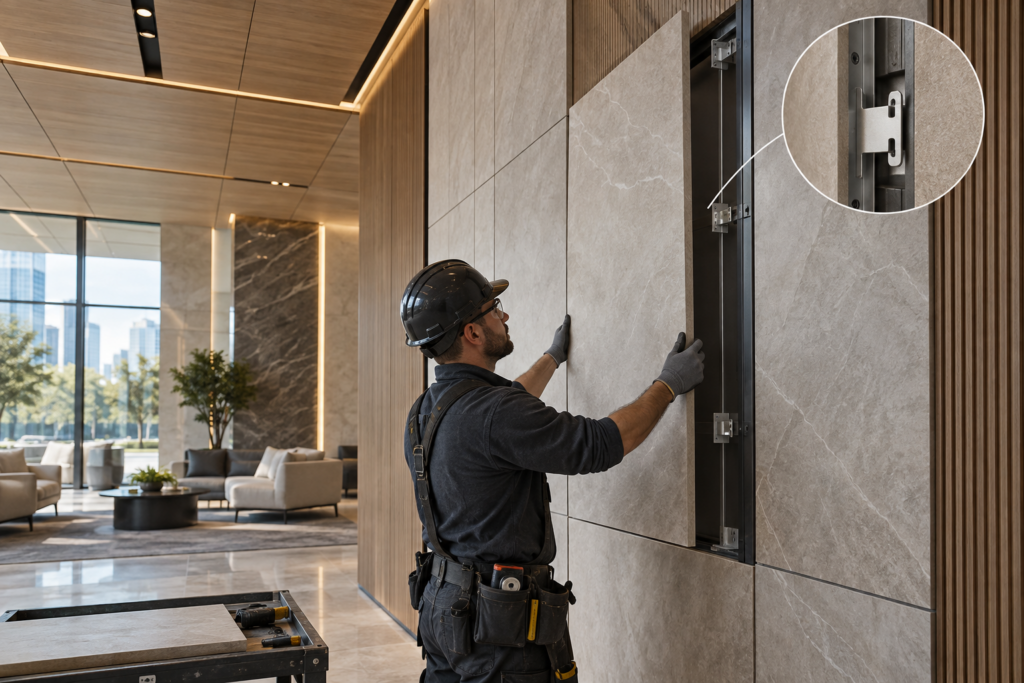
Modern interiors are becoming cleaner, more detailed, and increasingly sophisticated. Architects, interior designers, millworkers, boatbuilders, furniture manufacturers, and contractors often want panels that look perfectly finished while still allowing access to wiring, plumbing, ventilation, mechanical systems, and other services behind them.
That is where a panel mounting system can make a significant difference.
Instead of driving visible screws through a finished panel or permanently bonding the surface with adhesive, a concealed mounting system allows panels to be securely attached while keeping the fixing hardware hidden from view. Depending on the system, panels can also be removed and installed again when maintenance or access is required.
Fastmount, for example, develops hidden panel mounting solutions based on paired clips designed for applications including architecture, marine interiors, furniture, recreational vehicles, and other specialized environments. Its systems are intended to provide concealed fixing, accurate panel alignment, and repeatable removal.
For professionals planning premium interiors, understanding how panel mounting systems work can help improve appearance, installation efficiency, servicing, and long-term flexibility.
This guide explains what a panel mounting system is, where it can be used, how concealed clips work, what benefits they provide, and what you should consider when choosing a solution for your next project.
What Is a Panel Mounting System?
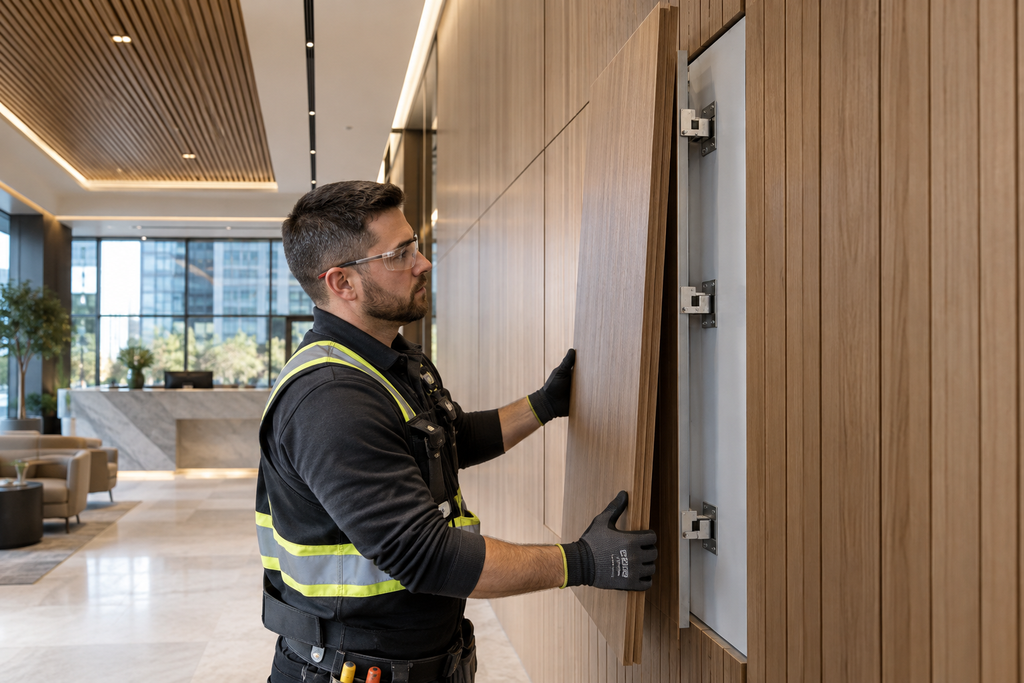
A panel mounting system is a collection of clips, fasteners, rails, or other components used to secure a decorative or functional panel to a supporting structure.
The supporting structure may be:
- Drywall
- Plywood
- MDF
- Timber framing
- Aluminum profiles
- Composite material
- Fiberglass
- Furniture frames
- Marine structures
Different systems are designed for different panel materials, weights, thicknesses, and installation conditions.
Traditional panel installation may rely on screws, nails, permanent adhesives, hook-and-loop materials, or cleats. A purpose-designed concealed system provides another option where clean aesthetics, repeatable alignment, and panel access are priorities.
Fastmount’s system, for example, uses matching mounting components that connect the panel to the substrate without leaving visible fasteners on the finished face. The company’s current ranges include solutions for small and medium panels, larger architectural panels, thin furniture components, textiles, and demanding applications.
How Does a Hidden Panel Mounting System Work?
The exact mechanism depends on the product, but many concealed mounting systems use two mating components.
With Fastmount, the basic concept involves paired male and female clips. One component is fixed to the supporting structure, such as a wall, ceiling, or framework, while the corresponding component is fixed to the back of the panel. When the panel is positioned correctly, the clips engage to create a concealed connection.
Because the fastening mechanism sits behind the panel, the finished surface does not need exposed screw heads or other visible mounting hardware.
Panel-Side Component
One part of the system is installed on the back of the decorative panel.
Depending on the specific mounting range and panel construction, the component may be mechanically fixed, recessed, adhesive mounted, or installed using another specified method.
Substrate-Side Component
The matching component is attached to the wall, framing, plywood, drywall, rail, or other supporting surface.
Correct positioning is important because all fixing points must align when the panel is installed.
Connecting the Panel
Once both sides are correctly positioned, the panel is aligned with its mounting points and pressed or placed into position according to the selected system.
The hidden clips engage behind the panel.
The result is a clean finished surface with the mounting hardware concealed from normal view.
Removing the Panel
One of the major advantages of a removable panel mounting system is access.
Rather than destroying the panel or removing permanent adhesive, compatible panels can be disengaged and then installed again.
Fastmount states that many of its systems allow panels to be removed independently rather than requiring neighboring panels to be removed first. Some products can be removed without tools, while others use dedicated removal tools.
This capability can be particularly useful when electrical equipment, plumbing, HVAC components, audio systems, or other services are located behind finished surfaces.
Why Use a Panel Mounting System?
The best fixing method depends on the project, but concealed mounting systems offer several advantages where aesthetics and serviceability matter.
Clean, Professional Appearance
Visible fasteners can interrupt an otherwise high-quality finish.
Even carefully positioned screws can become noticeable on wood veneer, upholstered panels, decorative composites, painted surfaces, or acoustic wall systems.
A hidden panel mounting system keeps the attachment points behind the finished surface.
The result can create a cleaner visual effect in:
- Luxury homes
- Hotels
- Corporate offices
- Retail spaces
- Restaurants
- Yacht interiors
- RV interiors
- Custom furniture
- Reception areas
- Entertainment spaces
Fastmount identifies concealed fixing and precise alignment as core benefits of its mounting systems.
Easier Access Behind Panels
Many attractive wall and ceiling treatments hide important building services.
Behind a finished panel there might be:
- Electrical wiring
- Lighting components
- Plumbing
- Data cables
- Speakers
- HVAC controls
- Inspection points
- Mechanical equipment
Permanent installation methods can make future access difficult.
Removable panel fasteners allow selected panels to function almost like concealed access doors while maintaining the appearance of the surrounding finish.
Panels Can Be Removed Independently
Some traditional panel mounting methods require installers to start removing panels from one end of a wall or ceiling.
This is known as sequential removal.
A non-sequential mounting arrangement can allow one panel to be removed without first taking down an entire row.
Fastmount specifically promotes non-sequential removal across its hidden mounting solutions, which can be valuable for maintenance and refit work.
Reduced Damage During Maintenance
Removing a permanently glued panel can damage:
- The panel
- The substrate
- Decorative finishes
- Paint
- Veneer
- Surrounding materials
A purpose-designed removable fixing is intended to avoid this problem when used according to its specifications.
That can be especially valuable when panels are expensive, custom-made, prefinished, or difficult to reproduce.
Common Applications for Panel Mounting Systems
A panel mounting system is not limited to ordinary wall paneling.
Different clip types can support a wide variety of interior applications.
Architectural Wall Panels
Architectural interiors are one of the clearest applications for concealed panel fasteners.
Feature walls increasingly use materials such as:
- Timber veneer
- Decorative MDF
- Acoustic panels
- Upholstered panels
- Composite surfaces
- Decorative laminates
- Custom millwork
- Pre-finished panels
Visible fixing hardware may undermine the intended appearance.
Fastmount describes architectural applications that include feature walls, ceiling systems, curved panels, commercial fit-outs, and high-end residential interiors.
A concealed wall panel mounting system can maintain the visual design while providing access behind selected sections.
Ceiling Panels
Ceiling installation presents additional challenges because panels must remain securely supported overhead.
The fixing system must be correctly selected for the panel weight, substrate, orientation, environmental conditions, and applicable safety requirements.
Fastmount offers specific products intended for ceiling applications, while some of its lower-profile ranges are explicitly listed as unsuitable for ceilings. This illustrates why mounting products should always be selected based on their stated application rather than appearance alone.
Where removable ceiling panels are required, an appropriate system can make access to utilities above the ceiling considerably easier.
Marine Interiors
Fastmount originally developed its panel fastening approach for the marine industry.
Marine interiors create special challenges because panels can be affected by movement, vibration, moisture, humidity, and repeated servicing requirements.
Fastmount’s marine mounting systems are used for applications such as:
- Wall panels
- Deckhead panels
- Upholstered panels
- Access panels
- Curved surfaces
- Cushions
The company emphasizes secure mounting and service access as important features in marine environments.
A removable system is especially useful on vessels because important mechanical and electrical services may need to remain accessible without compromising interior appearance.
Furniture Manufacturing
Concealed panel mounting is also useful in custom and commercial furniture.
Applications can include:
- Headboards
- Sofa panels
- Cabinet panels
- Upholstered surfaces
- Bed surrounds
- Decorative furniture components
- Access covers
Very thin furniture panels may require a mounting solution with minimal space between the panel and the supporting surface.
Fastmount’s Very Low Profile range is designed for applications involving furniture and limited-thickness substrates, while its Textile range is intended for upholstery and fabric applications.
Recreational Vehicles
RV and camper interiors need lightweight, secure finishes while still allowing technicians or owners to reach hidden equipment.
Fastmount lists removable wall and ceiling panels and upholstery fastening among the applications for its recreational vehicle systems.
Because RV interiors are exposed to continuous movement and vibration during travel, selecting a fastening solution suited to that environment is important.
Aviation Interiors
Specialized panel fasteners can also appear in aircraft interiors.
Fastmount works with aircraft manufacturers on purpose-designed systems for areas of private aircraft interiors, including interior panels and upholstery.
Aviation applications have strict engineering, material, fire, and certification requirements, so products should never be substituted without appropriate technical approval.
Types of Panel Mounting Systems
Not every panel should use the same fastener.
The correct system depends on panel size, material, weight, substrate, required gap, environment, removal requirements, and other project conditions.
Fastmount currently organizes its products into several specialized ranges.
Standard Panel Mounting Systems
Standard clips are useful for many conventional wall, furniture, and panel applications.
Fastmount describes its Standard Range as intended for small to mid-size panels and furniture, with plywood and MDF among the listed substrates.
This type of solution may suit projects where hidden fixing and repeated removability are needed without heavy-duty structural requirements.
Low Profile Mounting Systems
Low profile systems reduce the distance between the finished panel and the supporting substrate.
This can be important when:
- Space is limited
- The design requires a thin buildup
- Panels are curved
- The finished surface must sit close to the wall
Fastmount lists its Low Profile range for small to medium wall panels and applications where reduced panel-to-substrate space is desired.
Very Low Profile Systems
Furniture, upholstery, and thin panels sometimes provide very little depth for mounting hardware.
Very Low Profile systems are designed for these situations.
According to Fastmount, its Very Low Profile range is particularly suited to furniture and limited-thickness panels and substrates.
Heavy-Duty Panel Mounting
Large architectural panels require different engineering considerations from lightweight decorative covers.
Fastmount’s Stratlock range is designed for large or heavy architectural panels and can be used with a rail system or, in certain configurations, directly on timber battens.
Large panels should always be engineered based on their actual weight, dimensions, substrate, orientation, clip layout, and relevant safety requirements.
Adjustable Panel Mounting
Real construction surfaces are rarely perfectly straight.
Walls may be uneven, framing may vary, and large panels can magnify even small alignment problems.
Adjustable systems can simplify the process of achieving consistent joints and finished surfaces.
Fastmount’s SLX range is designed for drywall and plywood applications and provides multidirectional adjustment for large wall and ceiling panels.
Adjustability can be particularly useful for high-end millwork where small variations are easy to notice.
Metal Panel Fasteners
Some applications require additional strength, material performance, or compatibility with demanding environments.
Fastmount’s Metal Range is designed for robust applications and can be used for wall and ceiling panels, with nickel-plated and stainless-steel versions available.
Always check the technical documentation when fire, corrosion, structural, or code requirements apply.
Textile Fastening Systems
Not every removable surface is a rigid panel.
Upholstered cushions and fabric elements can also benefit from concealed fastening.
Fastmount’s Textile Range includes components designed to attach to fabric and matching mounting surfaces, allowing upholstery and cushions to remain securely positioned while still being removable.
Panel Mounting Systems vs. Traditional Fixing Methods
Understanding the alternatives helps explain why concealed clips are useful.
Screws
Screws are simple, familiar, and widely available.
However, exposed screws may:
- Interrupt premium finishes
- Require caps or plugs
- Damage a decorative face
- Become less secure after repeated removal
For utility areas, screws may still be perfectly appropriate. For luxury architectural surfaces, hidden fixing may produce a cleaner result.
Permanent Adhesive
Adhesive can create an extremely clean appearance because there are no visible fasteners.
The trade-off is access.
A permanently bonded panel may need to be damaged or destroyed during removal.
Adhesive therefore makes more sense when the panel is intended to remain permanently in place, and hidden services do not require future access.
French Cleats
French cleats are useful for hanging cabinets, artwork, and other components.
They generally rely on mating angled profiles.
However, they can require vertical lifting clearance during installation or removal, which may be inconvenient when panels sit closely beside ceilings, floors, or neighboring panels.
A clip-based removable system can offer more flexibility in projects where independent access to individual panels is important.
Hook-and-Loop Fasteners
Hook-and-loop systems are convenient and easy to understand.
For some lightweight applications, they may be sufficient.
More demanding architectural, marine, furniture, or transport installations may require a system engineered for defined substrates and loading conditions.
How to Choose the Right Panel Mounting System
Selecting the right fastener begins with the project rather than the clip.
Fastmount recommends considering factors such as panel weight, thickness, substrate, available space, and application requirements when selecting a system.
Consider Panel Weight and Size
A small upholstered furniture panel and a large architectural wall panel create very different loads.
Do not select mounting hardware based only on the appearance of the clip.
Consider:
- Total panel weight
- Panel dimensions
- Number of mounting points
- Orientation
- Dynamic loads
- Safety requirements
Identify the Substrate
Ask what the fixing will actually attach to.
Possible substrates include:
- Drywall
- MDF
- Plywood
- Timber
- Aluminum
- Fiberglass
- Composite material
The mounting method must be compatible with both the finished panel and the substrate.
Determine the Required Panel Gap
Some fixing systems create more space behind a panel than others.
That gap can affect:
- Finished wall thickness
- Door and trim alignment
- Shadow gaps
- Service cavities
- Acoustic performance
- Adjacent finishes
Fastmount’s different ranges provide different panel-to-substrate spacing, which is one reason several mounting profiles exist.
Think About Future Access
Ask how often the panel is likely to be removed.
An ornamental panel covering a permanent wall may rarely move.
A yacht service panel could be opened regularly.
A commercial access panel might need to be removed every time equipment is inspected.
The greater the need for access, the more valuable repeatable removal becomes.
Consider the Environment
Marine, RV, architectural, furniture, and aviation installations expose fasteners to different conditions.
Consider:
- Humidity
- Vibration
- Temperature
- Corrosion
- Fire requirements
- Movement
- Indoor or outdoor exposure
Use only systems rated and recommended for the intended environment.
Basic Panel Mounting Installation Process
Installation varies by product, but Fastmount describes a general three-stage process: install the substrate-side clips, position corresponding panel clips, and then mount the panel so that the components engage.
Step 1: Plan the Clip Layout
Before drilling or cutting anything, determine where each mounting point will go.
Layout should account for:
- Panel dimensions
- Panel weight
- Edges and corners
- Openings
- Adjacent panels
- Manufacturer spacing recommendations
Step 2: Install the Substrate Components
Install the wall, ceiling, rail, or framework components according to the technical instructions for the chosen mounting range.
Accurate positioning at this stage reduces alignment problems later.
Step 3: Transfer or Establish Panel Locations
The corresponding fixing positions must then be established on the back of the panel.
Fastmount provides dedicated alignment and installation tools for various products to help installers position mating components accurately.
Step 4: Install Panel Components
Attach the panel-side clips using the specified method.
The correct installation method can vary significantly between clip ranges and materials.
Step 5: Mount and Check the Panel
Carefully align the panel and engage the clips.
Check:
- Joint consistency
- Panel level
- Edge alignment
- Surface flushness
- Security
- Removal access
For repeated or large-scale projects, testing the complete method on a sample panel first can prevent expensive mistakes.
Benefits for Architects, Designers, and Contractors
A professional panel mounting system is not simply a hardware choice.
It can influence the entire workflow.
Architects gain more freedom to create uninterrupted finishes.
Designers can specify decorative wall and ceiling surfaces without placing visible screws through the finished face.
Millworkers can prepare panel components accurately off-site.
Contractors can install and adjust panels more efficiently.
Maintenance teams can access building services with less damage.
Property owners may benefit from easier repairs, replacement, refurbishment, and future upgrades.
Fastmount also states that its mounting systems can integrate with CNC workflows, enabling precise manufacturing and repeatable clip positioning in off-site production.
That becomes increasingly relevant as construction moves toward digital fabrication, modular interiors, and prefabricated building components.
Frequently Asked Questions About Panel Mounting Systems
What is a panel mounting system?
A panel mounting system is a set of clips, fasteners, rails, or other components used to attach panels to walls, ceilings, furniture, frameworks, or other substrates. Concealed systems hide the fixing hardware behind the panel for a cleaner finish.
What is a hidden panel mounting system?
A hidden panel mounting system places the fixing mechanism behind the panel instead of through the visible face. This makes it possible to create wall and ceiling finishes without exposed screw heads or brackets.
Can mounted panels be removed?
Yes, when a removable mounting system is used. Fastmount systems are specifically designed to allow compatible panels to be removed and reinstalled, including non-sequential removal in many applications.
Where can panel mounting clips be used?
Depending on the product, panel clips can be used for architectural wall panels, ceilings, furniture, yacht interiors, RVs, upholstery, access panels, and other applications. Fastmount provides dedicated ranges for architecture, marine, furniture, and recreational vehicle projects.
Can panel mounting systems be used on drywall?
Some systems can. Fastmount’s SLX range, for example, is designed for applications involving drywall and plywood. Product compatibility should always be checked before installation.
Can hidden clips support heavy panels?
Some products are specifically designed for larger or heavier panels. Fastmount’s Stratlock and SLX ranges target demanding architectural applications. The required number and type of fixings should be determined from the manufacturer’s technical specifications rather than estimated.
Can panel mounting systems be used on ceilings?
Yes, but only when the selected system is approved for ceiling installation. Some wall and furniture fasteners are not suitable for overhead applications. Always follow the manufacturer’s load, spacing, orientation, and safety guidance.
Are panel mounting systems useful for acoustic panels?
They can be. Concealed mounting may help preserve the appearance of decorative acoustic panels while allowing future access or replacement. The correct solution depends on panel construction, weight, spacing, and acoustic design requirements.
Are hidden panel fasteners suitable for marine interiors?
Purpose-designed systems can be. Fastmount originated in marine panel mounting and provides products for yacht and vessel interiors where vibration, service access, humidity, and clean finishes are important considerations.
How do I choose the correct Fastmount system?
Start with panel weight, size, thickness, substrate, orientation, required panel gap, environment, and removal needs. Fastmount provides technical guides and a product selection tool for choosing an appropriate mounting range.
Conclusion
A well-designed interior should not have to choose between appearance and access.
A modern panel mounting system can provide both.
By hiding the fastening mechanism behind the finished surface, concealed panel clips help architects, designers, contractors, boatbuilders, furniture makers, and manufacturers achieve cleaner walls, ceilings, furniture, and interior finishes.
Removable systems offer another important advantage: panels can be taken down when technicians need access to services and then installed again without relying on visible screws or permanently bonding every surface.
Fastmount’s current product portfolio demonstrates how specialized panel mounting has developed beyond a single universal clip. Its ranges address different panel sizes, thicknesses, substrates, installation gaps, textiles, architectural requirements, marine interiors, furniture, and other applications.
Choosing the correct solution requires careful attention to panel weight, dimensions, substrate, orientation, environmental conditions, required access, and manufacturer specifications.
For decorative interiors, feature walls, removable ceiling panels, luxury marine projects, custom furniture, or serviceable commercial spaces, the right panel mounting system can deliver a combination of precise alignment, hidden fixing, easier maintenance, and long-term design flexibility.
Instead of treating panel attachment as a small detail at the end of a project, designers and installers can consider the mounting strategy early in the planning process. Doing so can simplify installation, protect premium finishes, improve access, and help create interiors that remain functional long after construction is complete.

