
Construction projects often depend on components that must be strong, consistent, practical to install, and capable of performing reliably for years. From drainage infrastructure and road projects to mining operations and agricultural facilities, concrete remains one of the most widely used construction materials for demanding applications.
Precast concrete takes that familiar material and moves much of the production process away from the jobsite and into a controlled manufacturing environment.
Dallcon precast concrete solutions provide a broad range of standard and custom products for civil construction, mining, agriculture, commercial development, industrial projects, drainage systems, and structural applications.
Dallcon is an Australian family-owned business that manufactures its precast products in Western Australia using Australian-sourced materials. Its current range includes box culverts, headwalls, retaining systems, reinforced concrete pipe, structural footings, panels, traffic barriers, L-blocks, T-blocks, agricultural products, and custom precast components.
For U.S. readers researching precast construction, it is important to note that Dallcon primarily serves Western Australia. Products designed to Australian and Main Roads Western Australia requirements should not automatically be assumed to satisfy U.S. codes such as ACI, ASTM, AASHTO, or state DOT specifications. Nevertheless, Dallcon provides a useful example of how specialized precast manufacturing can support large civil, mining, agricultural, and infrastructure projects.
This guide explains what Dallcon precast concrete solutions include, how precast concrete can benefit construction projects, and what contractors, engineers, developers, and infrastructure professionals should consider when evaluating precast products.
What Are Precast Concrete Solutions?
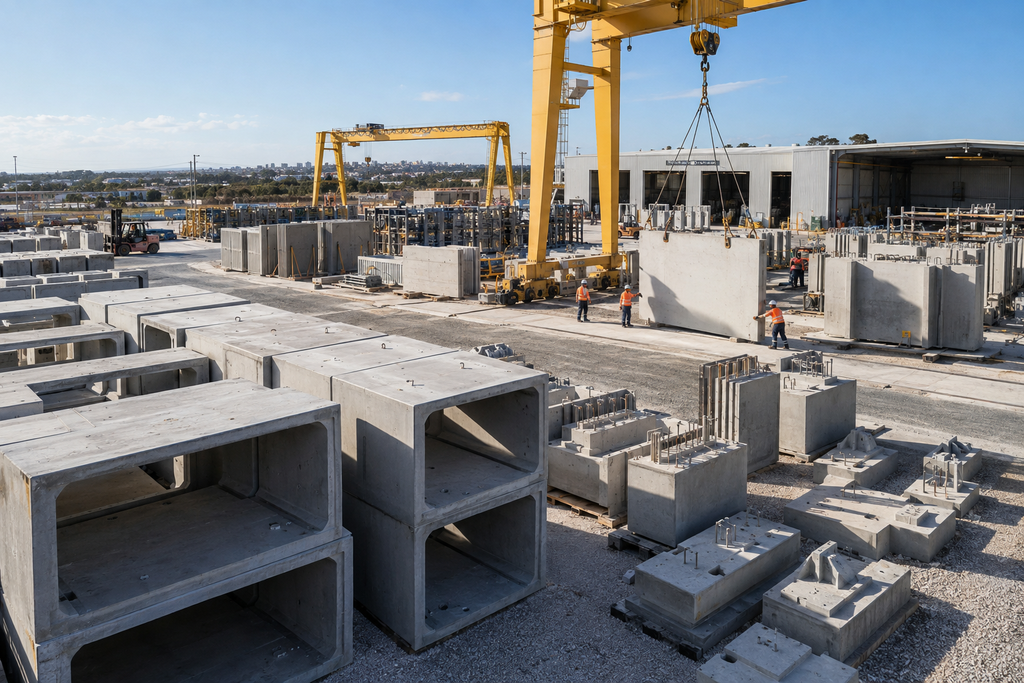
Precast concrete components are manufactured in a controlled facility before being transported to their final construction site.
Instead of building forms, placing reinforcement, pouring concrete, curing the material, and removing forms entirely at the jobsite, manufacturers can complete much of that work before delivery.
Typical precast products may include:
- Wall panels
- Box culverts
- Drainage components
- Retaining walls
- Structural footings
- Barriers
- Beams
- Foundations
- Headwalls
- Pits and risers
- Agricultural structures
- Custom engineered components
This approach can reduce the amount of concrete construction that has to take place under changing jobsite conditions.
Dallcon manufactures both standard and project-specific precast products. Its official range serves civil, mining, agricultural, commercial, industrial, irrigation, transport, and structural applications.
Understanding Dallcon Precast Concrete Solutions
Dallcon operates manufacturing and distribution facilities in Western Australia and provides product supply, delivery, and installation services throughout the state.
The company states that it has supplied precast concrete products for major Western Australian resource and infrastructure projects, including Wheatstone, Gorgon, Roy Hill, Iron Bridge Magnetite, and other mining and civil developments.
Its product strategy can broadly be divided into two categories.
Standard Precast Concrete Products
Standard products are manufactured in established sizes and configurations for commonly encountered construction needs.
These can simplify procurement when the design fits an existing product range.
Dallcon’s standard offerings include products such as:
- Box culverts
- Pipe headwalls
- Box culvert headwalls
- Reinforced concrete pipes
- Retaining wall systems
- Structural footings
- Concrete panels
- L-blocks
- T-blocks
- Traffic barriers
- Pits, risers, and lids
- Loading ramps
- Cattle grids
- Feed troughs
- Modular flooring
- Boat ramp components
Having standard configurations can help project teams identify a practical precast solution without developing every component from the beginning.
Custom Precast Concrete
Standard sizes cannot solve every engineering problem.
Infrastructure, mining, agriculture, and industrial projects often involve unusual dimensions, loading conditions, site restrictions, or installation requirements.
Dallcon therefore also manufactures custom precast products.
Its custom portfolio includes concrete walls, custom headwalls, blast walls, loading ramps, panels, pits, shed fit-outs, stairs, and other project-specific components.
Custom manufacturing allows engineering requirements to shape the concrete element rather than forcing the project around a standard product.
Major Types of Dallcon Precast Concrete Products
One of the main strengths of Dallcon precast concrete solutions is the variety of applications covered by the company’s catalog.
Precast Concrete Box Culverts
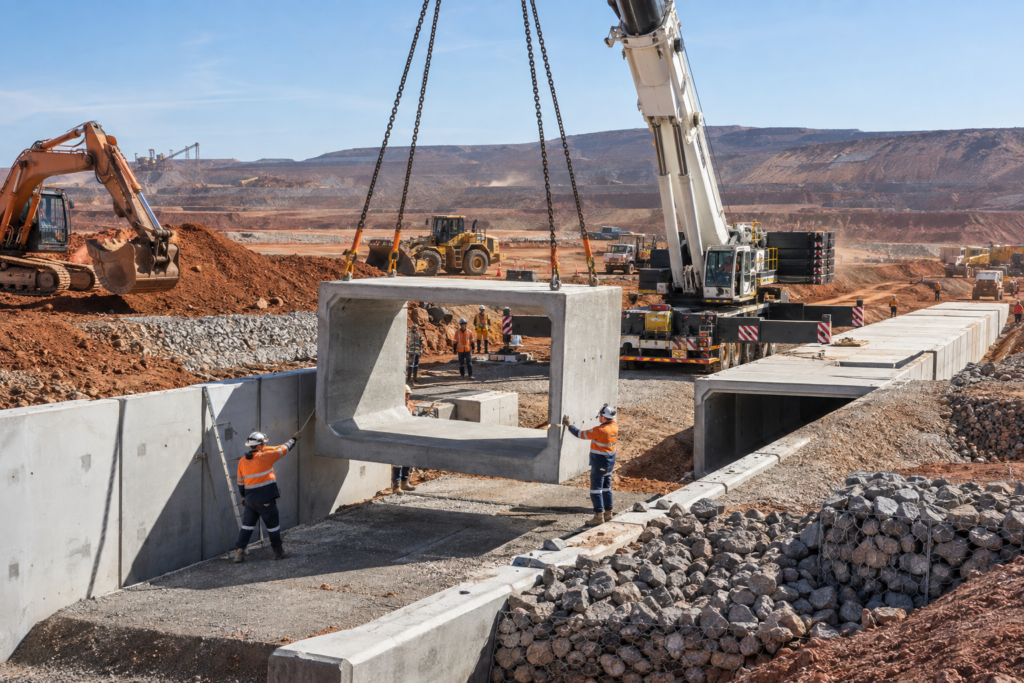
Box culverts are frequently used to allow water, utilities, vehicles, pedestrians, or other services to pass beneath roads, railways, embankments, and similar structures.
Dallcon manufactures reinforced concrete box culverts in standard and custom configurations.
According to the company’s current product information, its Western Australian box culverts are designed and manufactured to applicable AS 1597 requirements and Main Roads WA specifications. They can be used in conventional crown configurations or inverted with precast lids.
Applications listed by Dallcon include:
- Road crossings
- Watercourse diversion
- Pedestrian subways
- Utility tunnels
- Access shafts
- Attenuation systems
- Sea outfalls
- Civil drainage systems
For U.S. projects, engineers would need to select products designed to the relevant American standards and local transportation requirements rather than directly applying Australian specifications.
Why Precast Culverts Can Be Useful
Constructing drainage structures completely on site can require significant formwork, reinforcement placement, concrete pouring, curing, and weather management.
Precast culvert sections arrive with much of that process already completed.
Once site preparation and foundations are ready, crews can position individual sections using suitable lifting equipment.
The result can reduce on-site concrete operations and simplify certain installation schedules.
Precast Headwalls
Headwalls are installed around culvert and drainage openings to stabilize the surrounding area, support pipe interfaces, and help manage water movement.
Dallcon manufactures both pipe headwalls and box culvert headwalls.
Its pipe headwall range includes standard options for multiple pipe diameters, along with custom multi-segment and multi-cell configurations. The company’s current pipe headwall page lists heavily reinforced units manufactured from 50 MPa concrete for its specified applications.
Possible uses include:
- Stormwater systems
- Road drainage
- Bridges
- Driveway crossings
- Pedestrian infrastructure
- Irrigation systems
- Rail infrastructure
A well-designed headwall can help create a more controlled transition between a drainage pipe and the surrounding earth or open channel.
Precast Retaining Wall Systems
Retaining structures are used when soil, aggregate, stored materials, or other loads need to be supported at different elevations.
Dallcon manufactures precast retaining wall systems for civil, industrial, agricultural, mining, and material-storage applications.
Its current system includes reinforced precast units with multiple heights and finish options. The company lists tapered and stepped configurations and notes that its system uses bolt-together brackets.
Potential applications include:
- Earth retention
- Bulk material storage
- Industrial yards
- Mining operations
- Agricultural facilities
- Landscape grading
- Civil infrastructure
Drainage Still Matters
A strong concrete retaining wall does not eliminate the need for proper drainage.
Water accumulating behind a wall can increase lateral pressure and affect long-term performance.
Engineers must consider soil properties, drainage, loading, foundation conditions, wall height, nearby structures, and local design requirements before selecting a retaining system.
Structural Footings and Foundations
Precast structural footings can reduce the amount of formwork and concrete placement required at remote or congested project sites.
Dallcon manufactures standard and custom structural footing systems for mining, civil, and industrial applications.
A notable example is the Mt Webber mine project in Western Australia’s Pilbara region.
Dallcon reports that it supplied approximately 130 precast structural foundations totaling around 450 cubic meters of concrete for the project. Some individual components weighed approximately 30 metric tons.
Large precast foundation units demonstrate one of the broader advantages of factory production: complex reinforcement, embedded hardware, dimensional control, and curing can be handled before heavy components arrive at the jobsite.
Precast Wall Panels
Precast concrete panels can be used in industrial buildings, storage facilities, commercial structures, agricultural buildings, retaining applications, and other developments.
Dallcon manufactures both standard and custom wall panels, including concrete shed panels and tilt-up-style products.
Concrete panels may offer benefits such as:
- Durable wall construction
- Low routine maintenance
- Resistance to weather exposure
- Fast installation once site preparation is complete
- Compatibility with large industrial buildings
- Custom sizing for project requirements
Dallcon specifically promotes its shed panel range for workshops, storage buildings, agricultural sheds, garages, and related structures.
Concrete Traffic Barriers
Precast concrete barriers can provide traffic separation, access control, temporary road management, and protection around construction or industrial areas.
Dallcon supplies standard concrete traffic barriers as well as custom-sized products.
Applications can include:
- Road construction
- Work zones
- Industrial facilities
- Mining operations
- Site entrances
- Hazard separation
- Temporary traffic management
Its current product information describes standard 4-meter barrier sections and connecting hardware intended for its Australian market.
Again, transportation barriers are safety-critical products. U.S. users should rely on barriers tested and approved for the applicable federal, state, or local roadway requirements.
L-Blocks and T-Blocks
L-shaped and T-shaped precast blocks are highly versatile because they can create strong retaining and containment structures without conventional cast-in-place walls.
Potential uses include:
- Aggregate storage
- Grain and feed storage
- Mining materials
- Landscape retention
- Industrial separation
- Waste-management areas
- Agricultural facilities
Because precast units can often be moved or configured according to site requirements, they may offer more flexibility than permanently poured structures for certain applications.
Agricultural Precast Concrete Products
Agriculture has its own infrastructure requirements.
Concrete products used on farms and livestock operations may experience repeated impact, water exposure, soil contact, machinery traffic, and intensive day-to-day use.
Dallcon produces agricultural products such as:
- Cattle troughs
- Feed troughs
- Loading ramps
- Cattle grids
- Shed panels
- Retaining systems
- L-blocks
- T-blocks
The company notes that its agricultural range has been developed with practical regional farming requirements in mind.
Concrete Cattle Grids
Cattle grids allow vehicles to cross boundary points while discouraging livestock from moving through the same opening.
Dallcon manufactures concrete and steel cattle-grid components and states that its Australian cattle grids are engineered for the relevant Main Roads WA requirements.
This is another example of precast concrete being used beyond conventional buildings.
Why Precast Concrete Is Used in Civil Construction
Precast concrete is not automatically the best choice for every job.
However, certain characteristics make it attractive for infrastructure and industrial projects.
Controlled Manufacturing Conditions
Weather can complicate site-poured concrete.
High temperatures, low temperatures, rain, wind, access restrictions, or remote locations may affect construction planning.
Factory manufacturing allows formwork, reinforcement, concrete placement, curing, and quality procedures to be managed in a more controlled setting.
Dallcon states that its products are manufactured at its Western Australian facilities under documented quality processes. The company also identifies itself as ISO 9001 certified.
Consistent Production
Repeated infrastructure components benefit from dimensional consistency.
Examples include:
- Culvert sections
- Wall panels
- Barriers
- Pipes
- Blocks
- Footings
Producing components in reusable molds can help maintain consistent geometry across multiple units.
Less Site Formwork
Traditional cast-in-place concrete often requires crews to build forms at the project location.
Precast concrete shifts much of this work to the manufacturing plant.
The jobsite can therefore focus more heavily on excavation, foundations, lifting, positioning, connections, backfilling, and finishing.
Potential Schedule Benefits
Concrete needs time to achieve the required strength.
With precast manufacturing, site preparation can sometimes occur while concrete components are being produced elsewhere.
When the site is ready, cured components can then be delivered for installation.
Dallcon’s Telfer mining project demonstrates this approach. The company reports that it designed, cast, cured, and supplied 18 precast slabs and footings under a four-week project timeline.
Actual schedule savings always depend on design approvals, production capacity, transportation, crane availability, site access, and installation planning.
Dallcon Precast Concrete Solutions for Mining
Mining infrastructure often requires extremely durable components in remote locations.
Precast construction can be attractive because substantial portions of the concrete work can be completed before products arrive at the mine site.
Dallcon supplies mining applications such as:
- Structural foundations
- Footings
- Ramp slabs
- Retaining walls
- Culverts
- Drainage components
- Traffic barriers
- Material storage systems
- Custom structural products
The company’s project portfolio includes work associated with Iron Bridge Magnetite, Telfer, Mt Webber, Roy Hill, and other Western Australian resource projects.
Remote-Site Advantages
Remote projects can make labor, formwork, concrete batching, and curing logistics more difficult.
Precasting selected elements can shift those activities to a dedicated facility.
Heavy transport and crane operations still require careful planning, but the amount of construction activity required at the final location may be reduced.
Custom Precast for Specialized Projects
One of the most useful aspects of precast construction is that it does not have to be limited to catalog items.
Custom molds, reinforcement layouts, cast-in hardware, lifting points, openings, connection details, and dimensions can be incorporated during manufacturing.
Dallcon offers custom manufacturing for products including:
- Precast walls
- Custom panels
- Custom headwalls
- Blast walls
- Loading ramps
- Concrete pits
- Shed fit-outs
- Stairs
- Structural elements
Custom precast becomes particularly valuable when a project needs repeated specialized components.
Once engineering and production methods are established, identical or related units can be manufactured under controlled conditions.
Transportation and Installation Considerations
Precast concrete solves some problems while creating others.
One of the biggest considerations is logistics.
Concrete is heavy.
Large products may require:
- Specialized trucks
- Oversize transport planning
- Cranes
- Certified lifting equipment
- Suitable access roads
- Site storage space
- Carefully planned installation sequences
The largest practical precast component is therefore not always the largest component that can technically be manufactured.
Transportation and lifting limitations need to be considered during design.
Dallcon provides delivery and installation services across Western Australia, which allows manufacturing and project logistics to be coordinated as part of its service offering.
Choosing a Precast Concrete Supplier
Whether a project is in Australia, the United States, or elsewhere, several questions should be considered when selecting a precast partner.
Can the Supplier Meet the Required Standards?
Always determine which standards govern the project.
For a U.S. project, these could include requirements from:
- ACI
- ASTM International
- AASHTO
- PCI
- State transportation departments
- Local building codes
- Project-specific engineering specifications
Dallcon products discussed in this article are manufactured for the Australian market and may reference Australian Standards and Main Roads Western Australia specifications.
Those requirements should not be treated as substitutes for U.S. approval.
Does the Manufacturer Offer Custom Engineering?
Standard products are efficient when they fit the job.
When they do not, custom manufacturing capability becomes important.
Ask whether the supplier can coordinate:
- Shop drawings
- Reinforcement requirements
- Embedded components
- Lifting design
- Custom molds
- Penetrations
- Connection details
- Special finishes
Can Logistics Be Managed?
Manufacturing is only part of the precast process.
The finished component must arrive safely and be installed correctly.
Discuss:
- Product weight
- Transport routes
- Delivery sequence
- Crane requirements
- Site access
- Lifting points
- Storage areas
- Installation support
Before manufacturing begins.
Frequently Asked Questions About Dallcon Precast Concrete Solutions
What are Dallcon precast concrete solutions?
Dallcon precast concrete solutions include standard and custom concrete products manufactured for civil, mining, agricultural, commercial, industrial, drainage, and structural applications. Its range includes culverts, headwalls, panels, retaining systems, footings, pipes, blocks, barriers, and custom concrete components.
Where is Dallcon located?
Dallcon operates in Western Australia. Its current locations include a production facility in Dalwallinu, a metro depot in Kewdale, and a northwest depot in Karratha.
Does Dallcon manufacture custom precast concrete?
Yes. Dallcon manufactures custom panels, walls, headwalls, pits, ramps, stairs, blast walls, shed components, and other purpose-designed precast products.
What industries does Dallcon serve?
Dallcon primarily serves civil construction, mining, agriculture, commercial, and industrial sectors in Western Australia.
Does Dallcon manufacture concrete box culverts?
Yes. Dallcon manufactures standard and custom reinforced concrete box culverts for drainage, transportation, civil infrastructure, mining, and related applications.
Does Dallcon make retaining walls?
Yes. Its precast retaining range includes reinforced systems available in multiple heights and configurations for civil, industrial, agricultural, mining, and material-retention applications.
Can precast concrete reduce construction time?
It can reduce certain on-site activities because concrete elements are manufactured and cured before installation. However, overall project duration still depends on engineering, approvals, manufacturing capacity, transportation, crane access, site preparation, and installation requirements.
Is precast concrete suitable for mining projects?
Yes. Precast concrete is commonly used for foundations, drainage, retaining systems, slabs, barriers, and other mining infrastructure. Dallcon has supplied precast components to several major mining projects in Western Australia.
Are Dallcon products available in the United States?
Dallcon’s official information focuses on manufacturing, delivery, and installation throughout Western Australia. U.S. buyers should not assume domestic U.S. availability or code compliance without confirming those matters directly with the company.
Do Australian precast standards apply to U.S. construction?
Not automatically. U.S. projects typically need to comply with applicable federal, state, local, ACI, ASTM, AASHTO, PCI, DOT, and project-specific requirements. Australian product specifications should therefore be evaluated separately by qualified professionals before any international application.
Conclusion
Precast concrete can provide an efficient way to manufacture strong, repeatable construction components away from the final jobsite.
Dallcon precast concrete solutions demonstrate how this manufacturing approach can be applied across civil infrastructure, mining, agriculture, industrial construction, drainage, retaining systems, structural foundations, transportation projects, and custom engineering.
The company’s current portfolio includes box culverts, headwalls, structural footings, reinforced concrete pipe, wall panels, L-blocks, T-blocks, traffic barriers, retaining systems, agricultural products, and purpose-built precast components.
Dallcon also brings experience from major Western Australian resource and infrastructure developments, where precast elements have been used for foundations, bridges, ramps, drainage structures, panels, and other specialized construction needs.
For contractors, developers, engineers, and project managers, the main advantage of precast construction is not simply that concrete is produced somewhere else. The real value comes from combining controlled manufacturing with practical transportation, efficient installation, repeatable quality, and designs tailored to the project.
Custom precast capability adds another level of flexibility. Instead of restricting a project to standard shapes and dimensions, specialized molds, reinforcement, connections, openings, lifting points, and structural requirements can be incorporated into the manufacturing process.
Successful precast construction still requires detailed planning. Engineers must consider structural loading, drainage, foundation conditions, transportation, crane capacity, installation sequence, connection details, and applicable codes before production begins.
For U.S. readers evaluating Dallcon precast concrete solutions as an example of international precast manufacturing, the distinction between markets is important. Dallcon’s products are primarily manufactured for Western Australian projects and may follow Australian Standards and Main Roads WA specifications. American construction projects should use components engineered and approved for the applicable U.S. codes and project requirements.
When product engineering, manufacturing, transportation, and installation are coordinated correctly, precast concrete can provide a durable and practical solution for some of the most demanding construction environments.

