
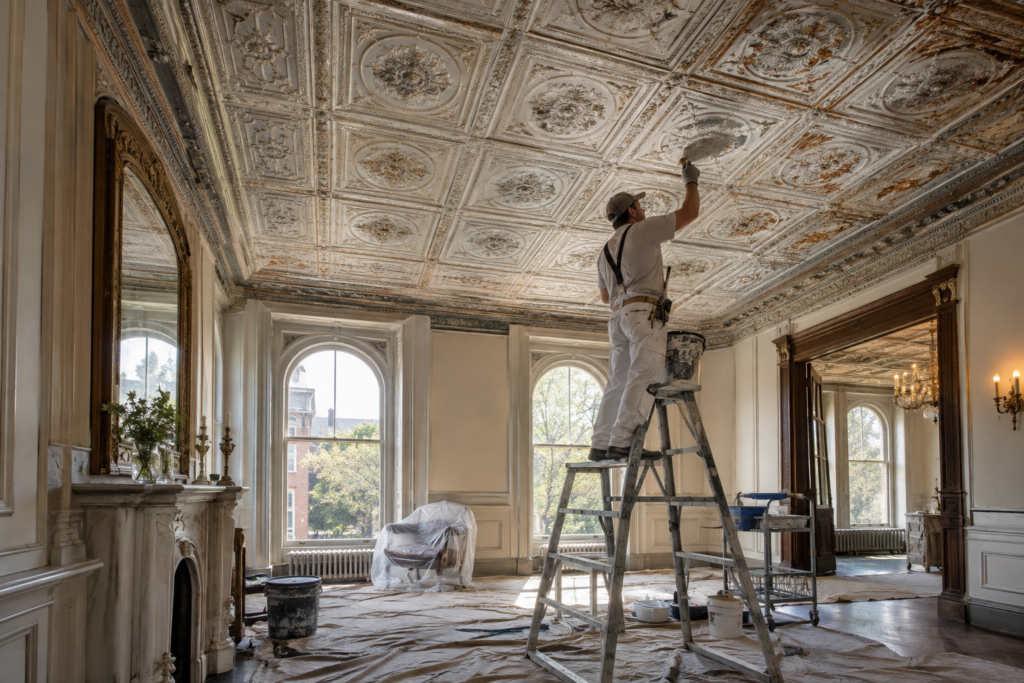
At first glance, painting a ceiling may seem like a simple calculation: measure the square footage, choose a paint, estimate the labor, and produce a quote.
That approach works reasonably well for a smooth drywall ceiling in good condition. It becomes much less accurate when the ceiling is made from decorative pressed steel.
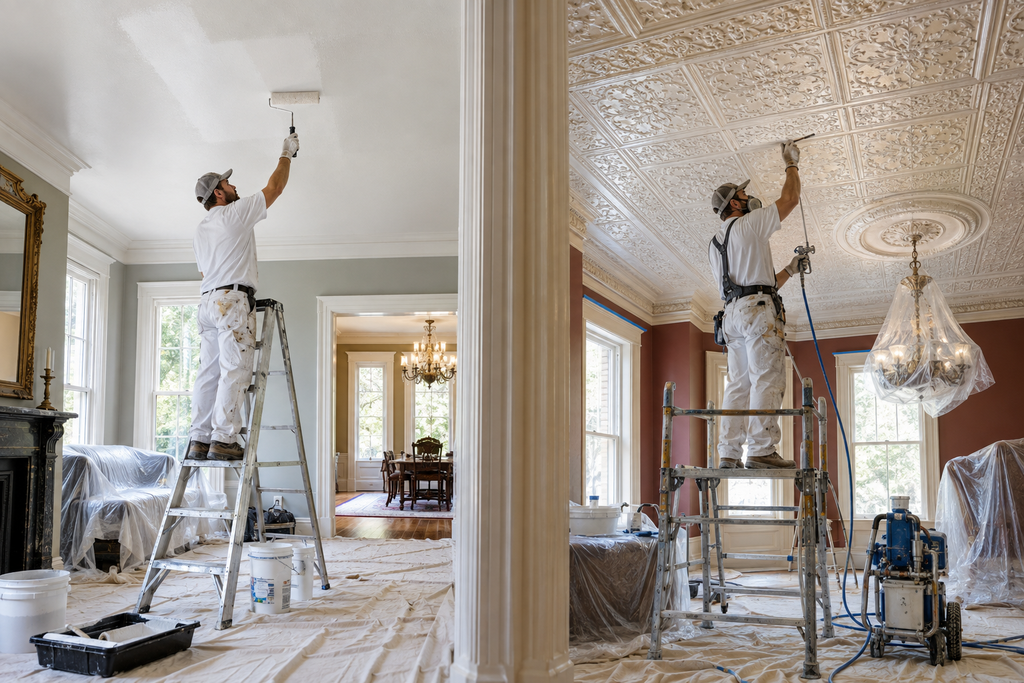
There is a good reason to see a pressed-steel repaint priced apart from a flat ceiling coat. The two surfaces may occupy exactly the same number of square feet, but the work required to prepare, prime, paint, and protect them can be completely different.
A flat drywall ceiling is usually an interior decorating project. A deteriorated pressed-metal ceiling may be closer to a combination of painting, corrosion control, detailed surface preparation, and architectural restoration.
The distinction is especially important in older American homes, storefronts, restaurants, churches, hotels, offices, and commercial buildings where historic decorative metal ceilings remain in place.
The National Park Service notes that pressed or stamped metal ceilings became widely used in the United States during the late 19th and early 20th centuries. Although they are commonly called “tin ceilings,” many surviving examples are actually pressed steel. They appeared in homes as well as shops, offices, restaurants, churches, manufacturing buildings, and other properties.
When one of these ceilings needs repainting, its square footage tells only part of the pricing story.
Surface condition, corrosion, layers of old paint, embossed detail, ceiling height, access requirements, primer selection, application technique, masking, preservation goals, and possible lead-based paint can all influence the final scope.
Understanding those differences helps homeowners and property managers compare quotes more intelligently and avoid treating specialized restoration work as if it were a routine ceiling repaint.
What Is a Pressed-Steel Ceiling?
A pressed-steel ceiling is constructed from thin decorative metal sheets formed in dies or presses to create repeating patterns.
Patterns can range from relatively simple geometric designs to elaborate floral motifs, borders, cornices, medallions, and deeply embossed Victorian-inspired details.
In the United States, these ceilings are commonly referred to as:
- Tin ceilings
- Pressed tin ceilings
- Pressed metal ceilings
- Stamped metal ceilings
- Decorative steel ceilings
- Victorian metal ceilings
Historically, the term “tin ceiling” became common, but National Park Service preservation guidance explains that most surviving decorative metal ceilings were made from steel rather than tin-plated material. Steel became especially common by the 1890s because it could be pressed into thin sheets with significant decorative relief.
That distinction matters when repainting.
Steel can corrode when moisture reaches the metal. A painter therefore may need to deal with rust and coating adhesion issues that simply do not exist on ordinary gypsum drywall.
Why a Pressed-Steel Repaint Is Different From a Flat Ceiling Coat
The easiest way to understand the pricing difference is to compare the job sequences.
A flat ceiling in good condition may require:
- Moving or covering furniture
- Protecting floors and walls
- Light cleaning
- Minor patching
- Spot priming where required
- Cutting around edges
- Rolling or spraying one or two finish coats
- Cleanup
A pressed-steel ceiling can require additional stages:
- Inspecting the metal and fasteners
- Checking for loose or failing coatings
- Evaluating corrosion
- Testing older coatings when appropriate
- Carefully removing unstable paint
- Treating rusted sections
- Cleaning embossed recesses
- Repairing loose, dented, or damaged panels
- Applying a compatible metal primer
- Painting intricate profiles
- Checking recesses for missed areas
- Applying additional finish coats as necessary
- Cleaning up restoration debris and masking
The referenced pressed-steel ceiling guide makes the same fundamental distinction: metal restoration requires corrosion treatment and appropriate primer before the final decorative coat, while ornate relief also increases application time.
In other words, contractors are not necessarily charging more simply because a ceiling “looks fancy.” They may be performing a substantially different scope of work.
Flat Ceiling Painting Is Primarily About Coverage
A smooth drywall ceiling generally presents a broad, relatively uniform surface.
Once cracks, stains, nail pops, or small imperfections have been addressed, a professional painter can often cover large sections efficiently with a roller or airless sprayer.
According to Angi’s 2026 U.S. ceiling-painting guide, smooth or flat ceiling painting commonly falls within a broad range of roughly $0.50 to $3 per square foot, although actual pricing changes with location, size, access, surface condition, and other project factors.
That benchmark should not automatically be applied to decorative pressed steel.
A contractor painting 300 square feet of smooth drywall can often work at a much faster production rate than someone carefully restoring 300 square feet filled with embossed flowers, narrow grooves, decorative borders, rust spots, and decades of previous coatings.
Square footage may be equal. Labor is not.
Surface Preparation Is the Biggest Difference
Professional painting depends heavily on preparation.
With pressed steel, preparation can become the most important part of the entire project.
Loose Paint Must Be Addressed
Applying new paint over poorly bonded old coatings does not repair the underlying failure.
If several layers of old paint are peeling, cracking, blistering, or separating from the metal, the contractor may have to remove unstable material before applying new coatings.
Decorative relief makes that job slow.
A large flat surface can often be sanded or scraped systematically. Pressed steel contains corners, recesses, ridges, seams, floral shapes, and other details that may require smaller hand tools and careful techniques.
Aggressive preparation can also damage thin historic metal or soften decorative features.
Rust Changes the Scope
Rust is another reason a pressed-steel repaint needs its own price.
Painting directly over active corrosion may hide it temporarily without solving the underlying problem.
Depending on the coating system and condition, preparation can involve removing loose rust, stabilizing the surface, cleaning exposed metal, and applying a compatible corrosion-resistant primer.
The National Park Service advises that after historic pressed metal has been cleaned and properly prepared, a metal primer should be applied promptly to cleaned steel.
The referenced ceiling-cost guide similarly identifies corrosion treatment and metal primer as key differences between pressed-steel painting and ordinary interior ceiling work.
Grease and Contamination Can Affect Adhesion
Metal surfaces may also contain contaminants.
Older ceilings located in kitchens, restaurants, commercial spaces, workshops, or buildings previously heated with certain fuel systems can accumulate grease, dirt, soot, and other residue.
Paint performs best when the surface underneath is properly prepared.
Cleaning can therefore become a separate labor stage rather than a quick dusting before painting.
Ornate Relief Slows Painting
One of the biggest attractions of a pressed-metal ceiling is also one of the reasons it costs more to repaint: detail.
A roller moves quickly across smooth drywall.
Now imagine moving that same roller across deeply embossed leaves, flowers, borders, ridges, recessed squares, rosettes, and overlapping panel seams.
Coverage becomes less predictable.
Paint may collect heavily on raised sections while failing to reach deep recesses.
Brushwork May Be Required
Detailed areas may need to be brushed carefully so paint reaches the recesses without building up excessively over the pattern.
Too much coating can gradually soften the crisp appearance of decorative relief, especially on a ceiling that has already accumulated multiple layers during its lifetime.
The original pressed-steel cost guide recommends careful brushwork around detailed relief and notes that intricate profiles increase labor.
Spraying Can Improve Coverage
Airless spray application may be appropriate for some metal ceiling projects.
Spraying can reach complex contours efficiently and reduce the roller pressure applied to detailed surfaces.
However, spraying creates another cost category: preparation.
Walls, floors, windows, lights, furniture, trim, doors, HVAC registers, fixtures, and adjacent surfaces may need extensive masking.
A large open commercial room can be relatively straightforward to prepare for spraying. A furnished historic dining room with elaborate trim and valuable flooring may require much more protection.
Application speed should therefore never be considered separately from setup time.
Metal Primer Is Not the Same as Ordinary Ceiling Primer
Standard ceiling painting frequently uses drywall primer, stain-blocking primer, or no full primer coat at all when the existing finish is sound.
Bare or corroded steel has different requirements.
The primer must be compatible with:
- The metal
- Existing coatings
- Surface-preparation method
- Topcoat
- Interior environment
- Corrosion conditions
Products designed specifically for metal may provide corrosion resistance and adhesion properties that ordinary wallboard primers do not.
Sherwin-Williams, for example, markets dedicated rust-inhibitive metal primers specifically for situations in which corrosion resistance and adhesion to metal are required.
The exact coating system should be selected according to the actual substrate and product manufacturer’s instructions.
That extra product selection and application is another reason a metal repaint should not simply inherit the rate used for a flat drywall ceiling.
Existing Paint Layers Can Make the Job More Complicated
Historic ceilings may have been repainted many times.
One room might contain:
- Original primer
- Multiple generations of oil-based paint
- Later latex coatings
- Decorative color layers
- Local repairs
- Water stains
- Corrosion spots
The contractor must determine whether the existing layers are sufficiently sound to remain.
Complete paint removal is not automatically necessary.
In preservation work, retaining sound historic material can often be preferable to aggressive stripping. However, unstable layers may need targeted removal before repainting.
The appropriate decision depends on condition, preservation goals, coating compatibility, and safety concerns.
Lead Paint Must Be Considered in Older U.S. Buildings
This is especially important for American properties with historic pressed-metal ceilings.
The federal government banned consumer use of lead-based paint in residential applications in 1978, and EPA says many pre-1978 homes still contain lead-based paint. Renovation, repair, and painting activities that disturb those surfaces can create hazardous lead-containing dust.
Pressed-steel ceilings frequently occur in buildings that are much older than 1978.
That does not prove a particular ceiling contains lead, but it makes the issue worth considering before sanding, scraping, grinding, or stripping old coatings.
EPA Requirements Can Affect Professional Work
EPA’s Renovation, Repair and Painting Rule generally requires firms paid to disturb painted surfaces in qualifying pre-1978 housing and child-occupied facilities to be certified and to use lead-safe work practices. EPA recommends that homeowners planning relevant renovations in pre-1978 homes use lead-safe certified contractors.
This can add legitimate project requirements involving:
- Containment
- Protective procedures
- Dust control
- Specialized cleanup
- Recordkeeping
- Worker training
Therefore, a very low painting quote based on aggressive dry sanding of an old decorative ceiling may deserve closer examination.
Ceiling Height and Access Affect Pricing
Pressed-metal ceilings often appear in historic buildings with high rooms.
A 9-foot residential ceiling is different from a 14-foot Victorian parlor ceiling or a tall commercial storefront.
Higher ceilings may require:
- Taller ladders
- Rolling scaffold
- Staging
- Elevated work platforms
- Additional setup
- Additional protection
- More time moving equipment
Angi identifies ceiling height and specialized access equipment as factors that can increase U.S. ceiling-painting costs.
Access can become even more significant when workers must spend long periods preparing small decorative details rather than making a few quick roller passes.
Repairs Should Be Separated From Painting
Not every pressed-steel ceiling is ready for paint.
Before repainting, an inspection may reveal:
- Loose panels
- Missing fasteners
- Corroded edges
- Open seams
- Dents
- Holes
- Previous patchwork
- Water damage
- Detached cornice sections
- Missing decorative pieces
These issues should ideally appear as separate line items in the quote.
Combining repairs into a single vague “painting” price makes it difficult to compare contractors.
One company may plan only to paint over the existing surface, while another may include extensive stabilization, repair, rust treatment, and primer.
The second quote can be substantially higher while actually representing much more work.
How a Pressed-Steel Repaint Should Be Quoted
Rather than asking only for a price per square foot, request a written scope.
A useful quotation should identify major stages.
1. Ceiling Area
The contractor should establish the approximate square footage.
Area remains important because it influences material quantities and overall labor.
2. Condition Assessment
The estimate should describe major visible conditions such as:
- Sound existing coating
- Localized peeling
- Widespread coating failure
- Minor surface rust
- Extensive corrosion
- Damaged panels
- Water staining
3. Surface Preparation
Ask what preparation is included.
“Prep ceiling” is vague.
A clearer scope might specify cleaning, scraping loose coating, hand preparation of decorative recesses, rust treatment, and feathering edges.
4. Lead-Safe Procedures Where Applicable
For qualifying pre-1978 properties, clarify whether work will disturb existing paint and whether EPA RRP requirements apply.
5. Primer
The quote should state whether the ceiling receives:
- Spot primer
- Full primer coat
- Rust-inhibitive primer
- Bonding primer
- Another specialized product
6. Finish Coats
Ask how many finish coats are included.
One contractor’s low quote may include one coat while another includes two.
7. Application Method
The estimate should indicate whether the ceiling will be:
- Brushed
- Rolled
- Sprayed
- Sprayed and back-brushed
- Finished using a combination of methods
8. Access Equipment
Scaffold or other specialized access should be clearly included or excluded.
9. Protection and Masking
Clarify who is responsible for protecting:
- Floors
- Walls
- Crown molding
- Furniture
- Lighting
- Windows
- Cabinets
- Architectural woodwork
10. Cleanup
Restoration creates more debris than simply rolling a fresh ceiling coat.
Cleanup expectations should be written into the scope.
Why Per-Square-Foot Comparisons Can Be Misleading
Imagine two 200-square-foot rooms.
Room A has an 8-foot smooth drywall ceiling in sound condition.
Room B has a 12-foot decorative steel ceiling installed around 1905 with embossed floral panels, peeling paint around several seams, small rust areas, and multiple previous coatings.
Both ceilings measure 200 square feet.
They are clearly not the same painting project.
Room A may primarily require masking and finish painting.
Room B could require inspection, special access, lead-safe precautions, careful preparation, corrosion treatment, metal primer, detailed application, and extensive masking.
This is why applying one generic ceiling-painting rate across both rooms can produce a misleading estimate.
What Makes a Pressed-Steel Ceiling Quote Rise?
Several factors can push the price upward.
Heavy Rust
More corrosion generally means more preparation and possibly more repair.
Severe corrosion can also reveal that moisture is still entering from somewhere above the ceiling.
The moisture source should be corrected before cosmetic restoration.
Heavy Paint Buildup
Many old layers can obscure detail and create adhesion problems.
Removing or stabilizing them can be slow.
Deeply Embossed Patterns
Intricate patterns have more surface area than their basic floor-plan measurements suggest.
They also require slower application.
Tall Rooms
Additional access increases setup and labor.
Occupied Rooms
Painting an empty room is easier than protecting furniture, antiques, flooring, cabinetry, and architectural finishes.
Multiple Colors
Some historic restoration schemes use contrasting colors to emphasize individual sections of the pressed pattern.
That changes the project from basic repainting into detailed decorative work.
Damaged Panels
Replacement or repair can require specialized sheet-metal knowledge.
National Park Service Preservation Brief 49 specifically addresses repair and replacement because maintaining historic pressed metal can involve much more than applying another coat of paint.
Can You Paint a Pressed-Metal Ceiling Yourself?
A simple modern metal ceiling in excellent condition may be manageable for an experienced DIY painter.
Historic ceilings deserve more caution.
Before beginning, consider:
- The age of the building
- Possibility of lead-based paint
- Ceiling height
- Existing rust
- Loose panels
- Number of paint layers
- Need for specialized access
- Ability to mask for spraying
- Preservation value
EPA recommends that homeowners renovating pre-1978 homes consider lead-safe certified professionals and provides specific lead-safe practices for people who choose to undertake qualifying work themselves.
If the ceiling has serious corrosion, large areas of coating failure, structural movement, valuable historic details, or unknown old paint, professional evaluation may be the safer approach.
Should a Pressed-Steel Ceiling Be Restored or Replaced?
Repainting is not always the right solution.
A ceiling with sound panels and primarily cosmetic coating problems may be a strong restoration candidate.
Replacement becomes more relevant when panels are:
- Severely rusted through
- Structurally damaged
- Missing large sections
- Deformed beyond practical repair
- Unsafe or poorly attached
Historic significance should also be considered.
A surviving original ceiling can be a character-defining part of an older building.
The National Park Service recommends evaluating historic decorative metal carefully and provides preservation guidance covering maintenance, paint removal, repair, and replacement.
Frequently Asked Questions
Why should a pressed-steel repaint be priced apart from a flat ceiling coat?
Pressed steel may require corrosion removal, specialized cleaning, metal primer, detailed brush or spray work, additional masking, repairs, and slower application. A smooth flat ceiling generally requires fewer specialized preparation steps.
Is a pressed-steel ceiling the same as a tin ceiling?
The terms are often used interchangeably, but many historic American ceilings commonly called “tin ceilings” are actually pressed steel. The National Park Service notes that steel became the dominant material for this type of decorative ceiling.
How much does it cost to paint a flat ceiling in the USA?
Angi’s 2026 guide places smooth or flat ceiling painting within a broad range of about $0.50 to $3 per square foot. Actual prices depend on location, ceiling height, project size, prep, paint, and contractor. That range should not be assumed to cover historic pressed-steel restoration.
Why does rust increase pressed-metal ceiling painting cost?
Rust must generally be addressed before the final coating system is applied. This adds preparation, cleaning, and specialized primer steps and may reveal areas requiring repair.
Does a pressed-steel ceiling need primer?
Bare or properly prepared steel typically requires an appropriate metal primer as part of the coating system. The exact product depends on the metal, existing coatings, environmental conditions, and chosen topcoat.
Can you use ordinary ceiling paint on pressed steel?
A suitable decorative topcoat may sometimes be used after correct preparation and priming, but ordinary drywall ceiling paint should not be treated as a substitute for the metal preparation and primer required underneath. Follow coating-manufacturer specifications.
Is spraying better than rolling a pressed metal ceiling?
Spraying can cover detailed relief efficiently and may produce more consistent coverage across complicated patterns. However, it requires extensive masking. Brushes may still be needed around details, edges, or difficult recesses.
How do I know whether old ceiling paint contains lead?
Age alone cannot confirm lead content. EPA says pre-1978 housing is more likely to contain lead-based paint and recommends appropriate testing or lead-safe assumptions before disturbing old coatings.
Can I sand an old tin ceiling?
Do not begin aggressive sanding of an old painted ceiling without considering lead hazards and the risk of damaging the decorative metal. Sanding and scraping are activities that can disturb old coatings and create contaminated dust when lead is present.
What should I ask a painter to include in the estimate?
Request separate details for surface preparation, rust treatment, repair, primer, finish coats, masking, access equipment, application method, cleanup, and lead-safe procedures where applicable.
Conclusion
Ceiling square footage is useful, but it does not tell the whole story.
That is the main reason to see a pressed-steel repaint priced apart from a flat ceiling coat.
A smooth drywall ceiling and a century-old decorative steel ceiling may cover the same area, yet one can require significantly more inspection, preparation, protection, skill, specialized coatings, and labor.
Pressed metal introduces issues that ordinary ceiling painting may not involve at all: corrosion, loose historic coatings, embossed details, difficult seams, specialized primers, careful application, preservation concerns, and potentially lead-based paint in older U.S. buildings.
Historic context matters too. Pressed-steel ceilings were widely used in American buildings during the late 19th and early 20th centuries and remain an important architectural feature in many properties today. The National Park Service recognizes their preservation value and specifically guides maintaining, repairing, stripping, repainting, and replacing historic decorative metal ceilings.
For property owners, the most useful strategy is therefore not to search for a single universal price per square foot.
Instead, compare the scope behind each quote.
Ask what preparation is included. Determine how rust will be handled. Confirm which primer will be used. Find out how many finish coats are included. Clarify whether panels need repair. Ask whether spraying, brushing, or a combination will be used. Confirm access costs and masking requirements.
For pre-1978 residential properties, also address lead safety before disturbing existing coatings. EPA rules and recommendations can materially change how professional preparation must be performed.
A detailed quote makes it easier to understand why one contractor’s price may be higher than another’s and whether both companies are actually proposing the same work.
Ultimately, a pressed-metal ceiling deserves to be treated as a distinct surface rather than just another white rectangle overhead. Correct preparation and a compatible coating system can protect the steel while preserving the architectural relief that makes the ceiling valuable in the first place.
When contractors price the restoration separately from a basic flat ceiling coat, homeowners get a clearer picture of the true work involved—and a much better basis for comparing quality, scope, and long-term value.

