Academic research can quickly become overwhelming.
A student may begin with one question and soon have dozens of browser tabs, PDF files, journal articles, notes, citations, and possible research directions open at the same time. Graduate researchers and faculty members face an even larger challenge because they may need to monitor hundreds of papers while keeping track of methods, results, limitations, and emerging research gaps.
An AI academic agent is designed to make that process easier.
Instead of acting like a basic chatbot, an academic agent can help researchers search for relevant papers, compare studies, summarize key findings, organize sources, identify possible knowledge gaps, and answer questions based on a specific collection of literature.
Platforms such as WisPaper are part of this shift. WisPaper describes itself as an AI-native research workspace that combines paper discovery, deep reading, literature analysis, personal libraries, research feeds, and academic Q&A in one environment.
For researchers in the United States, these tools can be especially useful when working on literature reviews, theses, dissertations, journal articles, grant proposals, or fast-moving research areas.
However, AI does not remove the need for scholarly judgment. The strongest research workflow combines AI speed with human verification, critical thinking, and subject expertise.
What Is an AI Academic Agent?
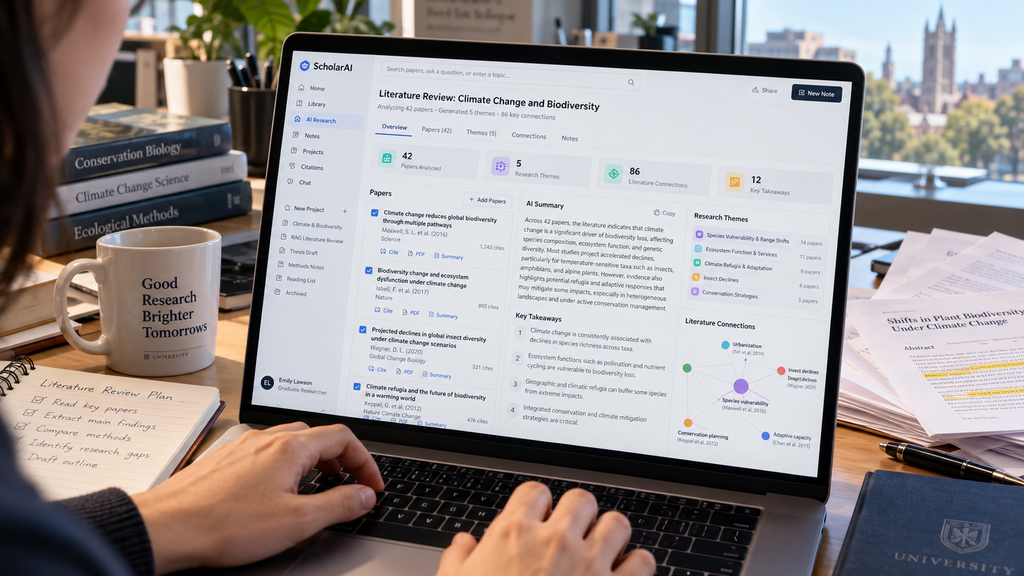
An AI academic agent is an artificial intelligence system designed specifically to assist with academic and scientific research tasks.
Unlike a general-purpose AI assistant, an academic agent is usually built around scholarly literature and research workflows.
It may help with tasks such as:
- Searching academic papers
- Finding related studies
- Screening literature
- Summarizing research
- Comparing findings
- Extracting methods and results
- Organizing citations
- Building research libraries
- Identifying possible research gaps
- Tracking new publications
- Answering questions about selected papers
The goal is not simply to produce text.
A useful academic agent should help researchers move from a broad question to an organized, evidence-based understanding of the literature.
WisPaper, for example, offers Quick Search and Deep Search options that allow researchers to search scholarly literature using natural-language questions rather than relying entirely on complex keyword strings.
Why Academic Research Takes So Much Time

Research involves much more than typing a question into Google Scholar.
A serious literature review may require researchers to:
- Define a focused research question.
- Identify relevant terminology.
- Search several databases.
- Screen titles and abstracts.
- Download or access full papers.
- Read methods and results.
- Evaluate study quality.
- Compare conflicting findings.
- Record citations.
- Identify unanswered questions.
- Build a structured argument.
Each step requires time.
The problem becomes even more difficult in fast-moving fields such as artificial intelligence, medicine, engineering, climate science, and computer science, where new papers appear constantly.
WisPaper notes that its academic search system is designed to support concept-based and natural-language discovery, helping researchers find work even when different fields use different terminology for similar ideas.
That is one of the main reasons AI research tools are gaining attention.
How an AI Academic Agent Can Improve Literature Search
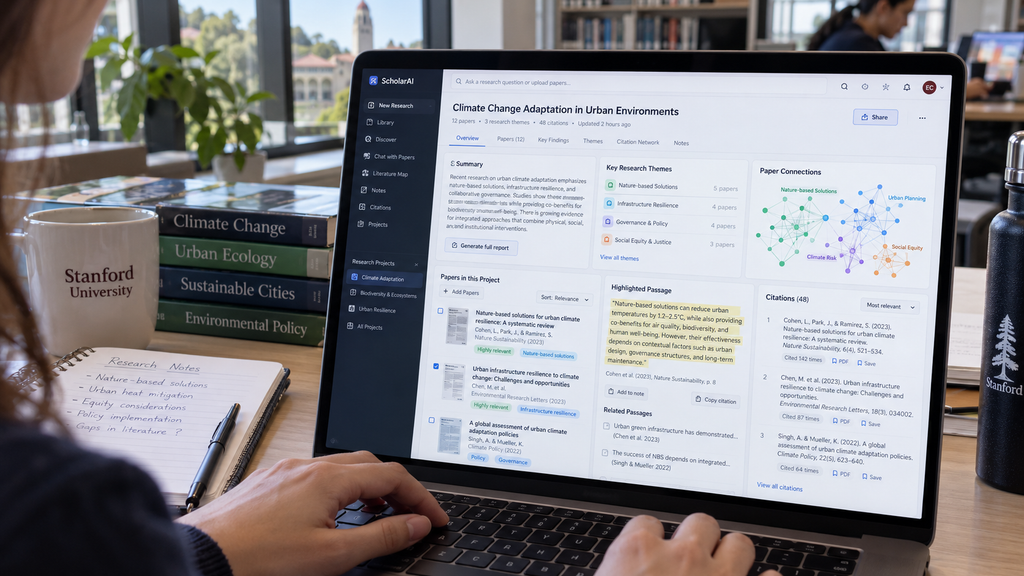
Finding relevant papers is often the first major challenge.
Traditional databases are powerful, but effective searching usually requires the right keywords.
Natural-Language Search
An AI academic tool can allow researchers to describe what they want in plain English.
Instead of building a complicated Boolean query, a researcher might ask:
“Find recent papers studying large language models for clinical decision support in U.S. hospitals.”
The AI can interpret the intent behind the request and search for conceptually related research.
This can be especially useful for students entering a new subject where they do not yet know the standard terminology.
Semantic Search
Traditional search often depends heavily on exact words.
Semantic search focuses more on meaning.
For example, two papers may discuss similar methods while using different terminology. An AI-based academic search system may be able to connect them conceptually.
This can help researchers discover relevant papers outside their original keyword list.
Intent-Based Filtering
WisPaper describes its search process as using intent validation, where the system interprets the research logic behind a query and helps filter papers according to that intent.
This can make the early discovery stage more efficient, although researchers should still review the final results themselves.
Using AI for Literature Reviews
Literature reviews are one of the strongest use cases for an AI academic agent.
A literature review requires more than summarizing papers. Researchers need to understand how studies relate to each other.
Finding Candidate Papers
AI can help generate an initial list of relevant sources.
Researchers can then apply their own inclusion and exclusion criteria.
Screening Research
An AI tool can help analyze titles, abstracts, methods, and research topics to determine which papers may be worth deeper reading.
This is useful when a search produces hundreds of possible sources.
Comparing Multiple Studies
Researchers often need to compare papers across variables such as:
- Study population
- Research method
- Dataset
- Sample size
- Main findings
- Limitations
- Research setting
- Publication year
AI can help organize this information into a more manageable structure.
Building an Evidence Map
A research evidence map helps scholars understand what has already been studied and where evidence may be weak or incomplete.
WisPaper supports library-based Q&A and paper organization, which can help researchers compare a known set of saved papers instead of repeatedly searching scattered browser tabs.
Can an AI Academic Agent Find Research Gaps?
Finding a research gap is one of the most difficult parts of academic work.
A gap should not simply mean that no paper uses exactly the same title or wording.
A meaningful research gap may involve:
- An understudied population
- Conflicting results
- Limited geographic coverage
- Weak methodology
- Outdated data
- Missing comparisons
- Unexplored applications
- Inconsistent definitions
- Limited replication
AI can help researchers identify patterns across multiple papers and surface areas where evidence appears limited.
However, it cannot automatically prove that a gap is real.
WisPaper itself advises that AI can identify candidate gaps by comparing studies, limitations, and themes, but the researcher should verify the gap through additional searching and reading.
This distinction is important.
The AI can help generate possibilities. The researcher decides whether those possibilities are academically meaningful.
Deep Reading and Paper Analysis
Finding papers is only the beginning.
Researchers also need to understand them.
An AI academic agent may help extract information from individual papers, including:
- Research questions
- Methodology
- Key findings
- Datasets
- Variables
- Limitations
- Conclusions
- Important citations
This can make the initial reading process faster.
However, researchers should still read important papers directly before citing them.
A summary can help with navigation, but it should not replace close reading when a source is central to an argument.
Research Library and Knowledge Management
One of the most frustrating parts of academic work is losing track of useful sources.
A paper may be saved in one folder, cited in another document, summarized in a notebook, and forgotten three months later.
An AI-powered research library can create a more centralized workflow.
WisPaper allows researchers to save or upload papers into a personal library and then ask questions based on that selected collection.
This can help researchers return to earlier work without starting their search from zero.
Over time, a structured personal knowledge base can become valuable for:
- Dissertation research
- Long-term academic projects
- Lab work
- Journal writing
- Grant preparation
- Research collaboration
Staying Updated With New Research
Academic knowledge changes quickly.
Researchers working in active fields need a way to monitor new publications.
WisPaper’s AI Feeds feature allows users to follow topics, keywords, or authors and receive personalized research updates based on those interests.
This kind of feature can reduce the need to repeatedly run the same searches.
For graduate students and faculty members, automated research monitoring can help with ongoing literature reviews and long-term projects.
AI Academic Agent vs. Google Scholar
Google Scholar remains one of the most widely used academic discovery tools.
An AI agent does not necessarily replace it.
The two can work together.
Google Scholar Is Strong For
- Known paper searches
- Citation counts
- Author searches
- Citation chaining
- Broad scholarly discovery
An AI Academic Agent Is Strong For
- Natural-language questions
- Concept-based discovery
- Rapid paper screening
- Summarization
- Comparing studies
- Research organization
- Library Q&A
- Exploring possible gaps
WisPaper recommends combining AI discovery with structured database searching, citation chasing, and manual verification rather than relying on one system alone.
That approach creates a stronger and more defensible academic workflow.
Responsible Use of AI in Academic Research
Using AI effectively requires clear boundaries.
Students and researchers remain responsible for the final scholarly work.
Verify Citations
Never assume a citation is correct simply because an AI generated it.
Open the paper and verify:
- Author names
- Title
- Publication year
- Journal
- DOI
- Relevant claim
Read Important Sources
If a paper is important enough to support a major argument, read it directly.
AI summaries are useful for triage, not as substitutes for scholarship.
Follow University Policies
U.S. colleges and universities may have different rules regarding AI use.
Some courses allow AI-assisted research but restrict AI-generated writing. Others require disclosure.
Students should follow the policy of their instructor, department, institution, or journal.
Keep Human Judgment in the Process
AI may identify patterns, but researchers must decide whether those patterns are meaningful.
WisPaper’s own guidance emphasizes that AI can assist with search, screening, and organization while researchers retain responsibility for interpretation and final conclusions.
Who Can Benefit From an AI Academic Agent?
These tools can help many types of users.
Undergraduate Students
Students can use AI research tools to understand unfamiliar topics and discover relevant academic papers.
Graduate Students
Master’s and Ph.D. students can use them for literature reviews, dissertation planning, research gap exploration, and source organization.
Professors and Researchers
Faculty members can monitor emerging publications, explore related work, and organize large research collections.
Scientific Teams
Research groups can use academic AI tools to centralize literature and identify useful connections across projects.
Industry Researchers
Professionals in healthcare, technology, engineering, and other research-intensive industries may use academic agents to stay informed about relevant scientific developments.
How to Build a Better AI-Assisted Research Workflow
The strongest workflow keeps AI and human expertise working together.
Step 1: Define Your Question
Start with a clear question rather than a broad topic.
Instead of “AI in healthcare,” consider something more focused, such as:
“How are large language models being evaluated for diagnostic support in U.S. healthcare systems?”
Step 2: Use AI for Discovery
Search with an AI academic agent to discover papers, terminology, authors, methods, and adjacent concepts.
Step 3: Refine Your Keywords
Use what you learn from the initial search to create more structured database queries.
Step 4: Screen the Literature
Apply clear inclusion and exclusion criteria.
Step 5: Save and Organize Sources
Build a central research library.
Step 6: Compare Findings
Analyze methodology, findings, limitations, and disagreements across studies.
Step 7: Verify Every Important Claim
Return to the original paper before citing it.
Step 8: Write With Your Own Analysis
Use AI to organize information, but make the final argument based on your own understanding.
Frequently Asked Questions
What is an AI academic agent?
An AI academic agent is a research-focused AI system that helps users discover, analyze, organize, and compare academic literature.
Can AI conduct a complete literature review?
AI can assist with searching, screening, summarization, and organization, but researchers should still verify sources, critically evaluate studies, and write the final synthesis themselves.
Can an AI academic agent find research papers?
Yes. Tools such as WisPaper support natural-language academic search and Deep Search for finding papers based on research intent.
Can AI identify research gaps?
AI can suggest possible gaps by comparing papers and limitations, but researchers must confirm whether the gap is real through additional searching and critical reading.
Is AI academic research reliable?
It can be useful when results are grounded in real academic sources, but no AI system should be trusted without verification. Researchers should always check important claims and citations against the original sources.
Can students use AI for research papers?
In many cases, AI can assist with research and organization, but acceptable use depends on the policies of the student’s school, professor, or academic program.
What is the difference between AI academic search and regular search?
Traditional search often relies primarily on keywords. AI academic search can use natural-language questions and semantic relationships to discover conceptually relevant papers.
What academic research features does WisPaper offer?
WisPaper currently offers scholar search, Deep Search, personal libraries, academic Q&A, research feeds, AI-assisted literature workflows, and tools for exploring research directions.
Conclusion
Academic research will always require careful reading, critical thinking, and human judgment.
What is changing is how researchers manage the enormous amount of information surrounding that work.
An AI academic agent can help reduce repetitive tasks by finding papers, screening literature, organizing sources, summarizing research, tracking new publications, and helping researchers compare evidence across multiple studies.
Platforms such as WisPaper demonstrate how academic AI is moving beyond simple question-answer chatbots toward integrated research environments that combine search, libraries, deep reading, scholarly Q&A, research feeds, and workflow support.
The most effective approach is not to let AI replace the researcher.
Instead, use AI to handle information-heavy tasks while keeping source verification, interpretation, methodology, and academic judgment firmly in human hands.
For students, faculty members, scientists, and research professionals, that combination can create a faster and more organized path from the first research question to a well-supported final paper.
As academic literature continues to grow, the value of an AI academic agent may come from something simple: helping researchers spend less time managing information and more time understanding what the evidence actually means.