
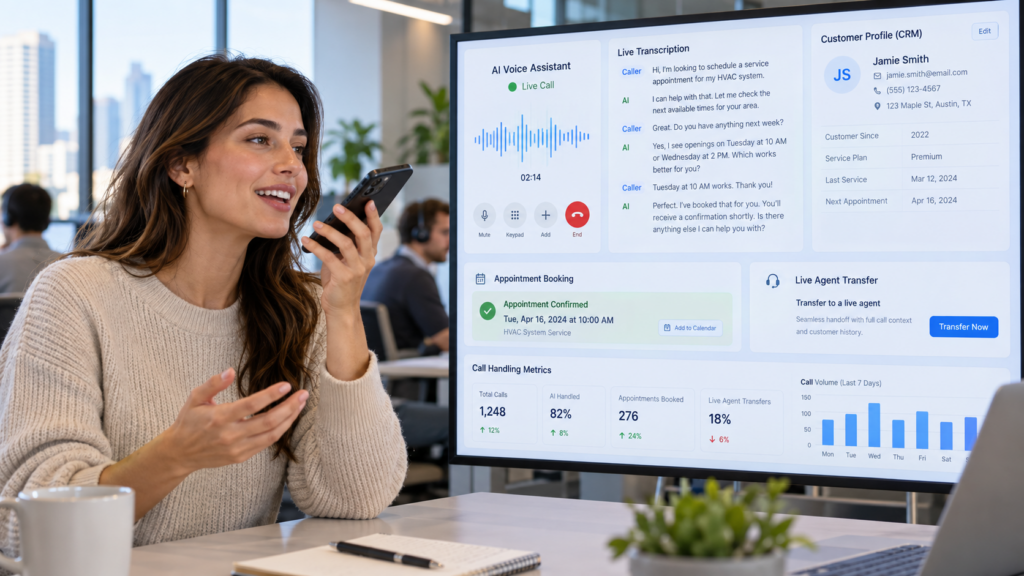
Phone calls remain one of the most important ways businesses communicate with customers, prospects, patients, candidates, and clients.
The problem is that answering every call can be difficult.
Sales teams may be busy with existing opportunities. Receptionists may be helping customers in person. Support departments can become overwhelmed during peak periods. Leads may arrive after normal business hours. Outbound follow-ups can also take hours of repetitive work.
This is where AI phone agents are changing business communication.
Modern AI calling systems can answer inbound calls, make outbound calls, understand conversational language, qualify leads, schedule appointments, route callers, update business systems, and transfer important conversations to human employees.
Pete & Gabi currently offers conversational AI agents designed for sales, customer service, recruiting, appointment scheduling, lead generation, customer reactivation, and other high-volume calling workflows. Its Olivia AI system is designed for inbound and outbound business calls, while the company’s Rebecca AI product focuses on candidate screening and recruiting workflows.
For U.S. businesses looking to handle more conversations without manually expanding a phone team, AI call automation can provide another way to manage routine communication.
What Are AI Phone Agents?
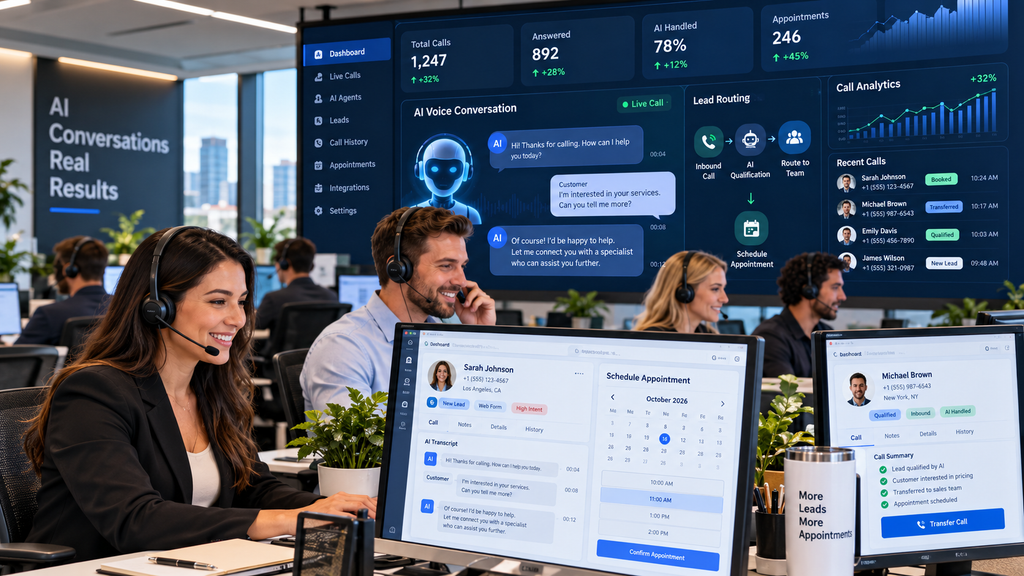
AI phone agents are software systems that use artificial intelligence, speech recognition, natural language processing, and voice generation to hold telephone conversations.
Instead of asking callers to navigate a traditional menu such as “Press 1 for sales,” an AI voice agent can allow someone to speak naturally.
A customer might say:
“I need to reschedule my appointment.”
The AI can identify the intent, ask for relevant information, check connected scheduling systems, and complete the task or transfer the call when human assistance is needed.
Pete & Gabi describes its phone agents as conversational AI capable of handling inbound and outbound calls, customer inquiries, lead qualification, appointment scheduling, live transfers, multilingual interactions, call routing, transcripts, and CRM-related workflows.
How AI Phone Agents Work
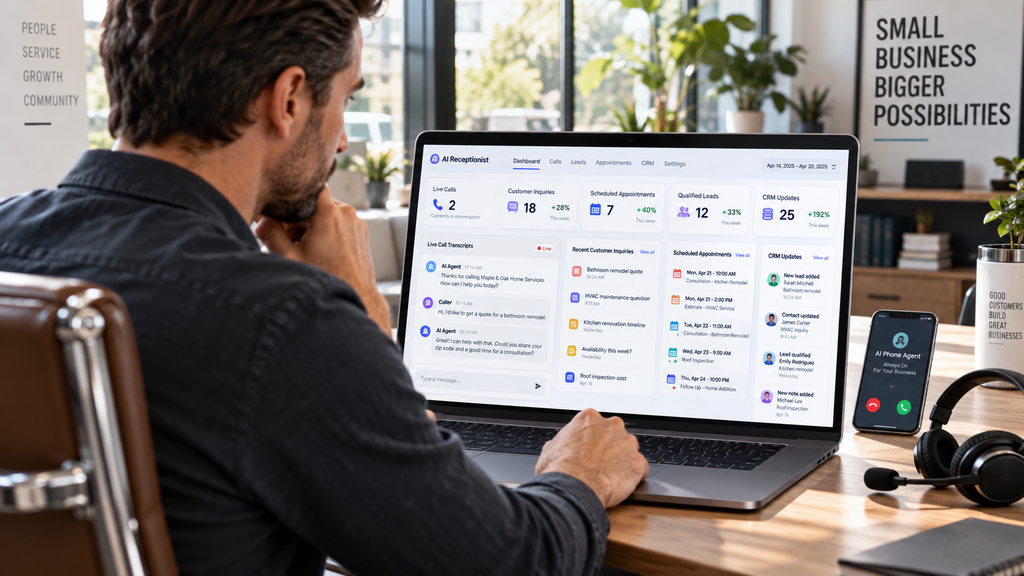
Although the technology behind voice AI can be complex, the customer experience should feel simple.
Step 1: The Call Connects
An AI agent can answer an incoming call or initiate an outbound call based on a business workflow.
For inbound calls, the system can respond immediately instead of leaving the caller on hold.
For outbound workflows, calls may be triggered by events such as a new lead entering the CRM, an upcoming appointment, an incomplete application, or a customer follow-up list.
Step 2: The AI Understands the Conversation
The system converts spoken language into information it can interpret.
Unlike traditional interactive voice response systems that depend heavily on fixed button choices, conversational AI can respond to natural sentences.
The system may identify whether the caller wants to:
- Schedule an appointment
- Ask about a service
- Speak with sales
- Change a reservation
- Confirm availability
- Check an application
- Discuss a customer service issue
- Reach a specific employee
Step 3: The Agent Takes Action
The AI phone agent can then follow a predefined business workflow.
That may involve gathering information, booking an appointment, updating the CRM, answering approved questions, sending a follow-up message, or routing the conversation.
Pete & Gabi supports appointment scheduling, CRM and workflow integration, call routing, automated SMS reminders, call recordings, transcripts, and real-time analytics across its current voice AI offering.
Step 4: A Human Can Take Over
Good AI automation does not mean removing people from every conversation.
Some calls require judgment, negotiation, empathy, technical expertise, or management approval.
Pete & Gabi includes live call transfer functionality so qualified leads or callers with more complex needs can be passed to an employee in real time.
AI Phone Agents for Inbound Calls
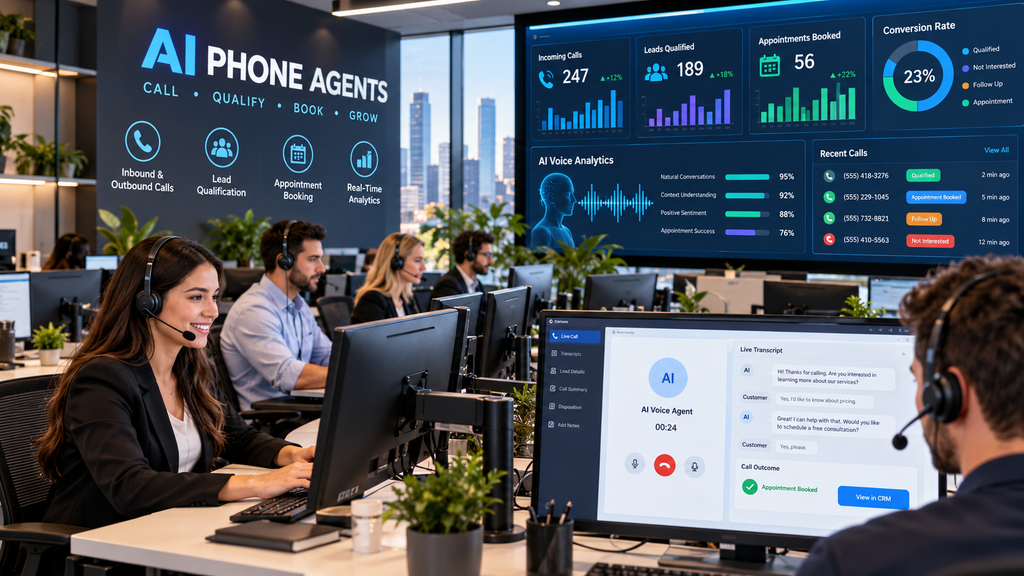
Inbound calls are a major challenge for businesses because customer demand is unpredictable.
A company may receive only a few calls one hour and dozens the next.
AI phone answering can provide consistent coverage during both busy and quiet periods.
Answering Calls 24/7
An AI answering system does not need traditional office hours.
Pete & Gabi markets its Olivia AI agent as providing 24/7 call handling, allowing businesses to answer inquiries even when staff members are unavailable.
This can be particularly useful for companies receiving leads through websites, advertising campaigns, directories, or online marketplaces outside normal operating hours.
Handling Frequently Asked Questions
Many customer calls involve repetitive questions.
Examples include:
- What time do you open?
- Do you serve my area?
- Can I schedule an appointment?
- What information do I need?
- Can I speak with sales?
- How do I change my booking?
When the AI has access to approved business information, it can handle many of these conversations without requiring an employee.
AI Phone Agents for Outbound Sales
Outbound calling is another area where voice automation can save substantial staff time.
Salespeople often spend hours attempting to reach leads who do not answer, are not qualified, or are not ready to buy.
An AI calling agent can perform initial outreach and allow human salespeople to focus on stronger opportunities.
Instant Lead Follow-Up
Speed can be important when someone submits a request for information.
An AI sales agent can call shortly after a new lead enters the system.
Pete & Gabi positions Olivia AI for instant lead management, including calling new and dormant leads, asking qualification questions, booking meetings, and re-engaging inactive prospects.
Lead Qualification
Not every inquiry is sales-ready.
AI agents can ask structured questions such as:
- What service are you interested in?
- What is your timeline?
- Where are you located?
- What problem are you trying to solve?
- When would you like to speak with a representative?
The responses can then be sent to a CRM or sales team.
Re-Engaging Old Leads
Many businesses have thousands of old leads sitting in databases.
Some may still be interested but were never followed up with consistently.
Pete & Gabi specifically markets AI calling for dormant lead reactivation and customer win-back campaigns.
AI Appointment Scheduling
Appointment scheduling involves more work than simply answering the phone.
Employees may need to check calendars, suggest available times, collect contact information, confirm bookings, and send reminders.
AI phone agents can automate many of these steps.
Pete & Gabi states that its platform can coordinate and confirm appointments and support follow-up through email or SMS.
This type of automation may be useful for:
- Medical and dental practices
- Home service companies
- Real estate businesses
- Auto dealerships
- Professional services
- Sales teams
- Hotels
- Recruiting firms
- Education providers
A business can configure the AI to collect the information required before placing an appointment on the calendar.
AI Customer Service Agents
Customer service departments often spend significant time handling repetitive requests.
Voice AI can help manage simple questions while allowing human representatives to focus on complex cases.
Pete & Gabi promotes its customer service AI for routine inquiries, call routing, customer follow-ups, reminders, appointment scheduling, and selected upsell or cross-sell workflows.
Reducing Call Queues
Customers generally do not enjoy waiting on hold.
If several AI agents can handle conversations simultaneously, businesses may be able to respond to more customers during high-volume periods.
Consistent Responses
AI systems can use approved scripts, workflows, and business information.
That can help standardize how frequently asked questions are handled.
However, companies should regularly review scripts and AI responses to make sure information remains accurate.
AI Phone Agents for Recruiting
Voice AI is not limited to customers.
Recruiting teams can also automate high-volume candidate communication.
Pete & Gabi’s Rebecca AI product focuses on recruiting and candidate screening. According to the company, it can conduct voice or video interviews, evaluate candidates against configured criteria, and send results into applicant tracking workflows.
AI calling can also help recruiting teams:
- Confirm candidate interest
- Ask screening questions
- Verify availability
- Schedule interviews
- Send reminders
- Reconnect with applicants
This can be useful for staffing agencies or employers that receive large numbers of applications.
CRM Integration Makes AI Calling More Useful
An isolated AI agent can answer calls, but integration makes the technology significantly more valuable.
When an AI phone agent connects with a CRM, scheduling platform, or business database, it can both retrieve information and record new information.
For example, after qualifying a lead, the system might:
- Update the contact record.
- Add qualification notes.
- Book a meeting.
- Save the call transcript.
- Notify the assigned salesperson.
Pete & Gabi currently advertises CRM connections, automated synchronization, custom API integrations, and webhooks. Its managed plans mention integrations with systems such as HubSpot, Salesforce, and Zoho.
Industries Using AI Phone Agents
Voice AI can be adapted to many industries because most businesses have repetitive communication workflows.
Pete & Gabi currently lists industries including automotive, staffing and recruiting, financial services, healthcare, hospitality, real estate, telecommunications, professional services, education, utilities, insurance, and marketing.
Professional Services
AI agents can answer inquiries, qualify potential clients, collect intake details, schedule consultations, and follow up with prospects.
Hospitality
Hotels and hospitality businesses can use conversational AI for reservations, guest questions, booking requests, and routing more complex inquiries.
Pete & Gabi states that its hospitality agents can integrate with property management or central reservation systems through APIs for access to current availability and pricing.
Home Services
Contractors and home service businesses can use AI phone agents to capture leads when technicians or office staff are unavailable.
The system can collect the customer’s location, requested service, preferred appointment time, and contact details.
Marketing Teams
Marketing campaigns can produce large numbers of leads in short periods.
AI agents can contact leads, qualify interest, schedule demos, and follow up without requiring marketing employees to make every call manually.
Benefits of AI Phone Agents
The main benefit is not simply replacing a person who answers a phone.
The larger opportunity is automating repetitive conversations while allowing employees to spend more time on work requiring human expertise.
Potential benefits include:
- Faster response to new leads
- 24/7 call coverage
- Reduced missed calls
- Consistent lead qualification
- Automated appointment scheduling
- Easier follow-up
- Scalable calling capacity
- Automatic call transcripts
- Better CRM documentation
- Live transfer of important calls
- Multilingual communication
The exact value depends on how well the AI is configured and whether the business chooses appropriate use cases.
What Businesses Should Consider Before Using AI Phone Agents
Voice AI should not simply be connected to a phone number and forgotten.
Start With a Clear Use Case
Choose a specific problem first.
For example:
“Call every new website lead within five minutes and schedule qualified prospects.”
That is easier to measure than trying to automate an entire call center at once.
Define Escalation Rules
The AI needs to know when a human should take over.
High-value sales opportunities, complaints, emergencies, unusual questions, and sensitive conversations may require immediate transfer.
Monitor Transcripts and Analytics
Call transcripts can reveal what customers actually ask.
Businesses can use this information to improve scripts, update FAQs, adjust qualification criteria, and identify where callers become confused.
Pete & Gabi includes call recordings, transcripts, analytics, and script optimization within parts of its managed AI calling offering.
U.S. Compliance Matters for AI Calling
Companies using AI-generated voices in the United States also need to pay attention to telemarketing and calling regulations.
In February 2024, the Federal Communications Commission clarified that AI-generated human voices fall under the Telephone Consumer Protection Act’s rules covering artificial or prerecorded voices. Calls using such technologies may therefore require prior express consent unless an applicable exemption exists.
The Federal Trade Commission also maintains Telemarketing Sales Rule requirements involving the National Do Not Call Registry, calling hours, identification, prerecorded telemarketing calls, opt-out mechanisms, and other practices.
Businesses should review the TCPA, FTC requirements, applicable state laws, call-recording rules, consent requirements, and campaign design with qualified legal counsel.
Pete & Gabi states that its managed service includes carrier-registration support and processes intended around TCPA guidelines and A2P 10DLC compliance, but individual businesses remain responsible for making sure their campaigns comply with laws that apply to their situation.
Frequently Asked Questions About AI Phone Agents
What are AI phone agents?
AI phone agents are conversational software systems that can make or answer telephone calls, interpret spoken language, respond with generated speech, collect information, and complete business workflows.
Can AI phone agents answer inbound calls?
Yes. They can answer incoming calls, understand the reason for the call, respond to common questions, collect information, schedule appointments, and route calls.
Can AI phone agents make outbound calls?
Yes. Outbound AI calling can be used for approved workflows such as lead follow-up, customer reminders, appointment confirmation, surveys, customer reactivation, and sales qualification, subject to applicable laws and consent requirements.
Can an AI agent transfer a call to a real person?
Yes. Platforms such as Pete & Gabi support live call transfers when a caller needs human assistance or a qualified opportunity is ready for a salesperson.
Do AI phone agents work 24/7?
They can. Pete & Gabi markets Olivia AI with continuous inbound call coverage, allowing companies to handle conversations outside normal office hours.
Can AI phone agents book appointments?
Yes. AI agents can connect with scheduling workflows to find times, confirm information, and book appointments automatically.
Can AI phone agents connect to a CRM?
Yes. Modern systems can integrate with CRM platforms to read and update customer or lead records. Pete & Gabi offers CRM synchronization and custom integration options.
Are AI phone agents legal in the United States?
AI phone agents can be used legally, but their use is subject to federal and state rules. The FCC has confirmed that AI-generated voices fall under TCPA artificial or prerecorded voice requirements, making consent and campaign design important considerations.
Can AI phone agents speak multiple languages?
Some platforms can. Pete & Gabi currently lists multilingual support among its voice agent capabilities.
Will AI phone agents replace human employees?
They are often most useful for repetitive, high-volume tasks rather than every conversation. Businesses can use AI for initial calls, qualification, scheduling, reminders, and basic support while transferring complex or sensitive situations to employees.
Conclusion
Businesses do not necessarily need more people answering more phones to handle growing call volume.
They may need a better way to decide which conversations should be automated and which require human attention.
AI phone agents can answer calls around the clock, contact new leads quickly, qualify prospects, book appointments, handle routine customer questions, update CRM systems, send follow-ups, and transfer important conversations to employees.
Pete & Gabi’s current platform combines inbound and outbound AI calling with live transfers, appointment scheduling, multilingual conversations, CRM integrations, analytics, transcripts, customer service workflows, sales automation, and recruiting applications.
For companies considering voice AI, the best starting point is a clearly defined workflow. Automating missed inbound calls, new lead follow-up, appointment confirmation, or first-stage qualification can make it easier to measure whether the technology is actually improving operations.
Businesses should also treat compliance as part of the implementation rather than an afterthought. U.S. rules governing artificial voices, telemarketing, consent, Do Not Call obligations, and call recording can affect how an AI calling program should operate.
Used carefully, AI phone agents can become more than automated answering systems. They can act as a scalable first layer of business communication—handling repetitive conversations quickly while allowing human teams to focus on relationships, complex questions, and opportunities where personal expertise matters most.

