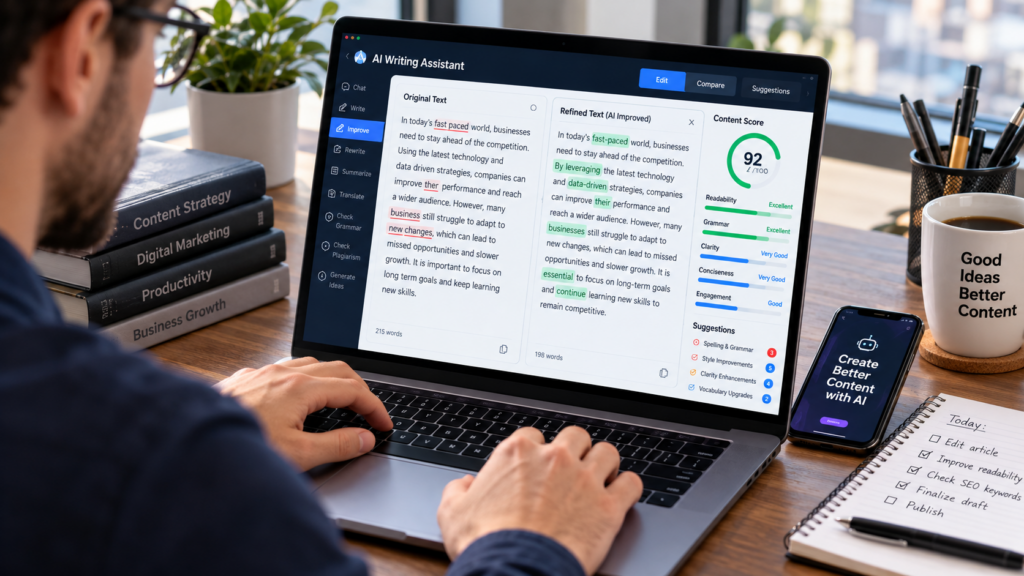
Artificial intelligence is now part of everyday writing for millions of people. Professionals use AI to create first drafts, marketers develop outlines and campaign copy, business owners improve emails, and content teams use AI to speed up research and editing.
As AI-assisted writing has become more common, a new topic has gained attention: AI text watermarking.
An AI watermark remover is a tool designed to process AI-generated or AI-assisted text and reduce the signals, formatting artifacts, or statistical patterns associated with machine-generated writing. Depending on the technology involved, this may include rewriting sentences, improving natural flow, removing unusual formatting, or changing statistical patterns within the text.
Phrasly offers an AI Text Watermark Remover that the company describes as a tool for transforming AI-generated text into cleaner, more natural, professional writing while preserving the original meaning. Its current interface also gives users different processing levels and integrates with a larger suite of writing tools.
However, AI watermarking is more complicated than simply finding hidden characters and deleting them.
Modern text watermarks can be statistical patterns built directly into the way an AI system chooses words. Understanding this distinction is essential before deciding what an AI watermark remover can realistically do.
What Is an AI Watermark?
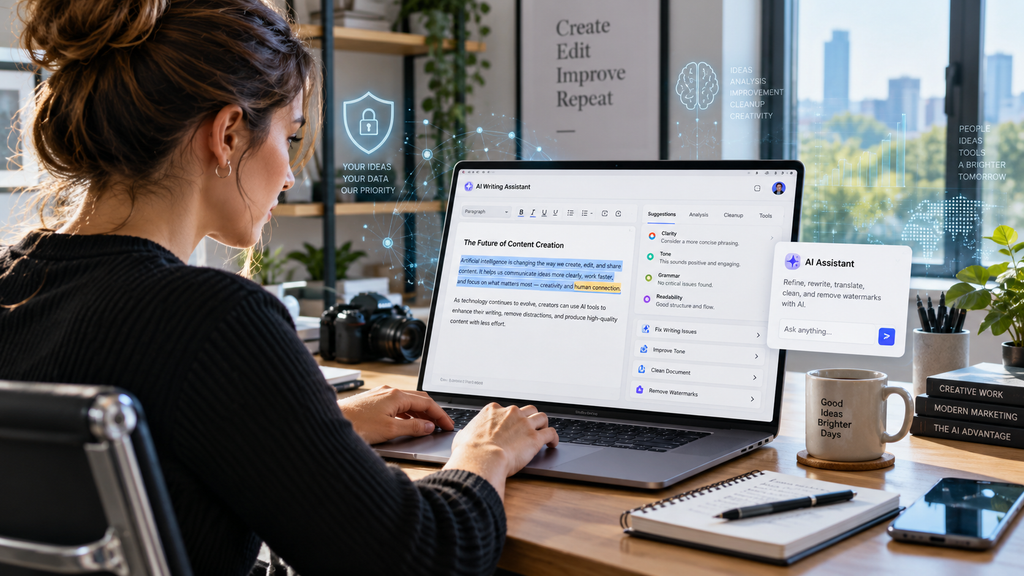
An AI watermark is a signal that can help indicate that content was generated by an artificial intelligence system.
The exact technology varies.
Some digital provenance systems use metadata attached to a file. Other watermarking approaches embed signals directly into the generated content.
For text, statistical watermarking can work by slightly changing the probability of which words or tokens an AI model chooses while generating a response.
Google DeepMind’s SynthID for text is an example. DeepMind explains that SynthID changes token probability scores during generation, creating a pattern that can later be analyzed to estimate whether the text contains the watermark.
Anthropic has also announced text watermarking for future Claude models released under its 2026 transparency requirements. Anthropic says its watermark does not rely on hidden characters and instead creates a numerical pattern that can help estimate whether Claude was involved in generating text.
This means an AI text watermark may not be something you can see inside a document.
AI Watermarks vs. Hidden Formatting Characters
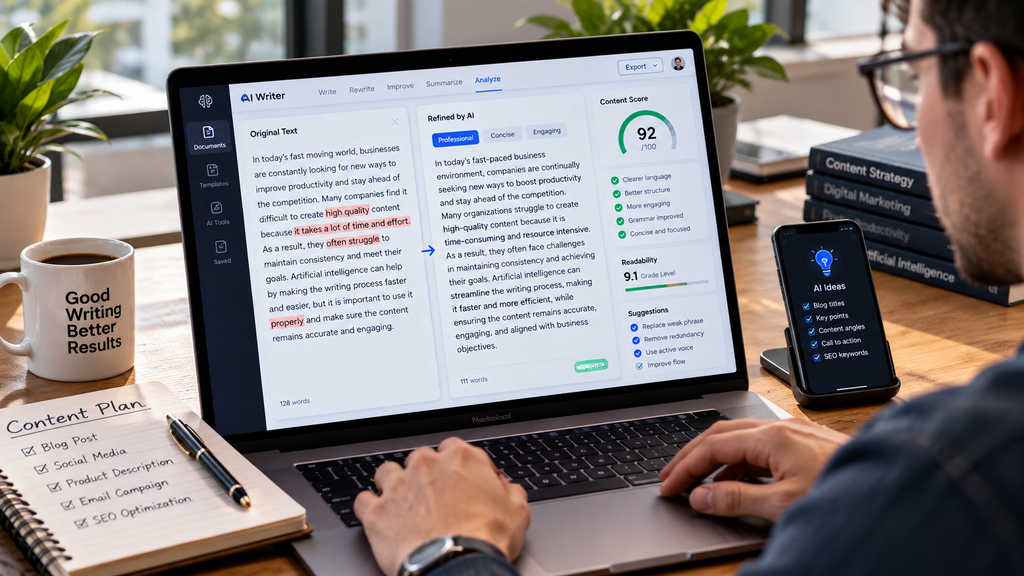
One common misunderstanding is that every strange space or invisible character inside AI-generated text is an intentional watermark.
That is not necessarily true.
Documents can contain:
- Non-breaking spaces
- Narrow spaces
- Zero-width characters
- Formatting marks
- Special punctuation
- Copy-and-paste artifacts
These may appear after moving text between websites, word processors, content management systems, and other applications.
Removing these characters can improve formatting, but it does not automatically remove a statistical AI watermark.
Phrasly itself distinguishes between formatting artifacts and statistical watermarking in its published content. The company notes that genuine statistical text watermarks work through patterns in word selection rather than relying exclusively on invisible characters.
What Is an AI Watermark Remover?

An AI watermark remover is generally a text-processing tool that attempts to rewrite or transform AI-generated text so that watermark signals or machine-like patterns are reduced.
This usually involves more than deleting characters.
A watermark removal system may change:
- Sentence construction
- Word selection
- Paragraph structure
- Transitions
- Rhythm
- Repetition
- Phrasing
- Overall writing style
Phrasly describes its own tool as combining watermark removal with natural-language processing to produce cleaner and more professional writing.
The important point is that the output is effectively a revised version of the original text.
That means users should always review the result for factual accuracy and meaning.
How Phrasly’s AI Watermark Remover Works
Phrasly’s current watermark-removal page provides a simple text-processing interface.
Users can paste text or import content and choose among different rewrite levels.
The available options currently include:
Easy
Designed for lighter changes and basic cleanup.
This option may be useful when the original draft already reads relatively naturally and only needs limited adjustments.
Medium
Designed to create a balance between preserving the original structure and making more noticeable improvements to flow.
Phrasly describes this level as suitable for professional content where users want both natural readability and watermark reduction.
Aggressive
This setting applies stronger rewriting.
Because heavier rewriting can create greater differences from the original draft, users should pay particular attention to factual accuracy, terminology, quotations, and technical details after processing.
Phrasly warns that AI systems can make mistakes and advises users to double-check the generated output.
Statistical Watermarks Can Survive Small Edits
A few manual edits may not be enough to affect some statistical watermarking systems.
Google DeepMind says SynthID for text is designed to remain effective after certain changes such as cropping, changing a few words, and mild paraphrasing.
However, DeepMind also acknowledges an important limitation: extensive rewriting or translation can substantially reduce the confidence of watermark detection.
This helps explain why modern AI watermark removal tools often operate more like rewriting systems than simple character cleaners.
The statistical structure of the text may need to change considerably before the original pattern is weakened.
AI Watermark Removal vs. AI Humanization
Watermark removal and text humanization are closely related, but they are not exactly the same.
AI Watermark Removal
The primary goal is to modify technical patterns that may be associated with machine-generated text.
AI Humanization
The primary goal is to make writing sound more natural, varied, readable, and appropriate for human audiences.
Humanization may address issues such as:
- Repetitive sentence structures
- Overly formal phrasing
- Unnatural transitions
- Excessive adjectives
- Predictable conclusions
- Robotic tone
Phrasly describes watermark removal and humanization as separate but related processes. Its published materials say humanization focuses primarily on natural writing style, while watermark removal focuses on disrupting statistical signals associated with AI generation.
For ordinary professional writing, readability may be more important than either label.
Phrasly’s Proprietary Model Claims
Phrasly says its humanization and rewriting technology runs on models developed and trained internally rather than simply passing user text through third-party AI providers.
According to the company’s technology information, it trains proprietary models using large datasets of human writing and uses detector feedback as one input during model development.
Phrasly also states that controlling its own models allows it to avoid inheriting text watermarks introduced by external AI providers.
These are company claims rather than independent guarantees, so businesses evaluating the platform for sensitive or regulated workflows should review the current technical documentation, privacy policy, and contractual terms directly.
What Else Is Included With Phrasly?
Phrasly currently markets its watermark-removal feature as part of a larger writing platform.
Its current feature list includes:
- AI Humanizer
- AI Detector
- AI Document Editor
- Content Generator
- Plagiarism Checker
- Flashcard Maker
- Chat with PDF
- YouTube Transcript Generator
This broader approach can be useful for users who want to edit, analyze, and refine documents in one workflow rather than moving between several separate tools.
Professional Uses for an AI Watermark Remover
There are several legitimate reasons someone may want to refine AI-assisted writing.
Cleaning Drafts
AI-generated first drafts can contain repetitive wording or awkward sentence patterns.
Rewriting can make those drafts more appropriate for publication.
Maintaining Brand Voice
A company’s published content should sound consistent.
AI drafts may need substantial editing before they match established brand terminology and tone.
Removing Formatting Problems
Text copied between tools can include unusual spaces or formatting artifacts.
Cleanup can make documents easier to publish in a website, CMS, email platform, or word processor.
Improving Readability
Some AI-generated text is grammatically correct but still feels mechanical.
A rewriting tool can vary sentence length, simplify complicated passages, and improve transitions.
Creating Client-Ready Documents
Agencies and freelancers frequently use AI during drafting but still need to transform the result into polished work that reflects their own expertise.
In these situations, the objective should be producing better writing rather than disguising authorship in situations where disclosure is required.
Responsible Use Matters
An AI watermark remover should not be treated as permission to ignore rules about AI-generated content.
Schools, employers, publishers, competitions, government agencies, and online platforms may have policies requiring disclosure of AI assistance.
Removing or weakening a technical provenance signal does not change those requirements.
For example, if a university prohibits submitting AI-generated work as a student’s own work, rewriting the text does not automatically make the submission compliant.
Similarly, some clients may contractually require writers to disclose AI assistance.
The responsible approach is straightforward:
Use AI tools where permitted, follow the rules that apply to the work, verify the final content, and disclose AI involvement when required.
AI Watermarks Are Not the Same as AI Detectors
Another important distinction is the difference between watermark detection and general AI detection.
A watermark detector looks for a signal deliberately introduced during generation.
An AI detector may instead analyze statistical characteristics of writing and estimate whether the text resembles machine-generated content.
Those systems are not the same.
DeepMind notes that AI classifiers can produce inconsistent results when applied across different types of content, while SynthID is designed around a specific embedded watermarking method.
This means a document could theoretically contain no known watermark and still be labeled as AI-generated by a separate detector.
Likewise, removing unusual formatting characters does not guarantee that an AI detector will classify text differently.
No AI Watermark Remover Can Guarantee Every Result
Users should be skeptical of absolute guarantees.
Watermarking technology is continuing to change, and different providers may use different methods.
Some signals may be based on:
- Token probability patterns
- Metadata
- Content credentials
- Model-specific identifiers
- Statistical classifiers
There is no single universal watermark that applies to every AI system.
Even Phrasly’s own interface reminds users that AI can make mistakes and that outputs should be reviewed.
For professional publishing, quality control remains essential.
How to Review Rewritten AI Content
After using any AI rewriting or watermark-removal tool, review the document carefully.
Check Factual Accuracy
AI rewriting can accidentally change numbers, names, product specifications, dates, or technical terminology.
Preserve Important Meaning
Make sure the new version still communicates the original argument.
Review Citations
Do not allow rewritten wording to misrepresent what a source actually says.
Check Grammar
Automated rewriting can occasionally create awkward grammar even when the original text was correct.
Maintain Brand Terminology
Product names, legal language, and specialized vocabulary may need to remain unchanged.
Read the Text Aloud
Reading a document aloud can reveal unnatural transitions and repetitive patterns that are easy to miss on screen.
AI Watermark Removal for SEO Content
AI-assisted writing is frequently used in SEO workflows, but search-focused content still needs human editorial review.
High-quality SEO content should provide:
- Accurate information
- Clear structure
- Useful answers
- Natural keyword placement
- Original analysis
- Relevant examples
- Appropriate sources
- Strong readability
An AI watermark remover may help improve the presentation of a draft, but it cannot replace subject knowledge.
A page that has been rewritten repeatedly without adding useful information is unlikely to become genuinely valuable simply because its wording changed.
The best workflow combines technology with real editorial judgment.
AI Watermark Removal for Business Writing
Business professionals may use AI to draft:
- Emails
- Reports
- Proposals
- Product descriptions
- Internal documents
- Marketing copy
- Website content
These documents often need substantial refinement before publication.
An AI text-cleaning tool can help transform a rough draft into something closer to the organization’s normal communication style.
However, confidential or regulated information requires additional caution.
Before uploading sensitive documents to any AI platform, review the provider’s current privacy and data-handling policies.
The Future of AI Text Watermarking
Text provenance is likely to become increasingly important.
Google DeepMind has already deployed SynthID for text within Gemini, and Anthropic announced watermarking for future Claude model outputs as part of broader transparency requirements.
The broader industry is also experimenting with content credentials, verification systems, metadata, and embedded signals.
This creates an evolving environment in which writing tools, watermark systems, and verification methods will continue adapting to one another.
Users should therefore avoid assuming that today’s detection or removal technology will behave identically in the future.
Frequently Asked Questions About AI Watermark Removers
What is an AI watermark remover?
An AI watermark remover is a tool designed to transform AI-generated text by changing formatting, wording, structure, or statistical patterns associated with AI output.
Does ChatGPT put invisible watermarks in every response?
There is no single universal hidden-character watermark that should be assumed to exist in every AI-generated text. Watermarking approaches differ among providers, and unusual characters can also result from ordinary formatting or copy-and-paste behavior.
How does Phrasly’s AI Watermark Remover work?
Phrasly says its tool rewrites AI-generated text while preserving meaning and improving readability. It currently provides Easy, Medium, and Aggressive processing levels.
Is an AI watermark always an invisible character?
No. Statistical text watermarks can be embedded through patterns in token or word selection rather than hidden characters. Google’s SynthID for text uses this kind of approach.
Can rewriting remove a statistical watermark?
Substantial rewriting can weaken some watermark signals. DeepMind states that SynthID detection confidence can decrease significantly when text is thoroughly rewritten or translated.
Is watermark removal the same as humanizing AI text?
No. Watermark removal focuses on technical watermark patterns, while humanization focuses primarily on tone, readability, sentence variety, and natural writing.
Does Phrasly include an AI detector?
Yes. Phrasly currently includes an AI detector among the tools offered within its platform.
Does Phrasly offer plagiarism checking?
Yes. A plagiarism checker is currently included in Phrasly’s broader writing-tool suite. Users should still independently verify important publishing or academic requirements.
Can an AI watermark remover guarantee that text will never be identified as AI?
No. Different AI detection and watermarking systems use different techniques, and technology continues to evolve. There is no universal guarantee covering every detector or future system.
Is it acceptable to remove an AI watermark?
That depends on why the text is being processed and what rules apply. Editing your own AI-assisted draft for readability can be legitimate, but watermark removal does not override school, employer, publishing, or platform disclosure policies.
Conclusion
The growing use of AI writing tools has made text provenance an increasingly important topic.
An AI watermark remover is designed to transform AI-assisted text by changing the linguistic or formatting patterns associated with machine-generated writing. Modern tools may combine watermark reduction with rewriting, humanization, editing, and content-quality improvements.
Phrasly’s AI Text Watermark Remover follows this approach. Its current platform provides multiple rewrite levels and combines watermark-removal functionality with tools such as AI humanization, content editing, plagiarism checking, AI detection, document generation, and other writing features.
At the same time, users should understand that not all AI watermarks work in the same way.
Some apparent “watermarks” are simply formatting artifacts. More sophisticated systems, such as Google’s SynthID for text and Anthropic’s announced Claude watermarking approach, operate through statistical patterns created during text generation rather than visible characters.
That distinction explains why genuine AI watermark removal often requires substantial rewriting rather than simple character deletion.
It also explains why no tool should promise universal results against every existing or future verification system.
For writers, marketers, business professionals, and content creators, the most useful role of an AI watermark remover may be as part of a broader editing workflow. A rough AI draft can be refined, cleaned, reorganized, checked, and transformed into writing that better reflects the user’s own voice and expertise.
But responsible use remains essential.
Watermark removal does not eliminate the need to follow academic rules, employer requirements, publishing policies, client agreements, or disclosure standards. It also does not replace fact-checking.
The strongest workflow is therefore not simply to generate AI text and process it automatically.
It is to use AI as a drafting tool, apply thoughtful editing, verify the facts, preserve the intended meaning, respect applicable disclosure requirements, and make the final content genuinely useful to its audience.
Used in that way, an AI watermark remover can be one part of a modern writing workflow focused not merely on changing how text is classified, but on producing clearer, more natural, and more professional communication.