

ressiona
The Congressional Research Service (CRS) plays a specialized role in the U.S. legislative process. It provides Congress with research, analysis, information, and confidential consultation on public-policy questions.
One example is CRS Report IF12920, titled “Short-Term Rental Markets: A Primer,” which was published on February 24, 2025. The three-page In Focus report examines the U.S. short-term rental market, possible effects on housing and hotels, tourism-related effects, and policy questions involving local regulation, price transparency, and online-platform liability.
For readers, researchers, real estate professionals, and policymakers trying to understand the short-term rental debate, the report provides a concise overview of several dimensions of the issue without presenting a single national policy recommendation.
Read the official CRS Report IF12920
What Is the Congressional Research Service?
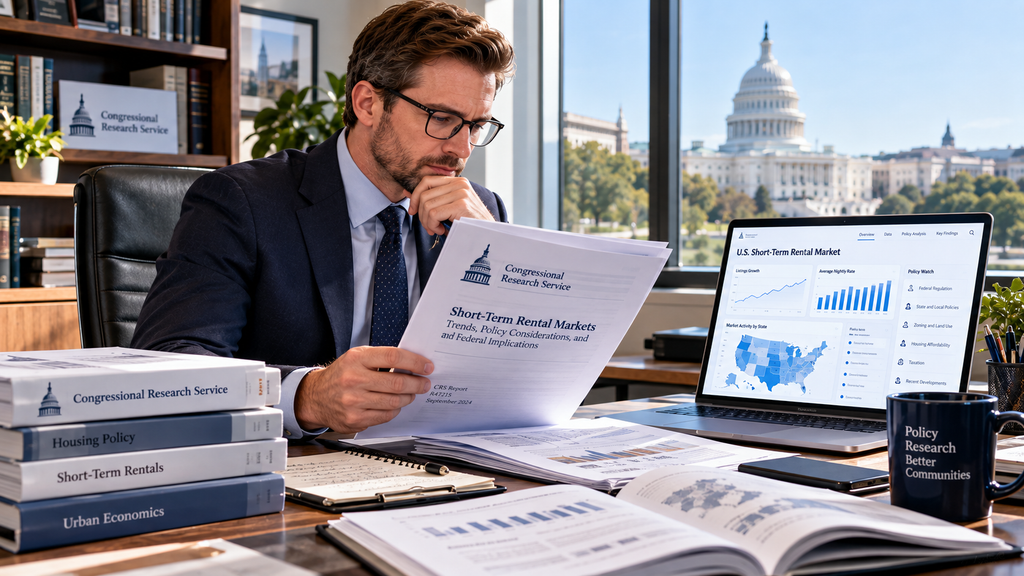
The Congressional Research Service is a legislative-branch agency within the Library of Congress that works exclusively for Congress. Its statutory mission is to provide high-quality research, analysis, information, and confidential consultation to support Congress’s legislative, representational, and oversight responsibilities.
CRS began in 1914 as the Legislative Reference Service. Congress renamed and significantly expanded it through the Legislative Reorganization Act of 1970. Today, CRS includes analysts, attorneys, librarians, editors, data specialists, and other professionals who support congressional offices.
The agency identifies confidentiality, objectivity, nonpartisanship, authoritativeness, and timeliness as important characteristics of its work. Its services can include written reports, confidential responses to congressional questions, briefings, legal analysis, legislative summaries, data analysis, and other research services.
What Does CRS Do for Congress?
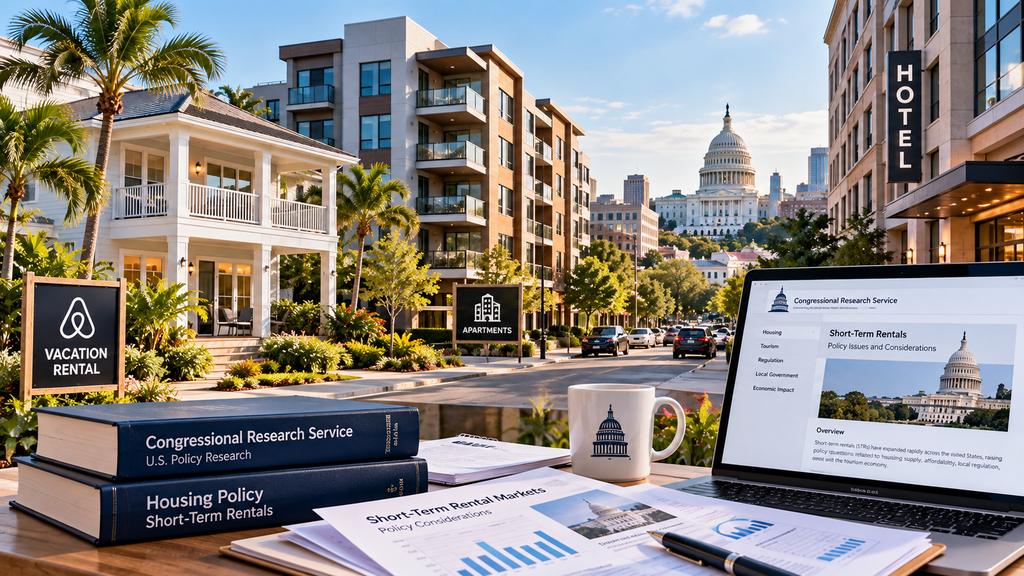
The Congressional Research Service is designed to help Members of Congress and congressional committees understand complex issues.
Its analysts may examine economic data, legislation, regulations, court decisions, scientific research, historical developments, and other information relevant to congressional work.
CRS can also provide customized assistance rather than only publishing general reports. The Library of Congress describes CRS as providing research, analysis, information, and consultation across the legislative process.
This makes CRS different from a government agency that administers a program or enforces a regulation. Its primary function is research and analytical support for Congress.
What Is a CRS Report?
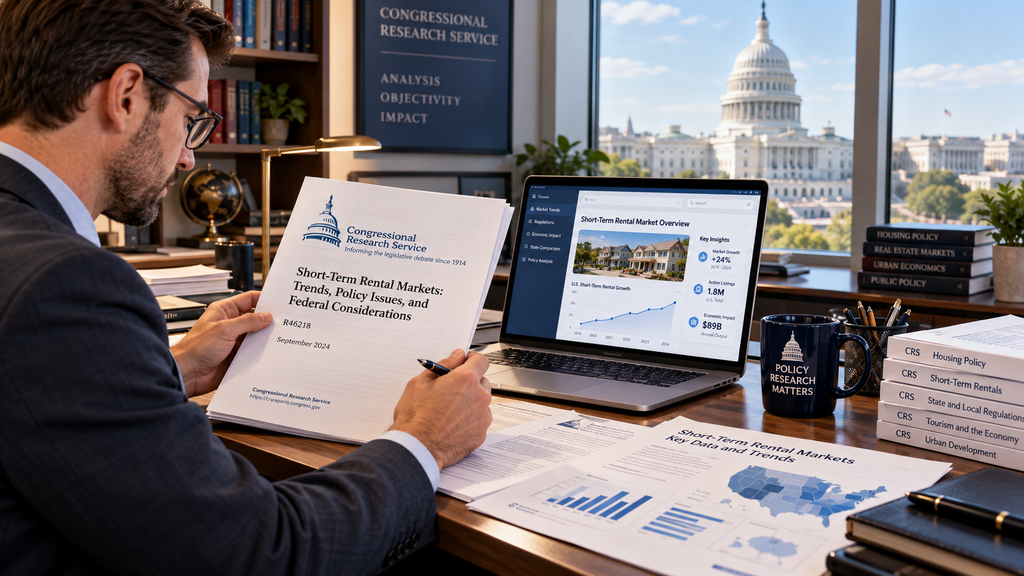
A CRS report is a research product prepared for congressional use. Different products have different formats and purposes.
An In Focus report such as IF12920 is designed as a concise overview that explains an issue and identifies important considerations.
A CRS report is not legislation, a regulation, or a congressional vote. It is also not itself a statement of what Congress has decided.
Instead, it is analytical material prepared to help Members of Congress and committees understand an issue.
That distinction is important when reading CRS material about a contested public-policy subject. A report may describe competing arguments, summarize research findings, identify policy options, and explain legal or economic considerations without endorsing one particular outcome. CRS describes its work as objective and nonpartisan and says its products undergo review intended to maintain those standards.
Short-Term Rental Markets: What IF12920 Covers
CRS Report IF12920 defines short-term rentals, or STRs, as generally furnished homes or rooms rented for fewer than 30 days, often for tourism or short-term business travel. It notes that the market existed before online platforms but expanded with the growth of platforms such as Airbnb and Vrbo.
The report identifies the United States as the largest STR market. It says Airbnb had the largest number of U.S. listings among STR platforms, followed by Vrbo and smaller platforms. Other platforms, including Expedia, Booking.com, and Google, also offer short-term rentals, although STRs represent a smaller share of their overall businesses.
According to AirDNA data cited by CRS, the United States had approximately 2.4 million total short-term rentals in 2023, representing about $64 billion in annual revenue. The average number actively available at any one time was lower, at approximately 1.5 million, reflecting seasonality and consumer demand.
CRS compares this with a U.S. housing stock of approximately 147 million units in the third quarter of 2024 and estimates that the total STR figure represented roughly 1.6% of the country’s housing stock.
These figures provide national context, but the report emphasizes that local markets can behave differently.
Short-Term Rentals and Housing Prices
Housing affordability is one of the central policy questions surrounding short-term rentals.
The basic concern is that converting homes or long-term rental units into short-term accommodations could reduce the supply available to local residents. If an area already has limited housing supply, a reduction in long-term supply could put upward pressure on rents or home prices.
However, the Congressional Research Service emphasizes that the relationship varies by locality. Local housing supply, demand, construction activity, zoning rules, land-use regulations, demographics, and other economic factors can influence outcomes.
What Does the Research Show?
The report cites research examining Airbnb listings and housing prices.
One study cited by CRS found that, at the median owner-occupancy-rate ZIP code, a 1% increase in Airbnb listings was associated with a 0.018% increase in rents and a 0.026% increase in house prices.
The report also cites research from Irvine, California, and Santa Monica, California, where local restrictions produced different results.
CRS cautions that these studies represent only part of the available research and that findings from individual communities should not automatically be generalized across the entire United States. The report also notes that short-term rentals cannot by themselves explain the overall increase in U.S. housing prices since 2012. Other factors include housing supply constraints, zoning and land-use rules, interest rates, economic growth, and demographic changes.
Short-Term Rentals and the Hotel Industry
The hotel industry is another area examined in IF12920.
Short-term rentals can compete with hotels for tourists and business travelers, potentially giving consumers more accommodation choices.
However, CRS notes that short-term rentals and hotels are not perfect substitutes.
How Are STRs Different From Hotels?
Short-term rentals may appeal to families or larger groups because they can offer additional space and may be available in locations where hotels are less common.
Hotels, meanwhile, can offer different advantages, including services and locations that may be particularly useful for business travelers.
The CRS report says research has found that increasing numbers of short-term rentals can affect hotel prices and profitability. It also notes that restrictions on STRs can reduce competition and may affect hotel prices.
These effects can vary substantially by market. A major tourist destination may experience different competitive conditions from a community with limited visitor demand.
Short-Term Rentals and Tourism
Tourism is another potential economic channel.
The Congressional Research Service notes that increased accommodation options and potentially lower lodging prices can benefit visitors and may contribute to increased tourism in some communities. More visitors can, in turn, affect local businesses and employment.
The report cites research examining Airbnb’s relationship with employment in hospitality, tourism, and leisure industries in selected metropolitan areas. That research found statistically significant positive effects in the locations examined.
However, the geographic scope matters. Evidence from selected metropolitan areas does not necessarily describe every U.S. community.
How Local Governments Regulate Short-Term Rentals
A major theme of the CRS report is that many STR policy questions are local.
State and local governments have used different approaches, including restrictions on whole-home rentals, occupancy rules, taxes, permits, and business-license requirements.
The report gives New York City as an example of a jurisdiction that has imposed restrictions on entire-home rentals of fewer than 30 days. It also discusses Santa Monica and Irvine as examples of local rules that can limit whole-home STR activity.
Local tax treatment also varies. CRS notes that nearly every locality imposes at least some type of tax on short-term stays, but treatment can differ significantly between jurisdictions.
Permits and business licenses are another regulatory tool. Some localities require STR operators to obtain permits or licenses associated with the property or business.
For hosts and property owners, this means national information about short-term rentals is not enough to determine whether a particular property can legally operate as an STR. Current city, county, and state requirements should be checked directly with the relevant authorities.
Price Transparency in Short-Term Rentals
Another policy issue discussed in IF12920 is the way lodging prices are displayed.
Short-term rental and hotel bookings can include mandatory fees that are not always reflected in an initial nightly rate. The report notes that some platforms have voluntarily moved toward more inclusive pricing.
The report also references a Federal Trade Commission rule finalized in 2024 concerning upfront disclosure of total prices, including mandatory fees, for short-term lodging and hotels. CRS notes that legislation in the 118th Congress, including H.R. 6543 and S. 2498, addressed similar price-disclosure issues.
This issue matters to consumers because the advertised nightly rate may not always represent the total amount payable for a stay.
Online Platform Liability
The Congressional Research Service also discusses questions involving online-platform liability.
Section 230 of the Communications Act provides online platforms with certain legal protections related to third-party content. The report explains that this can raise questions about whether STR platforms should face liability when listings allegedly violate state or local laws.
CRS describes H.R. 1107 from the 117th Congress as an example of legislation that would have changed Section 230 protections in specified STR circumstances and expressly addressed state and local authority.
This is historical legislative context, not a statement that the proposal became current law. Readers researching present-day platform liability should consult current federal statutes, regulations, court decisions, and legislation.
Why the Congressional Research Service Report Matters
The value of IF12920 is its structure. Instead of treating short-term rentals as only a housing issue, it shows how the market intersects with several areas:
- Housing supply and affordability
- Hotel competition
- Tourism
- Local regulation
- Taxes
- Price transparency
- Online-platform liability
The report also illustrates an important feature of policy research: effects can vary by place.
A regulation that changes STR activity in a dense urban market may have different consequences in a resort town, suburban community, or small city. Similarly, an increase in short-term rental supply may interact differently with housing markets depending on construction levels, vacancy rates, zoning, and local demand.
For that reason, national statistics are useful for context, but local evidence is often necessary when property owners, businesses, and policymakers are examining a particular community.
How to Read CRS Reports Responsibly
When using the Congressional Research Service as a research source, readers should pay attention to the report date, scope, cited evidence, and limitations.
First, check when the report was published or updated. Policy areas can change quickly.
Second, distinguish between CRS’s description of research and CRS’s own institutional role. A report may cite studies with different findings without selecting one study as definitive.
Third, check the geographic scope. A study of one city or group of cities may not apply nationally.
Fourth, distinguish existing law from proposed legislation. A CRS report may discuss bills that were introduced but never enacted.
Finally, use the report as one component of research when making a practical decision. For current short-term rental rules, official state and local government sources are generally necessary.
Frequently Asked Questions About the Congressional Research Service
What does the Congressional Research Service do?
The Congressional Research Service provides Congress with research, analysis, information, and confidential consultation covering legislative, oversight, and representational needs.
Is the Congressional Research Service part of Congress?
CRS is a legislative-branch agency within the Library of Congress and works exclusively for Congress. Its mission is to support congressional offices and committees.
Are CRS reports nonpartisan?
CRS states that its work is objective and nonpartisan and uses a multilayered review process intended to maintain those standards.
What is Congressional Research Service Report IF12920?
IF12920 is an In Focus report titled “Short-Term Rental Markets: A Primer,” published February 24, 2025. It examines the U.S. short-term rental market, housing-price questions, hotel-industry effects, tourism, local regulation, price transparency, and online-platform liability.
Does IF12920 recommend a national short-term rental policy?
No. The report describes the market, research findings, and policy issues. It does not present a single national policy recommendation.
What is a short-term rental?
CRS says short-term rentals generally refer to furnished homes or rooms rented for fewer than 30 days, often for tourism or short-term business travel. It also notes that there is no official definition that applies universally to every context.
Does the Congressional Research Service regulate Airbnb or other rental platforms?
No. CRS is a research and analytical service for Congress. It does not issue short-term rental permits, regulate platforms, or enforce local STR laws.
Where can I find CRS reports?
CRS reports are available through Congress.gov and Library of Congress resources, while many reports are also indexed by public research repositories. The official IF12920 report is available through Congress.gov.
Conclusion
The Congressional Research Service provides a useful window into how complex policy questions are researched for the U.S. Congress. Its role is not to make laws or regulate industries, but to provide objective, nonpartisan research and analysis that can help lawmakers understand the issues before them.
IF12920, “Short-Term Rental Markets: A Primer,” is a clear example. Published on February 24, 2025, the report examines a significant part of the U.S. lodging market and explains how short-term rentals can intersect with housing, hotels, tourism, local government regulation, pricing practices, and online-platform liability.
One of the report’s central analytical points is that short-term rental effects are highly dependent on local conditions. Housing supply, construction, zoning, tourism demand, regulations, demographics, and broader economic conditions can all influence what happens in a particular market.
For readers researching Airbnb, Vrbo, vacation rentals, or short-term rental policy, IF12920 provides a concise starting point. It should be read with attention to its February 2025 publication date and supplemented with current state and local rules when the question involves a specific property or jurisdiction.
More broadly, the Congressional Research Service demonstrates the value of separating documented evidence from policy choices. Understanding the available research, the limitations of individual studies, and the differences between proposed and enacted policies can help readers follow the short-term rental debate with greater clarity.

