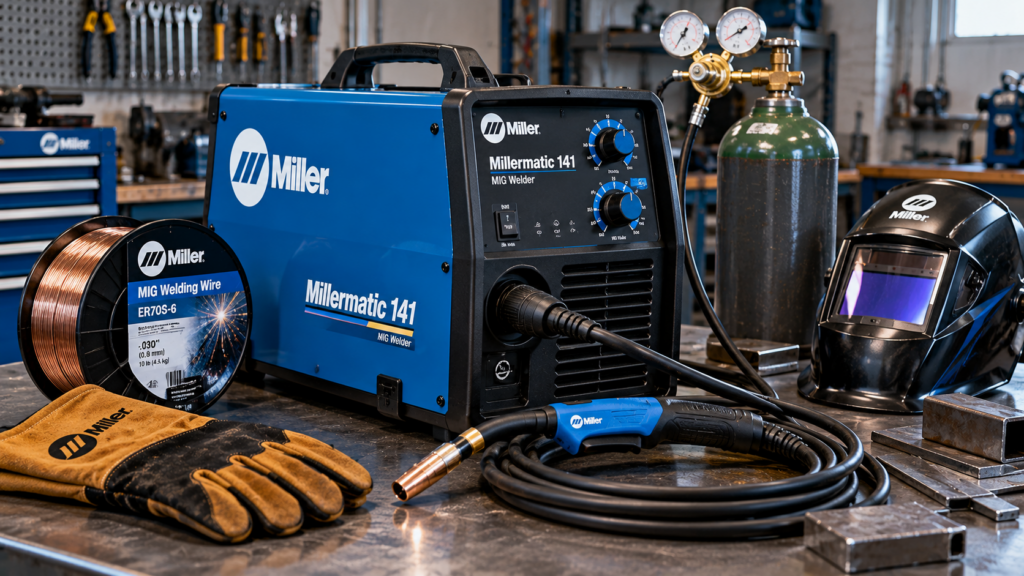
Choosing the right MIG welder can make a significant difference in how easily you can complete fabrication, repair, automotive, maintenance, and DIY projects. For many American welders, a machine that can operate from a standard 120V outlet is especially attractive because it does not require a dedicated 240V circuit.
The Millermatic 141 has been a well-known example of this type of compact MIG welding machine. Designed by Miller Electric, the 141 combines 120V operation with MIG and flux-cored welding capabilities in a relatively compact package.
The model is no longer a current product. Welding Supplies from IOC lists the Millermatic 141, stock number 907612, as discontinued and identifies the Millermatic 142 as its replacement. Miller’s current Millermatic lineup also lists the Millermatic 142 as its 120V MIG and flux-cored model.
However, the Millermatic 141 remains relevant for owners, used-equipment buyers, repair shops, and welders researching the specifications and capabilities of this model.
This guide explains what the Millermatic 141 can do, where it fits best, its important specifications, setup considerations, and what buyers should know about its successor.
What Is the Millermatic 141?
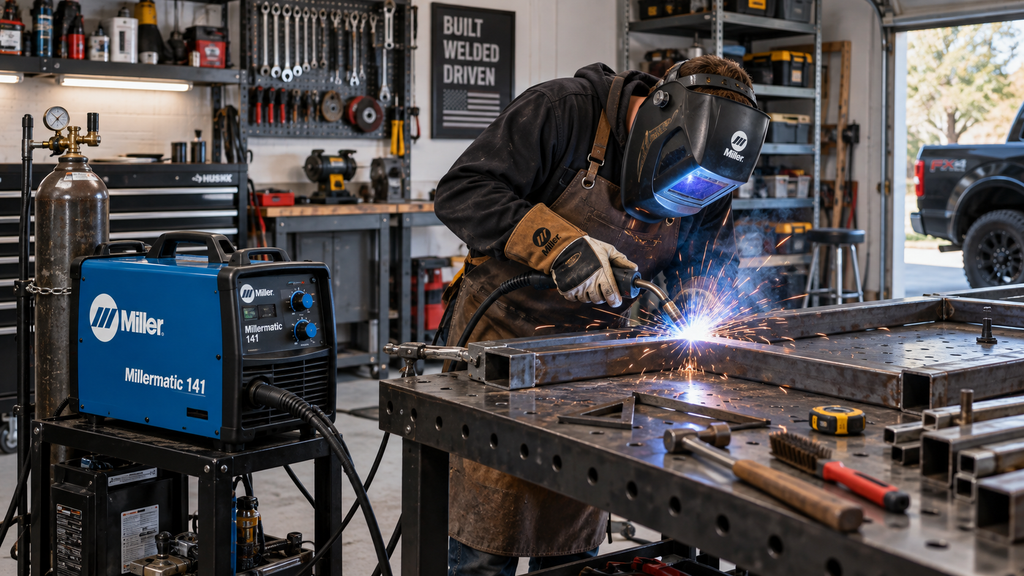
The Millermatic 141 is a compact MIG and flux-cored welding machine designed to operate from 120V single-phase power.
Its stock number is 907612, and Miller’s specifications list an amperage range of 30–140 amps. The rated output is 90 amps at 18.5 VDC with a 20% duty cycle.
The machine was designed for welders who wanted the convenience of a standard household-style electrical supply while still having access to a capable MIG welding platform.
This makes the machine particularly relevant for:
- Home workshops
- Automotive repair
- DIY fabrication
- Small repair businesses
- Maintenance work
- Light fabrication
- Farm and ranch repairs
- Hobby welding
The 120V design is one of its biggest practical advantages.
Millermatic 141 Specifications
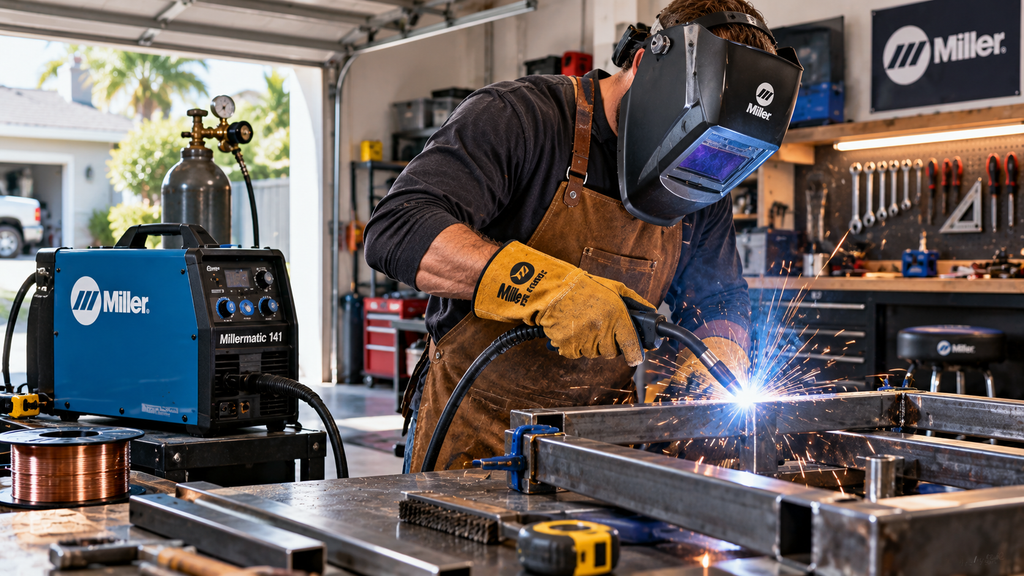
Understanding the technical specifications helps determine whether a welder is appropriate for a particular project.
According to Miller’s published specifications, the Millermatic 141 has the following characteristics:
Power
The machine uses 120V, 60 Hz input power and draws approximately 20 amps at rated output.
Amperage Range
The welding amperage range is 30–140 amps.
Rated Output
The rated output is 90 amps at 18.5 VDC with a 20% duty cycle.
Wire Feed Speed
Miller lists a wire feed speed range of approximately 15–360 inches per minute.
Dimensions
The published dimensions are approximately 12.5 inches high, 11.25 inches wide, and 20.5 inches deep.
Weight
The power source weighs approximately 51 pounds.
These specifications place the Millermatic 141 firmly in the compact 120V MIG welder category.
Key Features of the Millermatic 141
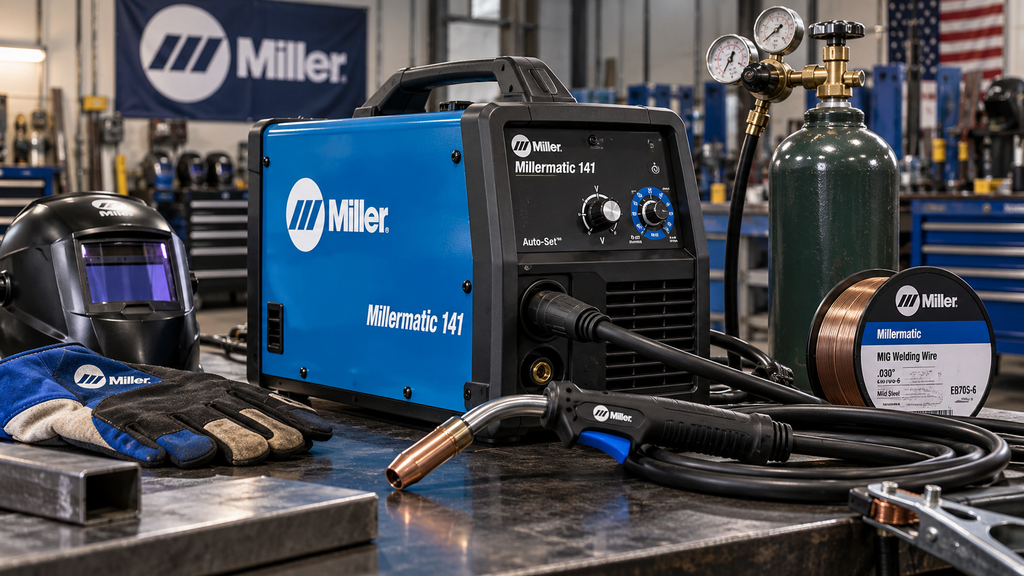
The Millermatic 141 was designed to simplify MIG welding without removing manual control from experienced users.
Auto-Set Technology
One of the machine’s best-known features is Miller’s Auto-Set technology.
The system helps establish welding parameters based on material thickness and wire diameter. Miller’s owner’s manual shows controls for material thickness and wire diameter alongside the wire-speed control.
For newer welders, this can reduce the amount of guesswork involved in setting up a basic MIG weld.
Experienced welders can also use manual settings when they want greater control.
Manual Welding Mode
The Millermatic 141 does not force the operator to rely exclusively on Auto-Set.
Manual mode allows welders to establish their own parameters for applications where they want to fine-tune voltage and wire feed settings.
This can be particularly useful when working with different materials, joint configurations, or welding techniques.
Quick-Select Drive Roll
The machine uses a Quick-Select drive roll system designed to simplify wire setup.
Welding Supplies from IOC describes the drive roll as having grooves for different solid-wire sizes and flux-cored wire.
Proper drive-roll selection is important because the wrong configuration can contribute to poor wire feeding and inconsistent welding performance.
What Materials Can the Millermatic 141 Weld?
The Millermatic 141 supports several wire types.
Miller’s specifications list:
- Solid steel wire from approximately .023–.030 inch
- Stainless steel wire from approximately .023–.030 inch
- Flux-cored wire from approximately .030–.035 inch
This gives the machine flexibility for common workshop applications.
Mild Steel
Mild steel is one of the most common materials for MIG welding.
The Millermatic 141 can be used for suitable mild-steel projects within its output and material-thickness capabilities.
Typical applications can include brackets, small frames, automotive repairs, equipment repairs, and general fabrication.
Stainless Steel
The machine can also be configured for stainless-steel welding using appropriate wire, shielding gas, and settings.
Stainless steel requires careful preparation and appropriate consumables, so users should follow the wire manufacturer’s recommendations rather than relying solely on generic MIG settings.
Flux-Cored Welding
Flux-cored wire provides another option when shielding-gas use is undesirable or when the application benefits from flux-cored welding.
The Millermatic 141 supports compatible flux-cored wire sizes within its specified range.
Can the Millermatic 141 Weld Aluminum?
Aluminum welding requires additional considerations.
The Millermatic 141 was designed primarily around common MIG and flux-cored applications, but Miller documentation and supplier information identify a Spoolmate 100 spool gun as an available accessory for the machine.
A spool gun can help with aluminum MIG applications by shortening the distance the soft aluminum wire has to travel through the gun and cable assembly.
However, aluminum welding also requires appropriate shielding gas, wire, contact tips, technique, and machine settings.
Users should verify the exact configuration and material requirements before attempting an aluminum project.
Millermatic 141 Setup
One reason the Millermatic 141 became popular with home and small-shop welders was its relatively straightforward setup.
A typical MIG configuration requires:
- Connecting the welding gun
- Connecting the work lead
- Installing the appropriate wire spool
- Selecting the correct drive-roll configuration
- Installing the correct contact tip
- Connecting shielding gas when required
- Setting gas flow
- Selecting wire diameter
- Setting material thickness or manual parameters
- Testing the weld on scrap material
The machine’s owner’s manual and Miller’s support resources provide model-specific setup and maintenance information. Miller also maintains setup videos covering parameter selection, MIG gun components, consumables, and flux-cored welding techniques.
Always follow the machine manual and consumable manufacturer’s recommendations.
Understanding the 20% Duty Cycle
Duty cycle is an important specification that is sometimes overlooked when choosing a welder.
The Millermatic 141 is rated at 90 amps with a 20% duty cycle.
In practical terms, duty cycle describes how long the machine can weld at its rated output within a standard test period before requiring cooling time.
A 20% duty cycle means that continuous high-output welding is not the intended use case.
For short welds, repair jobs, fabrication projects, and intermittent work, this may be perfectly appropriate.
For production environments requiring long periods of continuous welding, a machine with a higher duty cycle and greater output may be more suitable.
Where the Millermatic 141 Fits Best
The Millermatic 141 is particularly suited to applications where portability, 120V power, and straightforward MIG operation are important.
Home Workshops
A homeowner can use a 120V MIG welder for many repair and fabrication projects without installing a specialized 240V circuit.
Automotive Projects
The machine can be useful for suitable automotive fabrication and repair work, including brackets, panels, small structural components, and other appropriately sized projects.
Users should always match the welding process and machine capacity to the specific repair and material.
DIY Fabrication
The Millermatic 141 can be useful for projects such as:
- Workbenches
- Small trailers
- Metal shelving
- Gates
- Brackets
- Tool carts
- Garden equipment
- Decorative metalwork
The actual suitability depends on material thickness, joint design, required strength, and welding position.
What Are the Limitations of the Millermatic 141?
No welder is suitable for every application.
The most important limitation is its output and duty cycle.
A compact 120V machine should not be treated like a high-output industrial welder.
If your projects involve thick structural steel, long continuous welds, heavy fabrication, or production-level work, a larger machine may be more appropriate.
Power availability is another consideration. Although the Millermatic 141 operates from 120V input, its rated input current is significant, so the electrical circuit and extension-cord setup should be appropriate for the machine and application.
Millermatic 141 vs. Millermatic 142
For anyone researching the Millermatic 141 today, the most important point is that it has been discontinued.
Welding Supplies from IOC currently states that the 141 is no longer available from Miller and identifies the Millermatic 142, stock number 907838, as the replacement.
Miller’s current Millermatic lineup lists the 142 as its current 120V MIG and flux-cored welder, with an amperage range of 30–140 amps and the ability to weld mild and stainless steel from 24 gauge up to 3/16 inch.
This distinction is important for anyone shopping for a new machine.
If you already own a Millermatic 141, the machine can still be relevant as an existing piece of equipment. If you are looking to purchase a new Miller 120V MIG welder, researching the current Millermatic 142 is more appropriate.
Buying a Used Millermatic 141
Because the model has been discontinued, some buyers may encounter used or remaining-stock machines.
Before purchasing a used Millermatic 141, inspect the machine carefully.
Check:
- Overall physical condition
- Power cord
- MIG gun
- Work lead
- Drive rolls
- Wire-feed mechanism
- Contact tip
- Nozzle
- Fan operation
- Control knobs
- Over-temperature indicator
- Internal cleanliness
- Serial number
Miller provides manuals and parts resources that can be searched by model and serial number, which can be useful when identifying service information or replacement components.
A demonstration weld is also useful when buying used equipment, provided it can be performed safely.
Millermatic 141 Maintenance Tips
Proper maintenance can help keep a MIG welder operating consistently.
Clean the machine according to the manufacturer’s recommendations and keep airflow paths clear.
Inspect consumables regularly and replace worn contact tips, nozzles, liners, and other components when needed.
Pay attention to wire-feed performance. Bird-nesting, slipping wire, inconsistent feed, or excessive contact-tip wear can indicate a setup or consumable issue.
Miller’s support resources include owner manuals and parts information for its equipment.
The Millermatic 141 can also be protected from workshop dust and moisture with a suitable cover. Miller lists a protective cover designed specifically for the Millermatic 141/211 and Multimatic 215.
Frequently Asked Questions About the Millermatic 141
Is the Millermatic 141 still available?
The Millermatic 141 has been discontinued. Welding Supplies from IOC identifies the Millermatic 142 as its replacement, while Miller’s current lineup lists the 142 as its 120V MIG and flux-cored model.
What voltage does the Millermatic 141 use?
The Millermatic 141 uses 120V, 60 Hz single-phase input power.
What is the amperage range of the Millermatic 141?
Miller lists an amperage range of 30–140 amps.
What is the duty cycle of the Millermatic 141?
Its rated output is 90 amps at 18.5 VDC with a 20% duty cycle.
Can the Millermatic 141 weld flux-cored wire?
Yes. Miller lists flux-cored wire in the approximate .030–.035-inch range for the machine.
Can the Millermatic 141 weld aluminum?
It can be configured for certain aluminum MIG applications using compatible equipment such as the Spoolmate 100 spool gun, but aluminum welding requires the appropriate wire, gas, consumables, and settings.
Is the Millermatic 141 good for beginners?
Its Auto-Set controls were designed to simplify parameter selection, which can make the machine approachable for newer MIG welders. However, beginners should still learn proper welding technique, electrical safety, shielding-gas practices, and equipment setup before operating the machine.
What replaced the Millermatic 141?
The Millermatic 142 is the current replacement identified by Welding Supplies from IOC, and Miller currently lists the 142 in its Millermatic lineup.
Conclusion
The Millermatic 141 remains a notable compact MIG welder for anyone researching 120V welding equipment, especially for home workshops, automotive work, maintenance, DIY fabrication, and other intermittent welding applications.
Its 120V input, 30–140 amp range, Auto-Set functionality, manual controls, MIG and flux-cored capabilities, and relatively compact design made it a practical machine for welders who did not need a larger industrial power source.
At the same time, prospective buyers should understand that the Millermatic 141 is now a discontinued model. Current information from Welding Supplies from IOC identifies the Millermatic 142 as its replacement, while Miller’s current product lineup lists the 142 as its 120V MIG and flux-cored offering.
For existing owners, the 141 can remain a useful workshop machine when operated within its specifications and maintained properly. For someone shopping for a new Miller welder today, comparing the current Millermatic 142 with other available models is the more practical route.
Regardless of the model, successful MIG welding depends on matching the machine, wire, shielding gas, material thickness, settings, and welding technique to the application. Always follow the manufacturer’s operating instructions and use appropriate welding safety equipment.