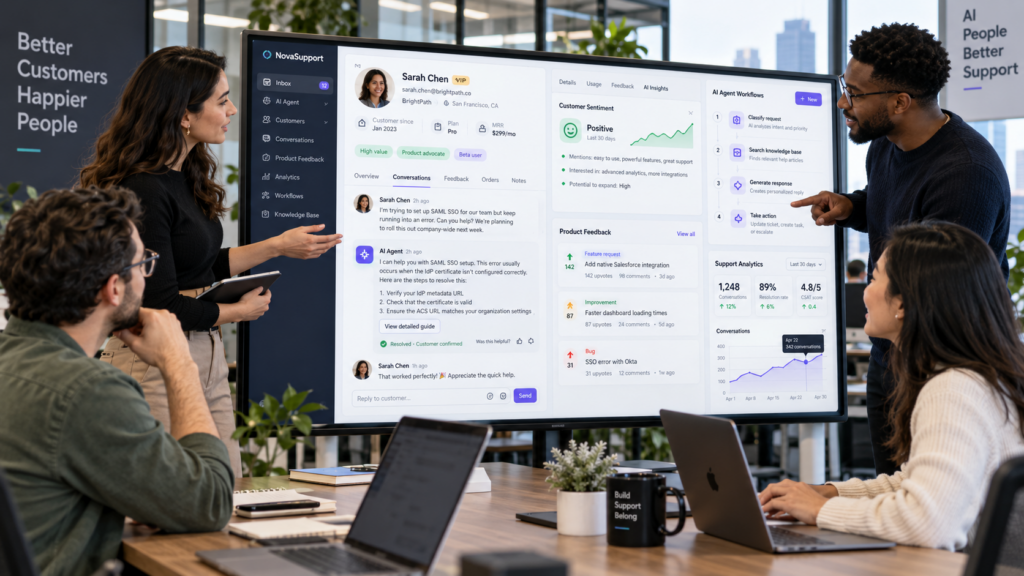
Customer support has traditionally been treated as a separate function from product development. A customer asks a question, a support agent provides an answer, and the conversation ends.
But for modern SaaS companies, that conversation can contain much more valuable information.
A support message might reveal why a customer cannot complete onboarding, why a trial user is hesitating to upgrade, which feature is confusing, or what customers repeatedly request. If that information stays inside an inbox, the business may solve the immediate problem without addressing the underlying issue.
Zens, through its Zens AI platform, takes a different approach. It is designed to connect AI-powered customer support with customer identity, account context, product feedback, analytics, and team workflows. The platform describes itself as AI customer support for SaaS teams, with capabilities covering 24/7 support, knowledge management, customer context, human collaboration, proactive conversion support, feedback loops, and reporting.
For American SaaS companies looking to improve customer experience while reducing repetitive support work, understanding how Zens works can help clarify where AI-powered support fits into a modern business.
What Is Zens AI?
Zens AI is a customer support platform built specifically around SaaS products.
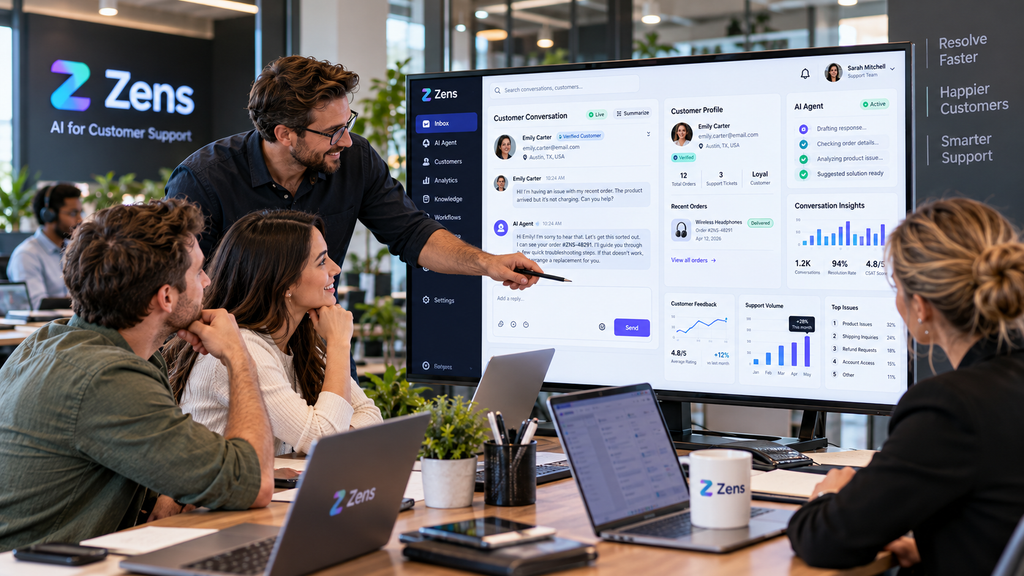
Rather than functioning only as a traditional chat widget, Zens combines customer conversations with information about the user, account, subscription, current page, product activity, and other relevant context.
Its product page describes a workspace where teams can view customer conversations alongside identity, account traits, recent activity, recommended actions, and customer journeys.
This approach matters because customer questions rarely exist in isolation.
For example, “Why can’t I upgrade?” could mean very different things depending on the customer. One person might be confused about pricing, another may have reached a seat limit, and another may have encountered a technical issue during checkout.
Context allows the support team or AI system to understand the situation before responding.
Why Customer Context Matters in SaaS Support
A fast answer is useful, but an accurate answer is more valuable.
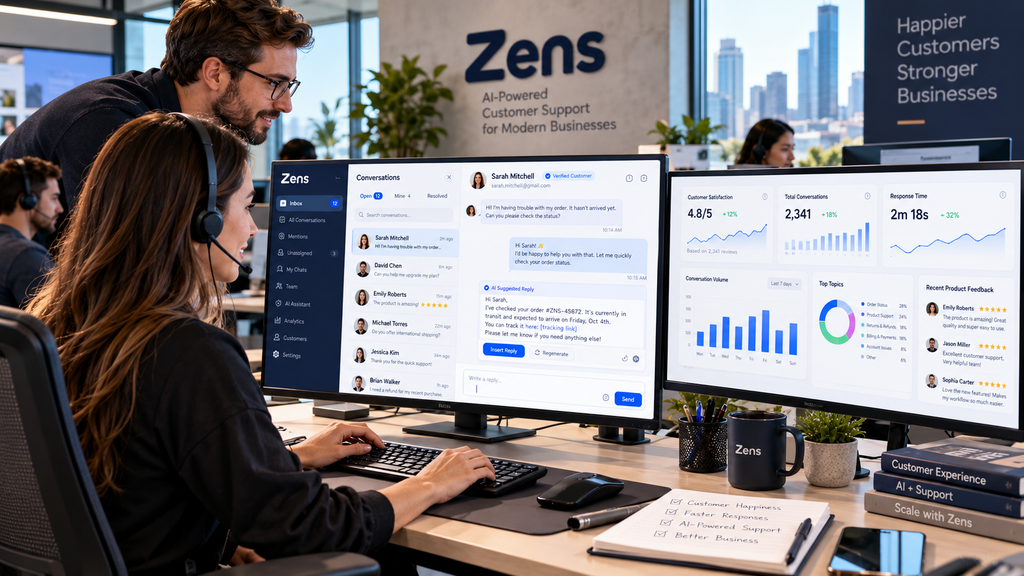
Imagine a customer contacts support after spending several minutes on a pricing page. If the support system knows the customer’s account, plan, recent activity, and current page, the response can be more relevant than a generic answer copied from a help article.
Zens describes this as a unified customer context layer that can bring together anonymous visitors, signed-in users, accounts, plans, pages, and events.
Understanding the Customer Behind the Question
Customer identity can provide important context.
A support team may need to know whether the person is:
- A trial user
- A paying customer
- An account administrator
- A high-value business account
- A new user
- An existing customer considering an upgrade
Zens can connect these types of account attributes with support conversations so teams can understand who is asking and what they are trying to accomplish.
Seeing What the Customer Was Doing
Current-page information and recent product activity can provide additional context.
A question asked while a user is on a billing page is different from a question asked while they are configuring an integration.
Instead of asking customers to explain everything from the beginning, the support system can potentially start with information already available in the customer context.
Zens as an AI Customer Support Platform
One of the central capabilities of Zens is AI-assisted support.
The platform is designed to receive customer questions, analyze relevant product information, prepare responses, and provide teams with tools for human collaboration.
Zens states that its default approach is review-first, meaning AI can prepare drafts while the team maintains control over what is actually sent to customers.
This can be particularly useful for companies that want AI assistance without immediately handing every customer interaction over to an autonomous system.
AI-Generated Reply Drafts
Support agents frequently answer similar questions.
Pricing, account settings, installation, integrations, password issues, billing, and onboarding questions can consume significant amounts of time when handled manually.
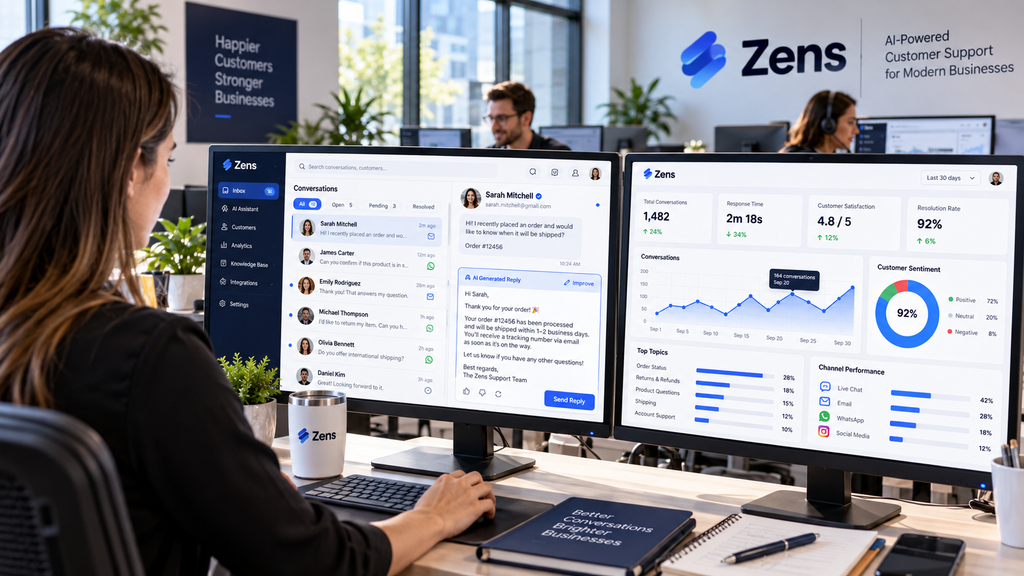
Zens can generate reply drafts based on available product knowledge and customer context. The support team can then review the response before sending it.
This creates a balance between automation and human oversight.
24/7 Support Availability
Customer questions do not always arrive during business hours.
Zens positions its AI support capabilities around continuous availability, allowing SaaS companies to respond to questions while their human teams are away.
For companies serving customers across multiple time zones, this can be particularly relevant.
However, availability should not be confused with unlimited autonomous decision-making. Businesses still need to establish appropriate rules for which questions AI can handle and which situations require human involvement.
Turning Customer Conversations Into Product Feedback
One of the more interesting aspects of Zens is its emphasis on using support conversations as product evidence.
Customer support teams hear directly from users every day. Those conversations can contain valuable information for product managers and engineers.
The challenge is organizing that information.
Zens describes capabilities for automatically clustering recurring questions and identifying themes such as bugs, feature requests, pricing objections, and user-experience friction.
Finding Repeated Problems
Suppose ten customers ask different versions of the same question.
Individually, each conversation may appear small.
Together, they may indicate a significant usability problem.
An AI system can help identify patterns across conversations, allowing product teams to investigate recurring issues rather than treating each message as an isolated support ticket.
Connecting Feedback to Business Impact
Not every feature request deserves the same priority.
A question from a high-value account, a recurring issue affecting dozens of trial users, and a minor interface suggestion may have very different business implications.
Zens describes support analysis that can be broken down by account, plan, role, region, journey stage, and other dimensions.
That type of analysis can help teams understand where support problems intersect with customer retention, activation, and conversion.
Zens and AI Agent Workflows
AI agents are becoming increasingly important in software development and business operations.
Zens is designed to connect customer evidence with agent-based workflows rather than keeping support isolated from engineering.
The platform says it can package recurring customer feedback into implementation-ready briefs containing evidence, affected routes, reproduction details, and acceptance criteria.
Connecting Customer Problems to Engineering
Consider a recurring software bug.
Traditionally, the workflow might look like:
Customer → Support → Product Manager → Engineer
Each handoff can lose information.
A support agent may summarize the problem differently from the original customer. The product manager may then rewrite it as a requirement, and the engineer may need to ask for additional details.
A structured customer-evidence workflow can reduce some of that information loss.
Zens currently highlights integrations and workflows involving Codex, Claude Code, Cursor, Windsurf, Gemini CLI, OpenCode, Slack, Linear, and GitHub.
Zens for SaaS Product Teams
Product teams need more than a list of support tickets.
They need to understand why customers struggle.
Zens provides tools for examining conversations and customer journeys to identify where friction occurs.
The platform highlights journey-stage analysis, cohort analysis, heatmaps, and smart filters for understanding patterns across support conversations and visitor activity.
Product Questions That Zens Can Help Investigate
A SaaS team could use customer-support data to explore questions such as:
- Which onboarding steps generate the most questions?
- Which features create repeated confusion?
- Why are trial users not upgrading?
- Which accounts are showing signs of expansion?
- What questions appear before a customer cancels?
- Which help documents fail to answer common questions?
- Which product pages generate the most support activity?
These questions turn customer support into a source of product intelligence.
Human Oversight Still Matters
AI customer support does not mean removing humans from the support process.
For many businesses, the better approach is to automate repetitive work while keeping people involved in sensitive, complex, or high-value interactions.
Zens explicitly emphasizes a review-first approach in which AI can prepare drafts while humans control what reaches the customer.
This can be important for:
- Billing disputes
- Enterprise accounts
- Sensitive customer information
- Complex technical problems
- Refund decisions
- Security concerns
- Escalated complaints
The goal is not necessarily to automate everything. It is to automate appropriate tasks while preserving human judgment where it matters.
Data Privacy and Access Controls
Customer support systems can contain sensitive information, making data governance an important consideration when evaluating AI software.
Zens highlights several security-related capabilities, including signed identity, role controls, audit logs, private fields, permission scope, and a stated policy that customer conversations are not used for model training by default.
The platform’s privacy policy was updated in February 2026 and provides additional information about its approach to personal data.
Businesses should still review the provider’s current privacy documentation, contractual terms, data-processing arrangements, and security requirements before connecting production customer data.
Integrating Zens With an Existing SaaS Product
Zens describes a three-step integration process for SaaS teams.
Register Your Site
Teams create a workspace, receive a site ID and signing secret, and determine which user fields can be included in support context.
Install the SDK
The Zens SDK can be added to a product to synchronize information such as user identity, account details, subscription information, and current page context.
Connect Team Workflows
After the support context is established, teams can connect workflows with tools such as Slack, Linear, GitHub, and AI coding agents.
Zens also provides documentation covering SaaS integration, WordPress, GitHub, Zapier, and its Business API.
Who Can Benefit From Zens?
Zens is primarily positioned for SaaS companies rather than traditional businesses that only need a basic customer-service inbox.
It may be relevant to:
SaaS Founders
Founders can use customer conversations to understand recurring problems without manually reviewing every conversation.
Support Teams
Support agents can receive customer context and AI-generated drafts while retaining human control.
Product Managers
Product teams can identify recurring feedback, usability problems, feature requests, and customer objections.
Growth Teams
Growth teams can examine questions and friction around pricing, trials, checkout, and conversion.
Engineering Teams
Engineers can receive structured customer evidence that can be transformed into implementation tasks.
How to Evaluate Zens for Your Business
Before implementing any AI support platform, define the problem you actually want to solve.
Ask:
- How many support conversations do we receive each month?
- How much time is spent answering repetitive questions?
- How often does support feedback reach product teams?
- Which customer information should AI be allowed to access?
- Which conversations require human approval?
- What systems need to be connected?
- How will we measure improvement?
Useful metrics might include first-response time, resolution time, support backlog, AI draft acceptance rate, escalation rate, customer satisfaction, and conversion outcomes.
The goal should be measurable improvement rather than adopting AI simply because it is available.
Frequently Asked Questions About Zens
What is Zens?
Zens is the company behind Zens AI, an AI customer support platform designed for SaaS businesses. It combines customer conversations with identity, account context, product activity, feedback analysis, and team workflows.
What does Zens AI do?
Zens AI can help SaaS teams answer customer questions, generate support drafts, understand customer context, identify recurring feedback, produce reports, and connect customer evidence with product and engineering workflows.
Is Zens only a chatbot?
No. Zens describes itself as more than a traditional chat tool. Its platform includes customer identity, account information, support analytics, feedback clustering, reports, team collaboration, and integrations with development and business tools.
Can Zens connect with coding agents?
Yes. Zens currently highlights workflows with Codex and other coding-agent environments, including Claude Code, Cursor, Windsurf, Gemini CLI, and OpenCode. It can also send customer evidence into tools such as Linear and GitHub.
Does Zens automatically send AI replies?
Zens says review-first is the default approach. AI can prepare drafts and recommendations, while teams control whether and when responses are sent automatically.
Does Zens use customer conversations to train AI models?
Zens states that customer conversations are not used for model training by default. Businesses should still review the current privacy policy and applicable terms before connecting customer data.
Is Zens suitable for small SaaS companies?
The platform is positioned for SaaS teams, including independent developers and growing teams. Its usefulness for a particular company depends on support volume, workflow complexity, customer-data requirements, and the amount of automation the team actually needs.
Conclusion
Modern SaaS support is becoming more than a system for answering customer questions. Every conversation can contain information about product usability, customer intent, conversion barriers, technical problems, and potential improvements.
Zens approaches this problem by connecting AI customer support with customer identity, account context, support conversations, feedback analysis, reporting, and agent workflows.
For SaaS companies, this can create a more connected workflow in which a customer question does not simply end with an answer. The information can become a product insight, a structured engineering task, a sales signal, or a report for the broader business.
The platform’s emphasis on verified customer identity, role-based access, review-first AI responses, and controlled data sharing is also relevant for businesses that want to introduce AI without giving an automated system unrestricted access to customer information.
Ultimately, the value of an AI support platform depends on implementation and measurable outcomes. Businesses should define the repetitive work they want to automate, identify the customer context AI needs, establish appropriate human-review rules, and determine how support insights will reach product and engineering teams.
For SaaS companies that want customer support to become a continuous source of product evidence rather than a separate operational function, Zens AI represents an approach centered on connecting the entire customer-feedback loop—from the first question to the next product improvement.