
For contractors, builders, remodelers, and specialist trades, having enough work is only part of running a successful construction business. The bigger challenge is maintaining a predictable pipeline of future projects.
A company can have excellent workmanship, experienced employees, and strong customer reviews, yet still face slow periods if it does not consistently identify new opportunities.
That is why construction project leads are so important.
Construction leads are potential projects or customers that may eventually become paying jobs. They can come from referrals, search engines, social media, networking, advertising, industry directories, property developers, architects, and planning or permit information.
The most valuable opportunities are often the ones identified early.
When a homeowner, developer, or property owner has already decided to invest in a project but has not yet selected a contractor, there may be an opportunity to introduce your company before the market becomes crowded.
Planning applications are one example of this approach. BuildAlert, for example, uses UK planning-application data to help construction businesses identify projects while they are still at the planning stage. The platform says it monitors applications across more than 400 UK councils and allows users to filter opportunities by location, project type, value, and other criteria.
For U.S. contractors, the specific public-record systems and terminology vary by state and municipality, but the underlying lead-generation principle is similar: identify projects early, qualify them carefully, and contact prospects with a relevant offer.
What Are Construction Project Leads?

Construction project leads are potential customers, projects, or business opportunities that could eventually result in construction work.
A lead might be:
- A homeowner planning an extension
- A property owner considering a renovation
- A developer preparing a new building
- A commercial business remodeling its premises
- A homeowner planning a kitchen or bathroom renovation
- A property investor converting a building
- A general contractor looking for subcontractors
- An architect working on a new project
- A developer preparing a residential development
Not every lead becomes a customer.
The objective is therefore not simply to collect as many names as possible. It is to identify prospects whose project, location, budget, timeline, and requirements match your company’s capabilities.
Why High-Quality Construction Leads Matter
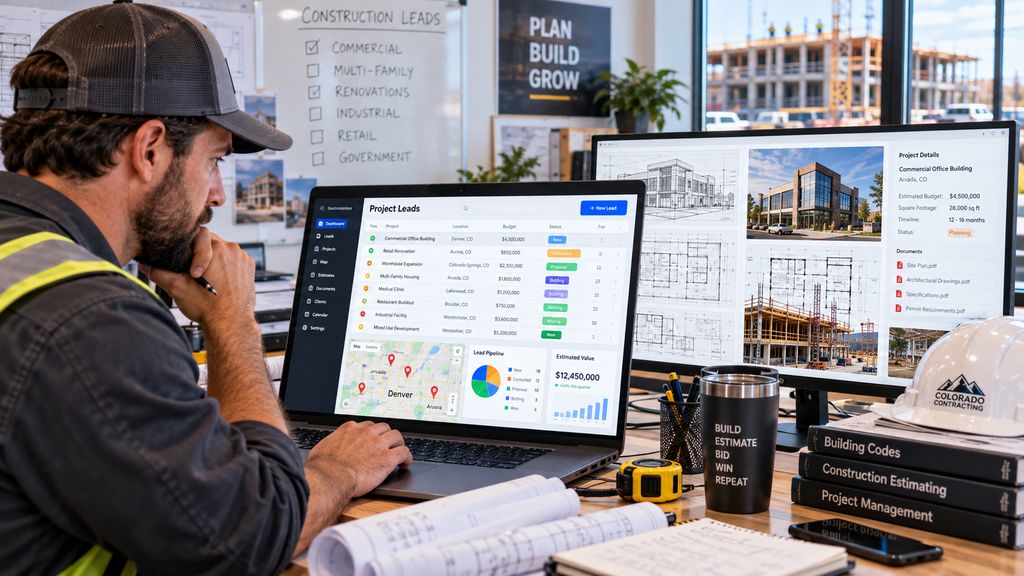
A large database does not automatically produce more construction revenue.
If most of the prospects are outside your service area, have unrealistic budgets, are not ready to start, or need services you do not provide, your sales team can spend hours following up without generating meaningful results.
Qualified leads are different.
A qualified construction lead has characteristics that make the opportunity potentially suitable for your company.
For example, a residential contractor specializing in $100,000-plus extensions might prioritize homeowners who are planning significant additions rather than small repair projects.
A commercial roofing company may want to identify businesses preparing major renovations or new developments.
A solar installer may want to identify projects where renewable energy systems could be incorporated.
The better your targeting, the less time you spend chasing unsuitable opportunities.
Where Can Contractors Find Construction Project Leads?

There is no single source that works for every construction company.
A strong lead-generation strategy usually combines several channels.
Referrals and Recommendations
Referrals remain valuable because they come from people who already know or trust your company.
Previous customers, architects, real estate professionals, suppliers, and other contractors can all become sources of future work.
The limitation is that referrals are difficult to predict.
You cannot always control when a past customer will recommend your business.
Search Engines
Local SEO can help contractors appear when homeowners or businesses actively search for services.
Examples include:
- General contractor near me
- Home remodeling contractor
- Kitchen renovation contractor
- Commercial roofing company
- Home addition contractor
- New construction contractor
Search traffic can be valuable because the person is already looking for a service.
The challenge is that SEO takes time and competitive markets can require substantial effort.
Paid Advertising
Google Ads, social advertising, local service advertising, and other paid channels can generate inquiries relatively quickly.
However, contractors need to monitor cost per lead and cost per acquired customer carefully.
A campaign that generates hundreds of inquiries is not necessarily successful if most inquiries are unqualified.
Networking
Local business groups, construction associations, architects, real estate professionals, property managers, and suppliers can all provide opportunities.
Networking is especially useful for contractors who want larger commercial or professional referral relationships.
Planning and Permit Data
Planning applications and permit records can provide another source of project information.
A planning application can indicate that a property owner is considering an extension, conversion, renovation, new building, or another type of construction project.
BuildAlert uses this model in the UK, turning planning applications into searchable construction opportunities and allowing contractors to review project information before deciding which prospects to contact.
Why Finding Projects Early Can Be Valuable
Timing can have a major impact on construction sales.
Consider two contractors.
Contractor A learns about a project after the homeowner has already contacted five builders.
Contractor B learns about the project while the homeowner is still planning and researching potential contractors.
Contractor B has an opportunity to introduce the company before the prospect has already created a shortlist.
This does not guarantee the job.
However, earlier contact can create more time to establish familiarity, answer questions, demonstrate expertise, and potentially become part of the homeowner’s consideration process.
BuildAlert specifically positions planning-stage outreach as a way for contractors to contact homeowners before they begin requesting multiple quotations.
Types of Construction Projects You Can Target
Different contractors need different types of leads.
A good lead-generation system should therefore allow businesses to filter opportunities according to their specialization.
Home Extensions
Extensions can create opportunities for general contractors, foundation specialists, roofers, electricians, plumbers, window companies, flooring companies, and other trades.
Loft and Attic Conversions
These projects can involve structural changes, roofing, insulation, electrical work, windows, stairs, and interior construction.
Garage Conversions
Garage conversion projects can create opportunities for remodelers, electricians, plumbers, HVAC professionals, flooring contractors, and general builders.
New Construction
New residential and commercial developments can generate opportunities for general contractors and numerous subcontractors.
Renovations
Renovation projects can range from individual rooms to complete property refurbishments.
Commercial Projects
Office renovations, retail fit-outs, industrial buildings, restaurants, and other commercial projects can produce larger opportunities for contractors with the right capabilities.
BuildAlert’s current project categories include extensions, loft conversions, garage conversions, new builds, refurbishments, kitchens, outbuildings, roofing, solar, heat pumps, offices, industrial units, and other specialist projects.
How to Qualify Construction Leads
Finding a potential project is only the first step.
Before investing time in a prospect, contractors should qualify it.
Location
Can your company realistically serve the project location?
Travel time can have a major effect on profitability.
Project Type
Does the project require the type of work your company specializes in?
Project Size
Is the estimated project size appropriate for your business?
A small contractor may prefer smaller jobs with shorter timelines, while a larger construction company may focus on higher-value projects.
Timeline
When does the customer expect construction to begin?
A project that will not start for two years may not be as useful as one expected to begin within the next few months.
Decision Maker
Identify whether you are dealing with the homeowner, developer, property manager, architect, or another decision maker.
Competition
Understanding how far the project has progressed can help you determine how aggressively to pursue it.
Using Project Information Before Making Contact
One advantage of planning-based leads is that project documents may provide useful information before you contact the prospect.
BuildAlert states that its construction leads can include applicant or agent details, project location, estimated project value, drawings, supporting documents, project descriptions, planning status, and other available information.
For a contractor, this can help answer basic questions before making contact.
For example:
Is the project within our service area?
Does it match our specialty?
How large is the proposed work?
Does the design indicate a requirement for our trade?
Is the project at an early planning stage?
This type of qualification can make outreach more relevant.
How to Turn Construction Leads Into Customers
Getting a lead does not mean getting a job.
Your follow-up process matters.
Introduce Your Company Clearly
A first message should quickly explain who you are and what you do.
Avoid long sales pitches.
Instead, explain why you are contacting the prospect and how your company may be relevant to the project.
Demonstrate Relevant Experience
If you specialize in home extensions, show examples of completed extensions.
If you specialize in commercial roofing, demonstrate relevant commercial projects.
The closer your proof is to the prospect’s project, the more useful it becomes.
Make Contact Personal
Generic messages are easy to ignore.
Mentioning the type of project can demonstrate that you understand why you are reaching out.
Make the Next Step Easy
Give prospects a simple next step.
For example:
- Request a site visit
- Ask for project drawings
- Offer a preliminary discussion
- Invite them to request a quotation
- Provide a phone number or online booking option
Why Follow-Up Matters
Many prospects are not ready to choose a contractor immediately.
They may still be:
- Comparing options
- Reviewing budgets
- Waiting for approval
- Finalizing designs
- Speaking with architects
- Applying for permits
- Waiting for financing
That means one message may not be enough.
A professional follow-up strategy can keep your business visible without becoming intrusive.
BuildAlert supports scheduled follow-up letters and says users can arrange additional outreach during the planning process or after planning approval.
The same principle can be applied through email, phone calls, direct mail, or other appropriate marketing channels.
Construction Lead Generation for Small Contractors
Small construction companies often have limited marketing budgets.
That makes targeting especially important.
Instead of advertising to everyone, a contractor can focus on projects that match:
- A specific geographic area
- A specific project value
- A specific type of construction
- A specific customer profile
- A specific timeline
For example, a remodeling company might focus on homeowners within 25 miles who are planning major residential renovations.
This approach can reduce wasted marketing effort and make it easier to track results.
Construction Leads for Specialized Trades
You do not need to be a general contractor to benefit from project-based lead generation.
Specialist companies can identify projects where their services are likely to be needed.
Potential examples include:
Roofers
Target additions, loft conversions, re-roofing, and new construction.
Electricians
Look for renovations, additions, new homes, commercial projects, and major remodels.
Plumbers
Identify kitchens, bathrooms, extensions, new builds, and large renovations.
HVAC Contractors
Look for additions, new construction, energy upgrades, and major renovations.
Window and Door Companies
Target projects involving extensions, new openings, replacement windows, and large renovations.
Solar Installers
Identify projects where solar, battery storage, or other energy improvements may be relevant.
Structural Engineers
Look for extensions, conversions, structural alterations, and new construction.
Planning-led construction data can therefore be useful across an entire project ecosystem rather than only for general builders.
Measuring Your Construction Lead Generation
A successful marketing strategy needs measurable results.
Track metrics such as:
- Number of leads identified
- Number of prospects contacted
- Response rate
- Qualified leads
- Site visits
- Quotations submitted
- Jobs won
- Average project value
- Cost per lead
- Cost per acquired customer
- Revenue generated
For example, if you spend $500 on lead generation and win one $40,000 project, the campaign should be evaluated differently than a campaign that generates 100 inquiries but no contracts.
BuildAlert says its platform includes lead tracking and ROI tools for recording responses, won work, and revenue generated by outreach.
Common Construction Lead Generation Mistakes
Chasing Every Lead
More leads do not necessarily mean more revenue.
Focus on opportunities that match your business.
Responding Too Late
A prospect may contact several companies. Slow responses can reduce your chance of being considered.
Using Generic Outreach
A generic sales message may not demonstrate that you understand the customer’s project.
Ignoring Follow-Up
Some prospects need time before they are ready to make a decision.
Failing to Track Results
Without tracking, you cannot determine which marketing channels produce profitable customers.
Competing Only on Price
Construction customers often consider experience, reliability, communication, quality, insurance, references, and professionalism in addition to price.
How Technology Can Improve Construction Lead Generation
Modern construction businesses can combine data and automation to reduce manual prospecting.
A lead-generation platform can potentially automate tasks such as:
- Searching project databases
- Filtering locations
- Categorizing projects
- Setting alerts
- Reviewing project documents
- Creating outreach templates
- Scheduling follow-ups
- Tracking responses
- Measuring campaign performance
BuildAlert currently offers filters for location, project type, estimated value, and other criteria, along with automated outreach options.
The goal is not to eliminate human sales work.
Instead, technology can help contractors spend more time speaking with qualified prospects and less time manually searching for projects.
Construction Project Leads in the U.S.
For U.S. contractors, lead generation can involve a combination of local search, referrals, permit data, planning information, developer relationships, public records, networking, paid advertising, and direct outreach.
The exact data sources differ from one jurisdiction to another.
Contractors should therefore identify which local government records are publicly available in their target markets and follow applicable privacy, marketing, and communications requirements.
The broader strategy remains the same:
Find projects early. Filter them carefully. Contact the right decision makers. Follow up professionally. Track what converts.
BuildAlert itself currently focuses on the United Kingdom, monitoring planning applications across UK councils rather than U.S. jurisdictions.
Frequently Asked Questions About Construction Project Leads
What are construction project leads?
Construction project leads are potential building, renovation, remodeling, development, or specialist-trade opportunities that could become paying projects.
Where can I find construction leads?
Contractors can find leads through referrals, SEO, paid advertising, networking, architects, developers, directories, permit or planning information, and specialized lead-generation platforms.
What makes a construction lead high quality?
A high-quality lead generally matches your service area, project specialty, desired project size, customer profile, and availability.
Are planning applications useful for construction leads?
Planning applications can provide early indications that a homeowner or developer is preparing a project. BuildAlert uses UK planning applications as a source of construction leads and allows contractors to review project information before deciding which prospects to approach.
Can specialist trades use construction leads?
Yes. Electricians, roofers, plumbers, structural engineers, window companies, HVAC contractors, landscapers, groundworkers, and many other specialists can target projects relevant to their services.
How early should contractors contact a construction prospect?
Earlier can provide more time to establish a relationship, but outreach should be relevant and respectful. Planning-stage prospects may still be developing budgets, designs, or timelines.
How can I improve construction lead conversion?
Focus on relevant projects, personalize outreach, demonstrate similar work, respond promptly, make the next step simple, and follow up professionally.
Should construction companies buy shared leads?
Shared leads can provide opportunities, but multiple contractors may receive the same inquiry. Project-based prospecting can provide another approach by allowing businesses to identify potential projects before a customer actively requests several quotes.
How do I measure construction lead generation?
Track lead volume, response rate, qualified opportunities, site visits, quotations, jobs won, project value, acquisition cost, and revenue.
Can construction lead generation be automated?
Yes. Technology can automate project discovery, filtering, alerts, outreach, follow-ups, and reporting. Human review is still valuable when qualifying projects and communicating with prospective customers.
Conclusion
Building a reliable pipeline is one of the biggest challenges facing construction companies.
A contractor may be excellent at delivering projects but still struggle with inconsistent revenue if there are not enough new opportunities entering the sales pipeline.
That is why construction project leads deserve a structured approach.
Rather than relying entirely on referrals or waiting for customers to search for a contractor, businesses can actively identify projects that match their capabilities. Search engines, referrals, networking, advertising, developer relationships, public records, and planning or permit data can all contribute to a broader lead-generation strategy.
Planning-stage opportunities are particularly interesting because they can reveal potential projects before the contractor-selection process is complete. BuildAlert’s UK platform is built around this concept, using planning applications to help builders and trades identify relevant projects, review supporting information, filter opportunities, and contact prospects.
For U.S. contractors, the specific sources of public project information will vary by location, but the same fundamentals apply: identify opportunities early, qualify them before spending marketing resources, personalize your outreach, follow up consistently, and measure the revenue generated.
The objective should not simply be to generate more leads.
It should be to generate better-matched construction opportunities.
When your lead-generation process is targeted, measurable, and consistent, your sales team can spend less time searching randomly for work and more time developing relationships with homeowners, developers, businesses, and other decision makers who have genuine construction projects ahead of them.
That is the foundation of a healthier and more predictable construction pipeline.