Music production has traditionally required a combination of creative ideas, technical knowledge, instruments, recording equipment, software, and significant amounts of time.
A songwriter might begin with a melody. A producer may develop a beat. A composer may write an arrangement. An engineer then mixes and masters the recording. For independent creators, completing every stage can be expensive and time-consuming.
Artificial intelligence is changing that workflow.
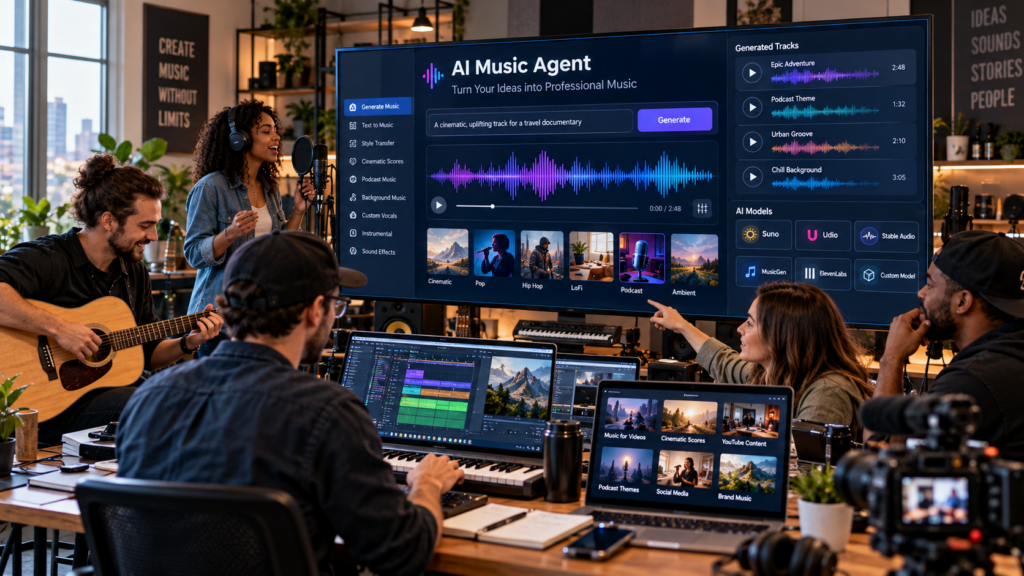
An AI Music Agent can combine conversational AI, musical analysis, composition, arrangement, and production tools into a single creative process. Instead of navigating multiple complicated programs, users can describe what they want in ordinary language and allow AI to translate that idea into a musical plan and, eventually, a finished track.
SongAgent is one example of this approach. The platform describes itself as an AI music agent designed to understand a creator’s musical vision, plan musical elements, generate songs, and support the production process. Its published workflow includes describing an idea, reviewing a musical blueprint, generating and refining the song, and downloading the finished track.
For American musicians, YouTubers, podcasters, filmmakers, game developers, marketers, and businesses, this technology can open new possibilities for creating original music without requiring every project to begin inside a traditional digital audio workstation.
What Is an AI Music Agent?
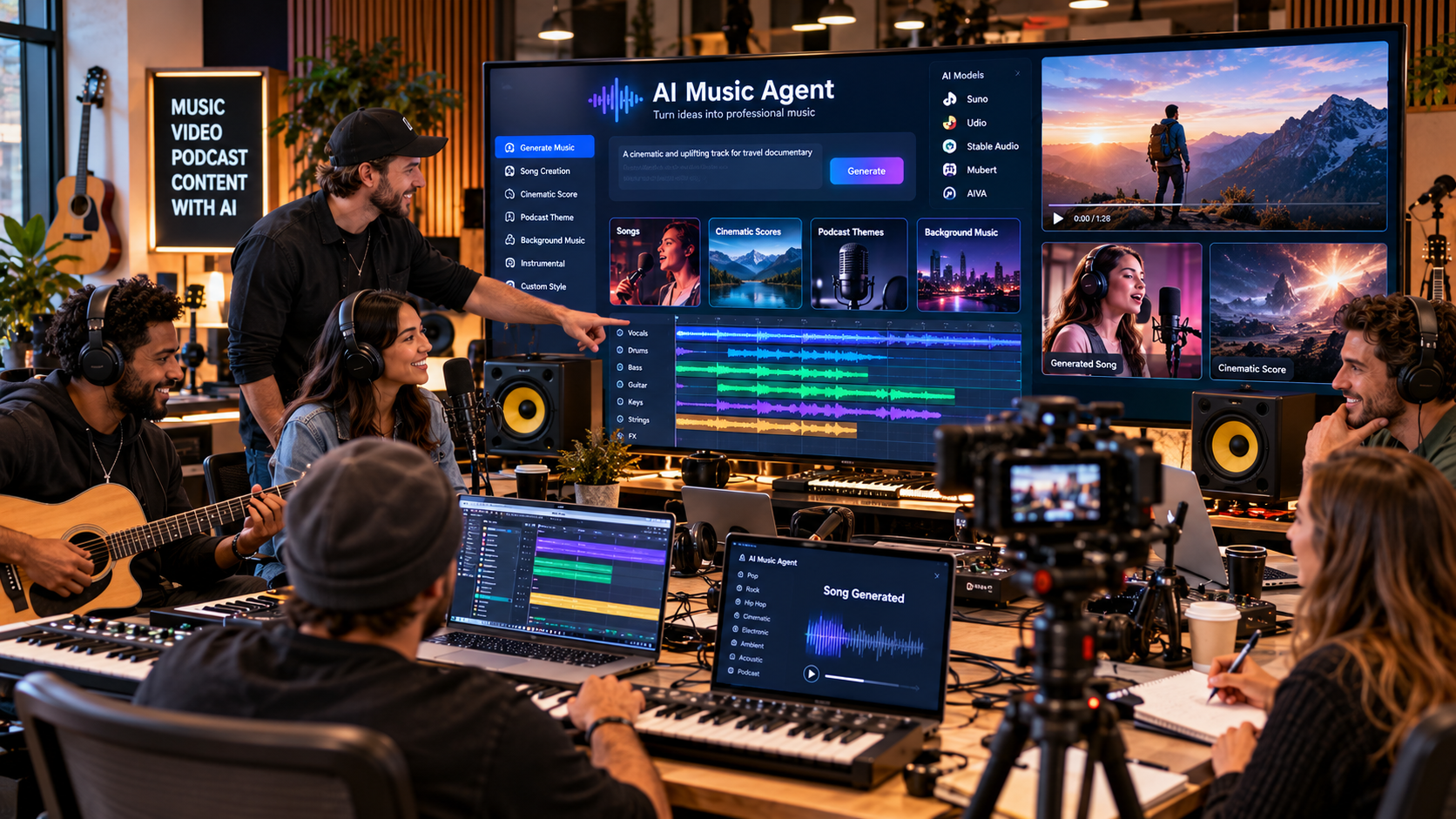
An AI Music Agent is an AI-powered system designed to do more than simply generate a short piece of audio.
A traditional AI music generator might take a prompt such as:
“Create relaxing acoustic music for a travel video.”
The system then generates an audio result.
An AI music agent aims to take a more structured approach.
It can interpret the creative request, identify elements such as genre, mood, instrumentation, tempo, harmony, and structure, create a musical plan, generate the composition, and allow the user to refine the result.
SongAgent says its system analyzes a user’s creative vision into musical components including melody, harmony, rhythm, and structure before generating the music. It also presents a musical blueprint that can include elements such as key, tempo, instrumentation, and arrangement.
This makes an AI music agent closer to a virtual creative collaborator than a simple one-click generator.
How an AI Music Agent Works
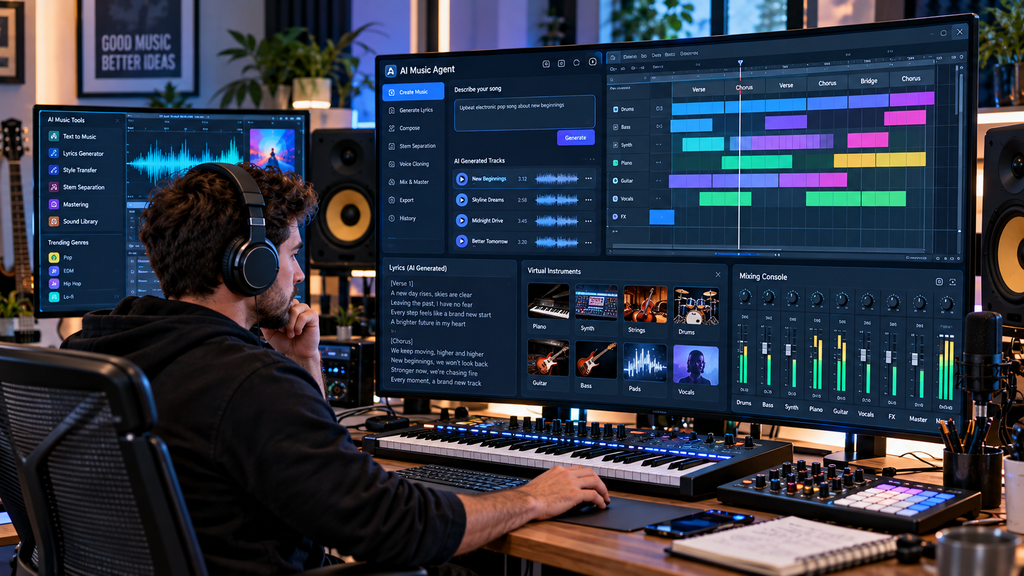
The process can be surprisingly conversational.
Step 1: Describe Your Musical Idea
The creator begins by explaining what they want.
For example:
“Create an uplifting indie-pop song about starting over after moving to a new city. Use warm guitars, energetic drums, emotional vocals, and a memorable chorus.”
The request does not need to be written using complicated music-production terminology.
The AI can interpret the description and translate the creative direction into musical characteristics.
Step 2: Review the Musical Blueprint
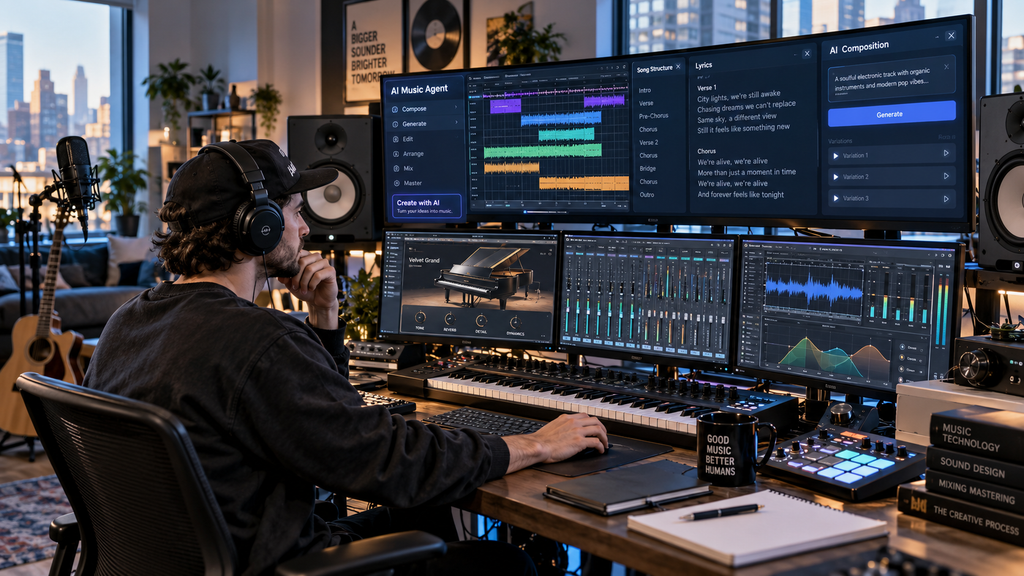
Rather than immediately generating audio, SongAgent describes a process where the AI first creates a musical plan.
The plan can include:
- Genre
- Mood
- Tempo
- Key
- Instrumentation
- Song structure
- Arrangement
- Emotional direction
This gives the creator an opportunity to adjust the concept before the complete track is produced.
Step 3: Generate and Refine
After the plan is approved, the AI generates the composition.
Creators can then request changes.
For example:
- “Make the chorus more energetic.”
- “Add strings during the bridge.”
- “Make the intro shorter.”
- “Increase the tempo.”
- “Create a more cinematic ending.”
This conversational refinement is one of the central ideas behind the AI music agent model.
Step 4: Export the Music
Once the track is complete, creators can download it and use it within their projects.
SongAgent currently lists MP3 and WAV downloads, vocal separation, and stem generation among its available features.
AI Music Agent vs. Traditional Music Production
An AI music agent does not necessarily replace traditional music production.
Instead, it can simplify certain stages.
Traditional production can involve:
- Writing
- Composition
- Arrangement
- Recording
- Editing
- Mixing
- Mastering
A modern AI platform can bring several of these stages into one workflow.
For beginners, that can make music creation more accessible.
For experienced producers, it can provide a rapid way to experiment with ideas.
For businesses and content creators, it can reduce the time required to produce custom background music.
The biggest difference is workflow.
Instead of starting with an empty DAW session, the creator starts with an idea and communicates that idea directly to the AI.
AI Music Agent for Songwriters
Songwriters can use AI to explore ideas that may otherwise take hours to develop.
For example, a songwriter could ask for several variations of a concept:
- Acoustic folk
- Modern pop
- Alternative rock
- Cinematic ballad
The resulting compositions can be used as creative references or starting points.
AI can also help explore different arrangements for the same lyrical concept.
This can be particularly useful during the early stages of songwriting, when the biggest challenge is often deciding which musical direction fits an idea.
However, human creativity remains important.
The strongest workflow may involve using AI to generate possibilities and then applying human judgment to select, edit, rewrite, and develop the final concept.
AI Music Agent for YouTube Creators
YouTube creators regularly need background music.
A travel channel might need relaxing music.
A technology channel may need modern electronic music.
A fitness creator may need energetic tracks.
A documentary creator may need cinematic background music.
An AI music agent can help generate music that is designed around the specific mood of the video.
Instead of searching through a generic music library, a creator can describe the desired sound.
SongAgent specifically presents examples involving vlog background music and other creator-focused applications. Its platform also states that users can generate royalty-free music for content such as YouTube videos and podcasts.
Creators should still review the specific licensing terms that apply to their plan before using generated music commercially.
AI Music Agent for Podcasts
Podcasts can benefit from custom audio branding.
A podcast may need:
- Intro music
- Outro music
- Transition sounds
- Background music
- Episode-specific themes
- Short promotional clips
An AI music agent can generate a coordinated set of tracks rather than forcing the creator to find unrelated pieces from different music libraries.
For example, a true-crime podcast might request dark, atmospheric music for its introduction and subtle suspenseful tracks for transitions.
A business podcast might choose a polished electronic theme.
The advantage is consistency.
AI Music Agent for Filmmakers
Independent filmmakers often need music that matches specific scenes.
A general music library may contain thousands of tracks, but finding something that perfectly matches a particular emotional moment can still be difficult.
An AI music agent can instead begin with the scene description.
For example:
“Create a slow cinematic piano piece for a scene where a character leaves their hometown at sunrise. Begin quietly and gradually introduce strings.”
The resulting music can provide a creative starting point for the filmmaker.
SongAgent describes use cases involving cinematic scores and film projects, including the ability to generate variations for different emotional approaches.
AI Music Agent for Video Games
Game developers often require multiple musical environments.
A fantasy game could need:
- Main theme
- Village music
- Battle music
- Dungeon ambience
- Character themes
- Menu music
- Victory music
Producing all of these traditionally can require considerable time.
An AI music agent can help developers prototype a complete musical world.
SongAgent specifically highlights game soundtrack creation and describes workflows involving different tracks for environments such as villages, battles, and dungeons.
For production games, developers should ensure that licensing and usage rights fit their distribution model before incorporating AI-generated music into a commercial release.
Creating Albums With AI
One of the more interesting capabilities of modern AI music systems is batch creation.
Instead of creating one song at a time, creators can describe an overall album concept.
For example:
“Create a 10-track electronic rock album about youth, nostalgia, change, independence, and starting a new life.”
The AI can then generate a collection of related songs while maintaining a broader creative direction.
SongAgent describes batch composition as a core capability and says it can be used to create EPs, albums, soundtracks, and song collections with consistent themes and styles.
This can be particularly useful for creators who need a large volume of related music.
AI Music Agent for Businesses and Brands
Businesses also need music.
Restaurants may need background tracks.
Retail brands may need advertising music.
Companies may need audio for social media campaigns.
App developers may need notification sounds and background music.
Marketing agencies may need several versions of a campaign soundtrack.
An AI music agent can make it easier to produce music that matches a brand’s desired tone.
For example:
“A premium luxury automotive brand needs a 30-second cinematic track with sophisticated strings, deep percussion, and a modern electronic pulse.”
That type of detailed creative brief can become the starting point for an AI-generated composition.
AI Music for Commercial Projects
Commercial licensing is one of the most important considerations when selecting an AI music platform.
SongAgent states that its premium plans provide commercial usage rights and describes generated music as royalty-free. Its current pricing page also lists private generation and MP3/WAV downloads across paid plans.
However, creators should always read the current terms associated with their specific subscription.
Terms can vary by plan, platform, content type, and usage.
For a business, the relevant questions include:
- Can the music be used in paid advertising?
- Can it be used on monetized YouTube channels?
- Can it be distributed through streaming platforms?
- Can it be used in films?
- Can it be used in games?
- Are there restrictions on redistribution?
- What happens if the subscription is canceled?
Checking these details before commercial publication can prevent misunderstandings later.
AI Music Agent and Music Stems
Professional production sometimes requires access to individual components of a song.
For example, a producer might want the drums separated from the vocals.
SongAgent currently lists vocal separation and stems with up to 10 stems as features available with its plans.
Stem separation can be useful for:
- Remixing
- Video editing
- Karaoke versions
- Instrumental versions
- Re-arrangement
- Audio post-production
Instead of treating the generated song as one finished audio file, creators can have more flexibility when individual elements are available.
Creating Multiple Versions of One Song
An AI music agent can also help create variations.
A marketing team may need:
- Full-length version
- 30-second advertisement
- 15-second social clip
- Instrumental version
- Short intro
- Outro
SongAgent describes conversational refinement and the ability to create variations such as instrumental versions and shorter social-media edits.
This can save time when one musical concept needs to be adapted for multiple formats.
How to Write Better AI Music Prompts
The quality of the creative brief can strongly influence the result.
Instead of saying:
“Make a good song.”
Provide more direction.
Describe the Genre
Example:
“Modern indie pop.”
Explain the Mood
Example:
“Hopeful, energetic, nostalgic.”
Mention Instruments
Example:
“Acoustic guitar, warm bass, live drums, subtle strings.”
Define the Tempo
Example:
“Mid-tempo with an energetic chorus.”
Explain the Structure
Example:
“Short intro, verse, pre-chorus, large chorus, bridge, final chorus.”
Describe the Audience or Purpose
Example:
“Designed as an uplifting soundtrack for a travel documentary.”
The more clearly the creative objective is communicated, the easier it becomes for an AI music system to interpret the request.
What Makes an AI Music Agent Useful?
The biggest advantage is not simply that AI can produce music.
It is that the technology can connect multiple parts of the creative process.
An effective AI music agent can help with:
- Creative ideation
- Musical planning
- Composition
- Arrangement
- Refinement
- Production
- Audio processing
- Exporting
- Creating variations
SongAgent positions itself around this end-to-end workflow rather than only offering basic text-to-audio generation.
Is an AI Music Agent Replacing Musicians?
AI music technology has created an ongoing discussion about the role of human musicians.
An AI music agent can generate compositions quickly, but music is more than a sequence of notes.
Artists bring personal experiences, cultural context, performance decisions, emotional interpretation, storytelling, and creative identity.
For many creators, AI may therefore function more effectively as a creative assistant than as a complete replacement for human musicians.
A songwriter can use AI to explore arrangements.
A producer can use it to prototype ideas.
A filmmaker can test different emotional approaches.
A content creator can produce background music without hiring a full production team for every short video.
The human remains responsible for deciding what fits the project.
The Future of AI Music Agents
AI music technology is continuing to move toward more autonomous production workflows.
SongAgent says it is developing an ecosystem in which specialized AI components could handle different stages such as composition, arrangement, mixing, and mastering.
This suggests a future where a creator might provide a complete project brief and an AI system could coordinate multiple production stages automatically.
The technology could potentially move from:
Prompt → Song
toward:
Idea → Musical plan → Multiple compositions → Arrangement → Mixing → Mastering → Versions → Final production package
Human review will remain valuable, particularly for professional projects where creative identity, quality, licensing, and brand requirements matter.
How to Get Started With an AI Music Agent
For beginners, there is no need to start with a complicated project.
Choose one simple goal.
For example:
“Create a relaxing instrumental track for a 5-minute YouTube travel video.”
Then experiment with:
- Genre
- Mood
- Instruments
- Tempo
- Song length
- Structure
Listen to the output and refine the prompt.
Once you understand how the system responds, you can move to larger projects such as podcast music packages, commercial jingles, game soundtracks, or complete albums.
SongAgent currently offers a free starting option, with its pricing page listing five free credits after login. Paid plans add larger credit allowances and features such as private generation, MP3/WAV downloads, vocal separation, and stems.
Frequently Asked Questions About AI Music Agents
What is an AI Music Agent?
An AI Music Agent is an AI-powered system that can interpret musical instructions, plan compositions, generate songs, and support multiple stages of music production.
How is an AI Music Agent different from an AI music generator?
An AI music generator may focus primarily on producing audio from a prompt. An AI music agent can combine generation with musical planning, conversational refinement, arrangement, production tools, and other workflow features.
Can an AI Music Agent create complete songs?
Yes. Platforms such as SongAgent are designed to generate complete songs based on descriptions, styles, lyrics, instrumentation, mood, and other creative instructions.
Can I create music without knowing music theory?
Yes. Conversational AI music tools are designed to accept natural-language descriptions. Users can describe a mood or musical idea without knowing technical terms such as chord progressions or modes.
Can AI Music Agents create different genres?
Yes. SongAgent says its system supports a broad range of genres, including pop, rock, electronic, classical, jazz, folk, hip-hop, ambient, and cinematic styles.
Can I use AI-generated music commercially?
This depends on the platform and subscription plan. SongAgent states that its premium plans provide commercial usage rights and royalty-free music. Users should review the current terms for their specific plan before commercial publication.
Can an AI Music Agent create instrumental music?
Yes. Users can request instrumental compositions, and SongAgent also lists vocal separation and stem-generation capabilities.
Can AI create an entire album?
Some AI music platforms support batch creation. SongAgent describes its batch composition system as capable of producing cohesive EPs, albums, and collections while maintaining a broader style and theme.
Can AI music be used for YouTube videos?
AI-generated music can be used for video projects when the platform’s applicable license permits that use. SongAgent markets its generated music for applications including YouTube and other content projects.
Is an AI Music Agent useful for professional musicians?
It can be. Professional musicians can use AI for ideation, rapid prototyping, arrangement experiments, alternative versions, and production workflows while retaining human creative control.
Conclusion
The rise of the AI Music Agent is changing how people approach music creation.
Instead of requiring every creator to begin with a complex production environment, AI can allow users to begin with a simple idea expressed in natural language.
A creator can describe a genre, mood, story, instrumentation, audience, or project requirement. The AI can then interpret that direction, develop a musical blueprint, generate a composition, and help refine the result.
SongAgent illustrates this approach through its conversational workflow, musical planning, multi-genre generation, batch composition, audio production tools, and export capabilities.
For YouTubers, the technology can provide custom background music. Podcasters can create recognizable audio branding. Filmmakers can explore different scores. Game developers can develop large collections of musical themes. Businesses can create custom advertising music. Songwriters and producers can use AI to explore new creative directions.
The technology also introduces important questions around licensing, commercial usage, originality, and the role of human creativity. Users should always review the current terms of the AI music platform they choose and understand what rights apply to their particular plan and intended use.
Ultimately, the most useful way to think about an AI Music Agent may be as a creative production partner.
It can handle repetitive technical work, rapidly explore possibilities, and turn rough ideas into musical prototypes. The human creator can then provide the taste, direction, storytelling, editing, and final creative judgment.
As AI music systems continue to develop, the process of making professional-sounding music is likely to become increasingly conversational, accessible, and collaborative—giving more people the ability to turn an idea in their head into a finished musical creation.