

Moving into a new home traditionally meant making a long shopping list. A sofa, bed, dining table, nightstands, dresser, desk, chairs, and other essentials could quickly add thousands of dollars to the cost of getting settled.
For many Americans, however, buying everything immediately is not always the most practical option.
Students move between cities. Young professionals relocate for jobs. Families need temporary housing during renovations. Corporate employees may spend only a year or two in a new location. Some renters simply do not know whether their current apartment will be their home several years from now.
These situations have created an established market for home furniture rental in the United States.
Rather than purchasing large pieces of furniture, moving them repeatedly, storing them, and eventually trying to sell them, consumers can rent furnishings for the period in which they need them.
This is not simply a small local trend. IBISWorld’s 2025 data backs this up nationally, with its Home Furniture Rental in the US industry research covering businesses that rent products such as bed frames, couches, dining tables, and other household furnishings. The report describes short-term needs, including those of students and other temporary users, as an important part of industry demand.
The result is a furnishing model built around flexibility rather than permanent ownership.
What Is Home Furniture Rental?

Home furniture rental is exactly what it sounds like: customers use furniture for an agreed period rather than purchasing it outright.
Depending on the provider, renters may be able to choose individual pieces or complete packages containing everything needed for a bedroom, living room, dining area, or home office.
Common rental items include:
- Sofas and sectionals
- Beds and mattresses
- Dressers
- Dining tables and chairs
- Coffee and side tables
- Desks and office chairs
- Lamps
- Entertainment units
- Accent furniture
- Complete room packages
Some services focus on short-term furniture rental, while others offer longer agreements.
The major difference from buying is that consumers are paying for temporary access and convenience rather than permanent ownership.
That distinction can be valuable when the customer’s living arrangement is temporary as well.
Why Furniture Rental Fits the Way Many Americans Live
Furniture ownership makes sense for millions of households. If someone expects to remain in the same house for many years, buying durable furniture may offer better long-term value.
But modern housing needs are diverse.
The United States has a large rental population. Statista estimated that roughly 46 million U.S. housing units were occupied by renter households in 2025.
Not every renter needs furniture rental, of course. Yet a large mobile population creates many situations in which temporary furnishing can solve a practical problem.
People Move for Work

A new job may require someone to relocate from Dallas to Denver, Chicago to Atlanta, or Boston to Los Angeles.
The assignment might last only 12 or 18 months.
Buying an entire apartment’s furniture can create another problem at the end of that assignment: what happens to everything when it is time to move again?
Furniture rental gives mobile professionals another option.
They can furnish the apartment during the assignment and return eligible rental items when the agreement ends.
Students Have Temporary Housing Needs
College students are one of the easiest groups to understand when discussing temporary furniture.
A student may live in an apartment for only one academic year.
Purchasing a bedroom set, desk, couch, and dining furniture means those items later need to be moved, sold, donated, or stored.
That inconvenience is one reason short-term users are an important part of the furniture-rental market identified in industry research.
Families Sometimes Need Temporary Homes
Furniture rental is not limited to students and single professionals.
Families may spend months in temporary housing because of:
- Home renovations
- Insurance repairs
- Military relocation
- Corporate transfers
- New-home construction
- Divorce or family transitions
- Extended work assignments
A temporary apartment can feel much more like home when it has a proper sofa, beds, dining furniture, and storage.
Buying all those items for a short stay may not make sense.
What IBISWorld’s 2025 Data Tells Us About the Market
The important point about industry data is not that every American is suddenly choosing rental furniture over ownership.
That would exaggerate the trend.
Instead, the data shows that home furniture rental is an established national industry serving a clear economic need.
IBISWorld maintains a dedicated Home Furniture Rental in the US specialized industry report, identified as OD5492 in its U.S. industry listings. The 2025 edition was published in April 2025.
Industry summaries referencing the 2025 figures put U.S. home furniture rental revenue at around $1.2 billion. They also indicate that the traditional segment experienced an annualized decline during the five years through 2025, which is important context.
In other words, the takeaway is more nuanced than “furniture rental is exploding.”
The stronger conclusion is that enough consumers continue to value temporary access to furniture to support a sizable national industry.
Flexibility Is the Core Value
The basic appeal of furniture rental is not difficult to understand.
Consumers can furnish a living space without committing to keeping each item permanently.
For someone who expects to move again soon, flexibility can be more valuable than ownership.
The consumer is effectively asking:
“Do I really want to own this sofa three years from now?”
If the answer is uncertain, renting becomes worth considering.
Furniture Rental vs. Buying: Which Option Makes More Sense?
Neither option is automatically better.
The right choice depends on the customer’s time frame, finances, lifestyle, and priorities.
When Buying Furniture May Be Better
Buying often makes sense when you expect to use an item for many years.
For example, someone furnishing a long-term family home may be better served by investing in durable pieces they genuinely want to keep.
Ownership also means there are no recurring rental payments and no requirement to return the item.
A well-made dining table or dresser may remain useful for decades.
When Furniture Rental May Be Better
Renting can be appealing when the housing situation is temporary or uncertain.
Consider a professional accepting an 11-month assignment in another state.
Buying furniture means paying for the pieces, arranging delivery, and then figuring out how to move or dispose of them less than a year later.
The true cost involves more than the original purchase price.
It can include:
- Moving expenses
- Storage
- Time spent reselling items
- Marketplace fees
- Possible loss in resale value
- Disposal costs
- Transportation
Furniture rental may simplify that entire cycle.
The Convenience Factor Is Easy to Underestimate
Price matters, but convenience is one of the strongest reasons consumers rent.
Buying furniture for an entire apartment can involve visits to multiple stores, coordinating separate deliveries, assembling flat-pack items, and waiting for pieces that are out of stock.
At the end of a lease, the process happens in reverse.
The customer must decide what to move, sell, store, donate, or discard.
A full-service furniture rental arrangement may make the process much simpler.
Furnishing an Entire Room at Once
One advantage of rental packages is coordination.
Instead of selecting every piece separately, customers may be able to rent a complete living-room or bedroom setup.
A living-room package might include a sofa, chair, coffee table, end table, and lamps.
A bedroom package might include a bed, mattress, nightstand, and dresser.
This is particularly useful for someone arriving in a new city who wants a functional home quickly.
Furniture Rental and Corporate Relocation
One area where temporary furnishing makes especially strong practical sense is corporate relocation.
Businesses routinely transfer employees between offices, assign specialists to temporary projects, and bring workers to different markets for defined periods.
Housing those employees requires more than finding an apartment.
The apartment also needs to be livable.
Buying furniture for every temporary assignment would create significant logistical complexity.
Rental allows organizations and relocation professionals to furnish accommodations for the duration of the employee’s stay.
When the assignment ends, the furniture can be returned rather than shipped across the country.
Remote Work Has Added Another Furniture Need
The modern home is not only a place to sleep and relax.
For many professionals, it is also a workplace.
That means temporary residents may need more than a couch and bed.
They may also require:
- A desk
- Ergonomic chair
- Task lighting
- Storage
- Bookshelves
- Additional tables
Someone on a six-month or one-year assignment may not want to buy and later transport an entire home-office setup.
Furniture rental can help create a functional temporary workspace without making every item a permanent possession.
How Online Furniture Rental Changes the Experience
Modern rental behavior is also shaped by e-commerce.
Consumers increasingly expect to browse products, compare options, schedule services, and manage accounts online.
Furniture rental can follow the same model.
Instead of visiting several physical stores, customers may be able to view furniture collections online, choose a package, select a rental period, and arrange delivery.
Digital convenience matters because the person seeking rental furniture is often already dealing with a move.
Anything that reduces additional errands can make the experience easier.
Is Renting Furniture More Sustainable?
Furniture rental can support some circular-use principles because the same item may serve multiple customers over its usable life rather than being purchased for one short stay and discarded.
However, sustainability is not automatic.
The full environmental impact also depends on:
- Furniture durability
- Transportation distances
- Delivery frequency
- Cleaning methods
- Repair practices
- Refurbishment
- Product life span
- End-of-life disposal
A strong rental operation benefits when furnishings are durable enough to be cleaned, repaired, and reused repeatedly.
For consumers concerned about sustainability, it is reasonable to ask providers how products are maintained and what happens to older inventory.
What Should Consumers Check Before Renting Furniture?
A convenient rental agreement still deserves careful review.
Understand the Total Cost
Do not look only at the monthly payment.
Multiply the payment by the expected rental term and consider all applicable charges.
For a long enough rental period, purchasing may become less expensive.
Review Delivery and Pickup Fees
Ask whether delivery, setup, removal, and pickup are included or billed separately.
These costs can significantly change the overall price.
Understand Damage Policies
Normal wear and actual damage are not always treated the same.
Read the agreement carefully so you know your responsibility if an item becomes stained, scratched, broken, or otherwise damaged.
Check Minimum Rental Periods
Some companies may require minimum commitments.
Make sure the term works with your housing plans.
Ask About Early Returns
Plans change.
Before signing, understand what happens if you move sooner than expected.
Who Benefits Most From Furniture Rental?
Furniture rental is particularly relevant for people whose need for furniture has a clear end date.
Potential users include:
- College students
- Traveling professionals
- Corporate transferees
- Military families
- People waiting for a home to be built
- Families displaced during home repairs
- Temporary residents
- People testing a new city before settling permanently
- Home sellers staging a property
- Renters who expect another move soon
For these groups, the decision is not simply “rent or own.”
It is a question of how much flexibility is worth.
Frequently Asked Questions About Furniture Rental
What is furniture rental?
Furniture rental allows a customer to use household furnishings for an agreed period in exchange for rental payments instead of purchasing the items outright.
What furniture can usually be rented?
Depending on the provider, customers may find sofas, beds, tables, chairs, dressers, desks, lamps, home-office furniture, and complete room packages.
Who commonly rents home furniture?
Students, mobile professionals, corporate transferees, military households, temporary residents, and families in transitional housing situations are common examples.
Is renting furniture cheaper than buying?
Sometimes, but not always. Renting may make financial sense for shorter periods when moving, resale, and storage costs are considered. For long-term use, buying may be more economical.
Can I rent furniture for an apartment?
Yes. Apartment furniture rental is one of the most obvious applications, especially for people with temporary leases or uncertain moving plans.
Why is the 2025 IBISWorld furniture-rental research relevant?
IBISWorld maintains a specific national industry report covering U.S. home furniture rental, demonstrating that the sector is an established commercial market rather than merely a small local service category.
Is furniture rental only for short stays?
No. Rental terms differ by provider, and some customers use furniture for longer periods. The value should be compared with the total cost of purchasing.
What should I ask before signing a rental agreement?
Check the total price, rental period, delivery and pickup fees, damage policy, early-return terms, product condition, and any other charges.
Conclusion
Furniture ownership will continue to make sense for households putting down long-term roots. But ownership is not the ideal solution for every stage of life.
Americans relocate for work, attend college away from home, renovate houses, accept temporary assignments, rent apartments before purchasing homes, and move between cities for countless other reasons.
Those consumers need comfortable spaces even when their housing situation is temporary.
Furniture rental addresses that gap.
It provides access to essential household items without requiring every sofa, bed, desk, or dining table to become a permanent possession.
And this is more than anecdotal behavior. IBISWorld’s 2025 data backs this up nationally through its dedicated research into the U.S. home furniture rental industry and the sizeable market serving short-term and flexible furnishing needs.
The takeaway is not that renting is always better than buying. It is that today’s consumers have more choices.
For a homeowner furnishing a permanent residence, purchasing quality furniture may remain the smartest approach. For a student staying nine months, a professional on a temporary assignment, or a family living somewhere temporarily, the calculation can look completely different.
The smartest decision starts with one question: How long do you actually need the furniture?
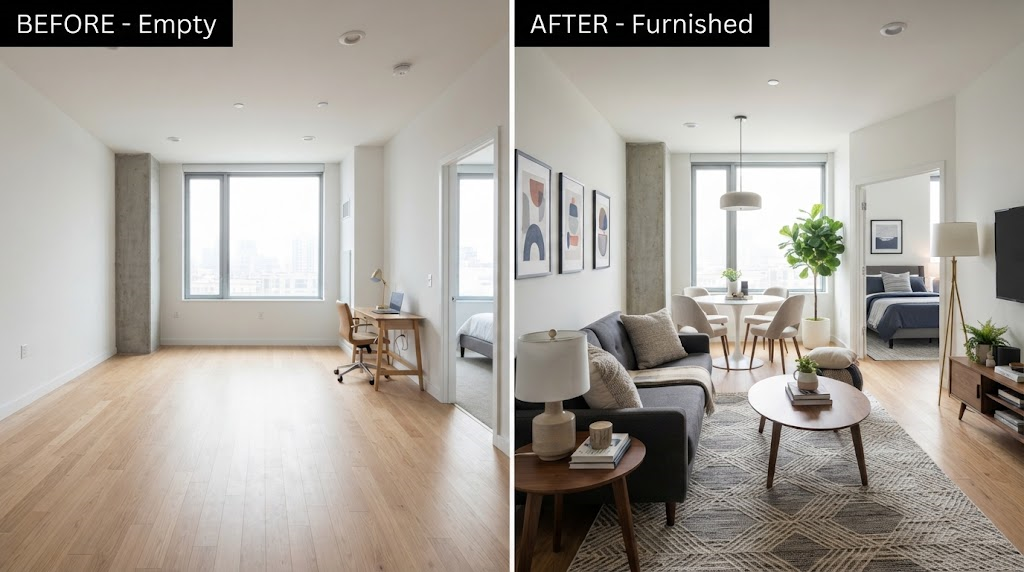
When the answer is temporary, furniture rental can turn an empty property into a comfortable, functional home without creating another long-term commitment.

