
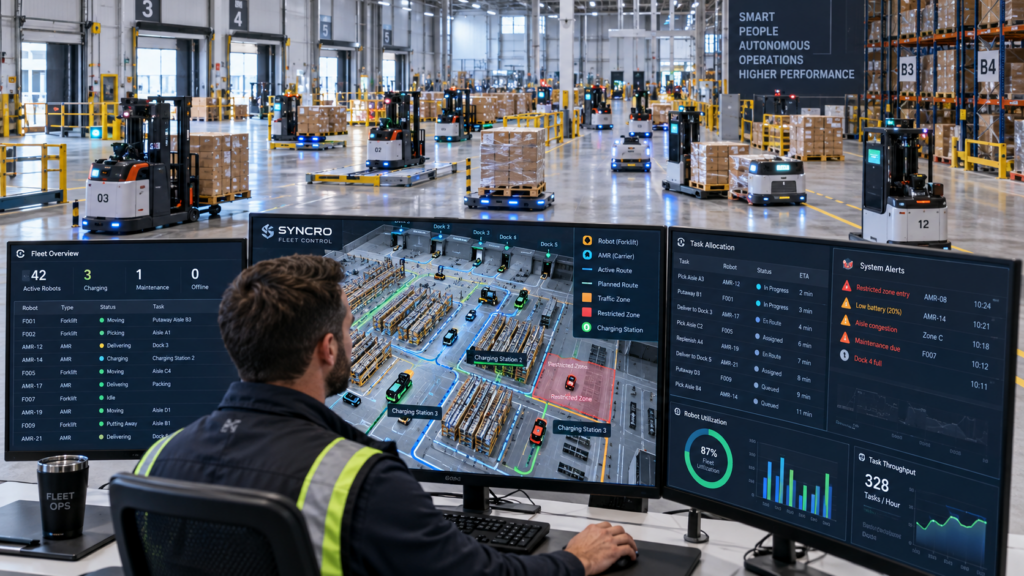
Warehouse automation is changing quickly. A facility that once relied mainly on manually operated forklifts may now use autonomous forklifts, automated guided vehicles, autonomous mobile robots, four-way shuttles, conveyors, elevators, and other connected equipment.
Adding robots, however, is only part of the automation challenge.
When dozens or even hundreds of autonomous vehicles operate in the same facility, businesses need a central system capable of deciding which robot should perform each job, which route it should take, when it should charge, and how it should interact with other vehicles.
That is where Multiway RCS fleet-control functions become important.
Multiway RCS, or Robot Control System, is designed to coordinate fleets of different robot types from a central software platform. Multiway states that the system can support the collaborative operation of hundreds of vehicles of different models in the same operating area while using optimized route planning to improve overall fleet efficiency.
For U.S. manufacturers, distribution centers, third-party logistics providers, cold-storage operators, and other warehouse businesses, this type of fleet orchestration can turn individual autonomous machines into a coordinated logistics system.
What Is Multiway RCS?
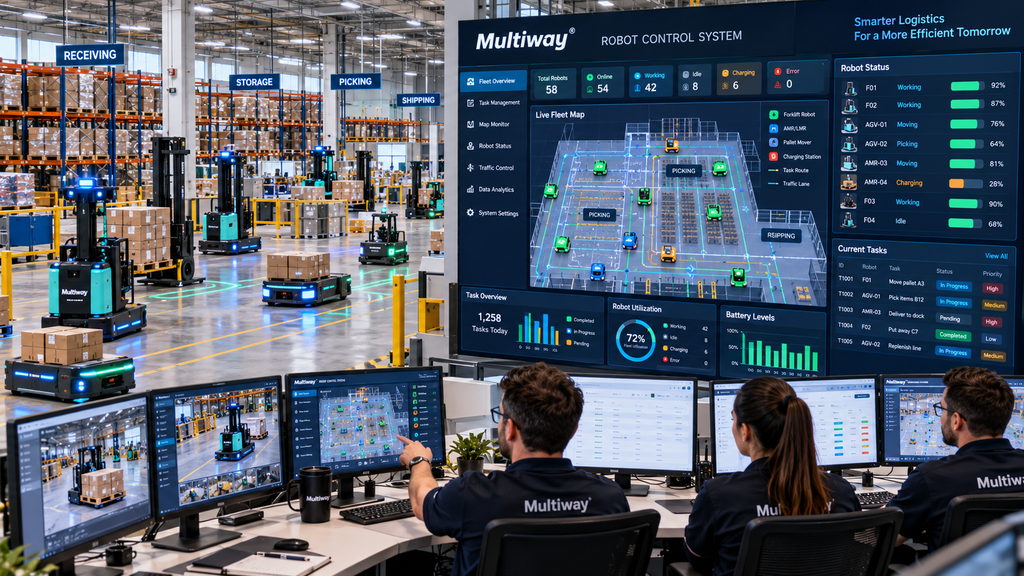
Multiway RCS is a robot fleet-control and dispatching platform developed by Multiway Robotics.
Instead of controlling only one autonomous vehicle, the software manages a fleet.
The system can coordinate equipment including autonomous forklifts, AMRs, and four-way shuttles within a shared operating environment. Multiway lists seven major functional areas within RCS: dynamic monitoring, task management, vehicle management, report statistics, traffic control, equipment management, and system configuration.
The goal is to make decisions at fleet level rather than allowing every vehicle to operate as an isolated machine.
That distinction becomes increasingly important as automation scales.
A warehouse with two autonomous vehicles may be relatively simple to manage. A site with 40, 80, or 100+ robots moving between receiving, storage, production, picking, staging, and shipping requires significantly more coordination.
Why Fleet Control Matters in Automated Warehouses
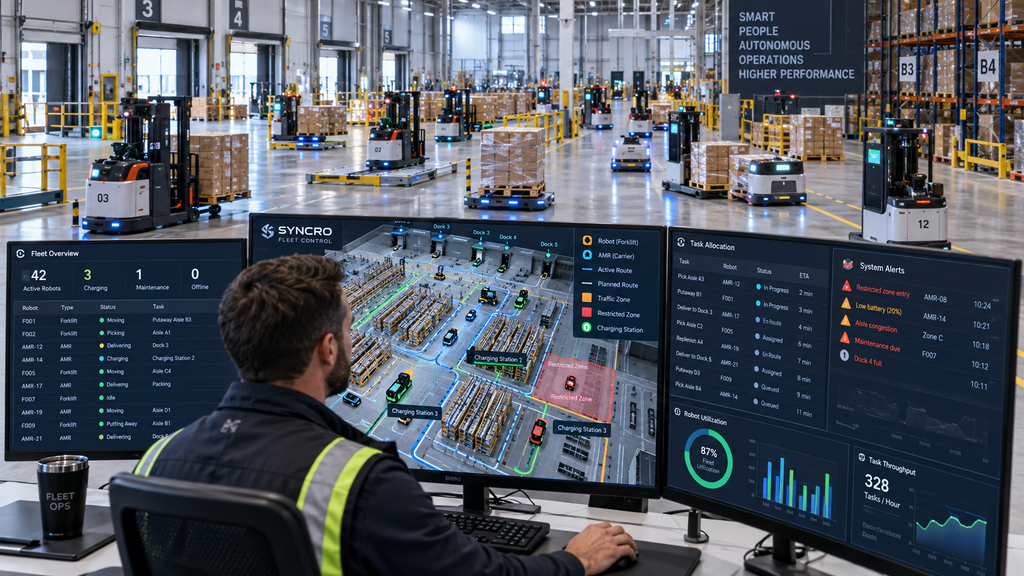
Every robot has limited resources.
It has a current location, battery level, task status, travel route, load capacity, and operating condition.
At the same time, the warehouse has shared resources such as:
- Aisles
- Intersections
- Elevators
- Charging stations
- Pickup points
- Storage locations
- Production lines
- Dock areas
- Automatic doors
- Conveyors
If autonomous vehicles are dispatched inefficiently, they may travel unnecessary distances, wait for shared resources, create congestion, or remain idle.
A robot control system coordinates those variables continuously.
Multiway describes its RCS as using dynamic task allocation and optimized path planning to coordinate multi-vehicle fleets.
Dynamic Monitoring Across the Robot Fleet
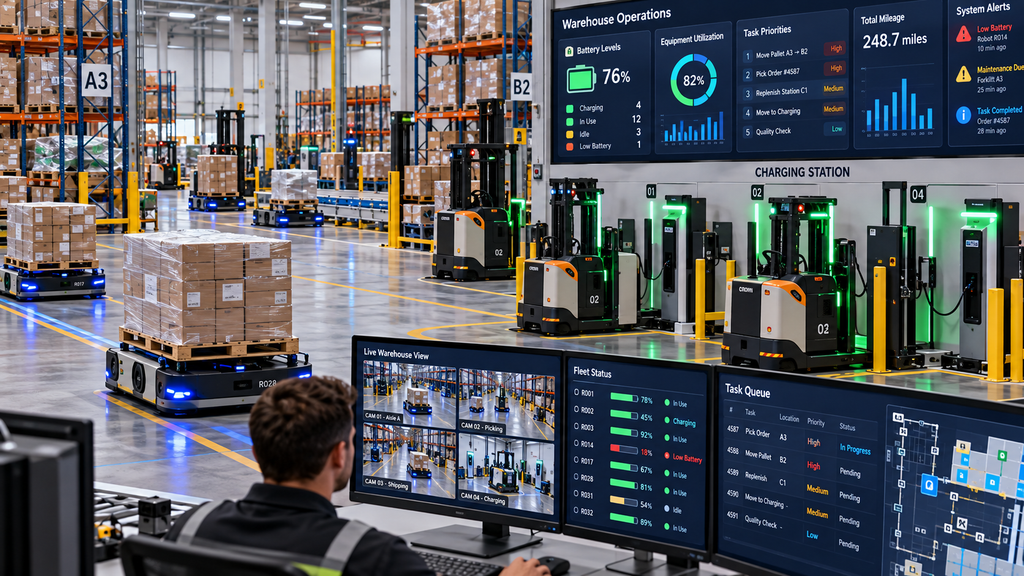
Visibility is one of the core Multiway RCS fleet-control functions.
Warehouse managers need to know what their robots are doing without walking through the entire facility.
Multiway RCS provides web-based monitoring and can display operational maps, including support for a 3D digital twin view.
Operators can monitor information such as:
- Robot location
- Current task
- Vehicle status
- Battery level
- Task queues
- System abnormalities
- Vehicle abnormalities
The system also allows task and vehicle information to be queried remotely. Different users and groups can receive different operational permissions.
Why Real-Time Fleet Visibility Helps
Imagine a distribution center operating 50 autonomous forklifts.
If throughput suddenly drops, operations managers need to determine why.
A centralized fleet view may reveal that several vehicles are waiting near one intersection, a charging station is unavailable, or a particular vehicle has generated an error.
Instead of investigating each robot separately, the manager can review fleet conditions through one interface.
Intelligent Task Management
Robots are valuable only when they perform the right tasks at the right time.
Task management is therefore another central RCS function.
Multiway RCS allows users to create transportation tasks that assign vehicles to move goods toward specified destinations. The platform can also support recurring tasks and lets operators monitor execution status in real time. Tasks may be manually canceled or completed when necessary.
Dynamic Task Allocation
In an automated warehouse, new tasks may appear constantly.
Examples include:
- Move a pallet from receiving to storage
- Deliver materials to a production line
- Retrieve finished products
- Transfer inventory between zones
- Deliver pallets to a shipping dock
Rather than permanently assigning one robot to one type of task, fleet-control software can evaluate the fleet and determine which available vehicle is best positioned to respond.
Multiway’s current RCS materials describe intelligent task sequencing and proximity-based dispatching as part of the system’s fleet coordination capabilities.
Reducing unnecessary travel can improve utilization and shorten task completion times.
Vehicle Management for Mixed Robot Fleets
Many automated facilities do not operate only one robot model.
A warehouse could use autonomous counterbalanced forklifts for pallet transport, reach trucks for racking, AMRs for smaller materials, and four-way shuttles for high-density storage.
Managing these systems separately can create operational complexity.
Multiway says its RCS can coordinate different robot models within the same control environment.
Vehicle management functions include:
- Monitoring vehicle operating status
- Configuring vehicle information
- Reviewing robot routes
- Viewing traffic-control information
- Creating simulated vehicles for testing
This mixed-fleet capability can be useful as a company expands automation over time.
Instead of approaching each robot deployment as a completely separate project, businesses can build toward a larger coordinated fleet.
Multi-Robot Traffic Control
Traffic management is one of the most technically important Multiway RCS fleet-control functions.
Imagine 30 autonomous forklifts moving through a warehouse.
Several robots approach the same narrow aisle. Two others need the same intersection. Another vehicle is traveling toward an elevator being requested by robots on different floors.
Without central coordination, these interactions can reduce throughput.
Dynamic Route Optimization
Multiway RCS continuously optimizes traffic routes and can adjust routing according to current road or aisle conditions.
The system considers robot meeting and following situations as well as task priorities when determining how traffic instructions should be issued.
Avoiding Congestion and Conflicts
Fleet-control software can dynamically change robot movements instead of relying only on static paths.
Multiway describes its intelligent traffic management as supporting dynamic avoidance between vehicles to reduce congestion and gridlock.
This becomes increasingly important as fleet density rises.
Adding more robots does not automatically increase throughput. Without effective traffic control, too many vehicles sharing the same space can actually create delays.
Cross-Floor Elevator Coordination
Warehouses and factories with multiple floors introduce another challenge.
Several robots may request the same elevator simultaneously.
Multiway RCS includes traffic-control handling for multiple vehicles calling the same elevator from different floors.
Combined with Multiway WCS, robots can interact with shared equipment such as elevators, automatic doors, conveyors, sorting machines, AS/RS equipment, and robotic arms.
Battery and Charging Management
Autonomous robots cannot work continuously without considering battery capacity.
If too many vehicles require charging simultaneously, fleet availability can drop.
If robots are allowed to run too low, tasks may be interrupted.
Multiway RCS includes battery monitoring, low-battery warnings, and configurable automatic charging strategies. The software can also monitor multiple robot batteries and direct vehicles toward recharging when needed.
Smarter Charging Strategies
Fleet charging can be managed as an operational resource.
For example, a warehouse may want vehicles to recharge:
- Below a particular battery threshold
- During periods of low task demand
- At specified charging stations
- According to vehicle type
- Before predicted peak activity
Multiway also lists self-charging management among its dispatching-system capabilities.
The objective is to keep enough robots available for operational demand instead of allowing charging schedules to become a bottleneck.
Equipment Health and Remote Management
Fleet availability depends on equipment health.
Multiway RCS includes equipment-management tools designed to check communication status across robot components and monitor information including position, obstacle avoidance, movement, and battery condition.
The system also supports remote one-touch parking and OTA software upgrades.
Why Remote OTA Updates Matter
Large automated fleets can be expensive to maintain if every software update requires manual work on each vehicle.
Remote over-the-air updating allows system administrators to update vehicles without physically accessing every robot individually.
As fleets grow, centralized software maintenance can reduce operational effort.
Report Statistics and Fleet Analytics
Automation projects need measurable results.
Managers may want to know:
- How many tasks were completed?
- How far did robots travel?
- How much time was spent in traffic control?
- What is fleet utilization?
- Which vehicles generate the most faults?
- Where are bottlenecks occurring?
Multiway RCS records robot running tracks, traffic-control time, failures, and task logs. Its reporting tools analyze metrics such as efficiency, mileage, and utilization and support charts and data export.
The platform can also generate system-failure events and provide log queries for troubleshooting.
Turning Robot Data Into Operational Decisions
Raw robot activity becomes more useful when managers can identify trends.
For example, analytics might reveal that vehicles consistently wait near one production area.
The issue may not require another robot. The actual solution could involve redesigning a route, changing a task priority, adjusting a station, or modifying traffic rules.
Fleet analytics can therefore help businesses improve the automation system after deployment.
System Configuration and Warehouse Flexibility
Warehouses change.
New storage areas are added. Charging locations move. Robots are introduced. Workflows evolve.
A useful fleet-management system needs configuration tools that allow the automation environment to adapt.
Multiway RCS supports map uploads and activation, vehicle configuration, station configuration, event configuration, automatic charging configuration, and standby-point configuration.
Stations can include locations such as:
- Charging points
- Storage points
- Standby points
- Pickup locations
- Delivery locations
Vehicles can also be configured to automatically return to specified standby positions.
How RCS Works With WMS and WCS
Understanding the difference between RCS, WMS, and WCS helps explain the larger Multiway software architecture.
WMS: Warehouse Management System
WMS manages warehouse business processes such as receiving, put-away, picking, shipping, and inventory management. Multiway describes its WMS as providing real-time inventory visibility across these operations.
RCS: Robot Control System
RCS manages the robot fleet.
It decides how tasks are assigned, how robots move, and how fleet traffic is coordinated.
WCS: Warehouse Control System
WCS connects robots to other automated equipment.
Multiway WCS integrates robots with elevators, automatic doors, conveyors, rollers, robotic arms, sorting machines, and AS/RS systems.
Together, these systems can connect business-level warehouse decisions with robot movement and physical equipment.
In one Multiway project, WMS, WCS, and RCS were integrated with the customer’s ERP system to enable automatic task generation, intelligent scheduling, and full-process visibility.
Benefits for U.S. Warehouses and Manufacturers
The potential value of Multiway RCS fleet-control functions becomes clearer in large facilities.
Better Robot Utilization
Dynamic task allocation can reduce unnecessary idle time and travel.
More Scalable Automation
A company can move from a small autonomous fleet toward larger multi-robot deployments without relying entirely on manual coordination.
Reduced Traffic Bottlenecks
Central traffic management allows the system to respond dynamically as robots meet, follow, or compete for shared routes.
Improved Operational Visibility
Managers can see vehicle status, battery level, tasks, errors, and fleet activity from one monitoring system.
Data-Driven Optimization
Historical reports can help operations teams evaluate mileage, utilization, failures, and efficiency.
Multiway states that its robotics and software solutions are used across manufacturing and logistics and that the company operates in more than 40 countries and regions, including a U.S. presence in Atlanta.
Frequently Asked Questions About Multiway RCS Fleet-Control Functions
What is Multiway RCS?
Multiway RCS is a robot control and dispatching system used to coordinate autonomous forklifts, AMRs, four-way shuttles, and other robots within shared warehouse or industrial environments.
How many robots can Multiway RCS manage?
Multiway states that the RCS can support collaborative operation of hundreds of vehicles of different models within the same operating area.
Can Multiway RCS manage different robot types?
Yes. The platform is designed to coordinate heterogeneous fleets, including unmanned forklifts, AMRs, and four-way shuttles.
Does Multiway RCS provide real-time monitoring?
Yes. Its monitoring functions display operational maps, vehicle locations, task status, battery levels, abnormalities, and other fleet information in real time.
Can it manage robot traffic?
Yes. Traffic control is a major part of the system. Multiway RCS supports optimized routing, dynamic avoidance, traffic-priority decisions, and multi-vehicle coordination.
Does Multiway RCS control robot charging?
It includes battery monitoring, low-battery alerts, and configurable automatic charging strategies.
Does the system support digital twins?
Yes. Multiway RCS lists real-time operating-map visualization with support for a 3D digital twin.
Can Multiway robots interact with elevators and conveyors?
Yes. Multiway WCS provides integration with equipment such as elevators, conveyors, automatic doors, robotic arms, sorting equipment, and AS/RS. RCS and WCS can work together within the broader automation architecture.
What fleet reports are available?
The system can record task history, running tracks, traffic-control time, failures, mileage, utilization, efficiency, and other operating data.
Which industries can use robot fleet-control software?
Multiway reports RCS deployments in sectors such as automotive, food, pharmaceutical distribution, new energy, and cold chain operations, while its broader solutions serve manufacturing, logistics, 3PL, and other intralogistics environments.
Conclusion
Deploying autonomous robots is only the first step toward a truly automated warehouse.
As robot fleets grow, businesses also need software capable of coordinating tasks, routes, battery levels, traffic, equipment status, and shared infrastructure.
Multiway RCS fleet-control functions address this challenge by placing fleet activity within a central robot control system.
The platform combines dynamic monitoring, intelligent task management, mixed-vehicle management, traffic control, equipment monitoring, automated charging strategies, system configuration, and performance reporting. It is designed to coordinate hundreds of heterogeneous vehicles while dynamically optimizing routes and task execution.
When combined with Multiway WMS and WCS, the RCS can become part of a broader smart intralogistics environment connecting warehouse management, autonomous vehicles, elevators, conveyors, automatic doors, AS/RS equipment, and other facility systems.
For U.S. warehouses, manufacturers, distribution centers, and logistics operators considering large-scale automation, the key question is no longer simply whether a robot can move a pallet autonomously.
The bigger question is whether an entire fleet can operate as one coordinated system.
That is the role of modern robot control software. By deciding which vehicle should take a task, where it should travel, when it should recharge, how it should avoid congestion, and when operators should be alerted, RCS technology can turn individual autonomous machines into a scalable warehouse automation network.
As fleets expand, intelligent coordination becomes just as important as the robots themselves.

