Artificial intelligence has changed image creation from a specialized design task into something almost anyone can experiment with. Instead of opening complex software, building layers, masking objects, and manually adjusting every element, users can increasingly describe the image they want in natural language.
GPT Image 2.5 represents the latest stage of that shift.
OpenAI officially introduced ChatGPT Images 2.5 in September 2026, describing improvements in image detail, editing precision, reference-image fidelity, lighting, textures, and generation speed. OpenAI says image generation latency has been reduced by up to 50% compared with Images 2.0, making iterative creative work faster.
For marketers, designers, ecommerce businesses, creators, photographers, agencies, and everyday users, the practical benefit is straightforward: it becomes easier to move from an idea to a usable visual without manually controlling every pixel.
Third-party interfaces are also appearing around this technology. gpt image 2.5 presents itself as an AI image generator and editor built around OpenAI’s GPT Image family, with prompt-based generation, reference editing, image downloads, and higher-resolution options depending on the selected plan.
Understanding what the underlying model can do—and where third-party tools fit into the workflow—can help you use AI image generation more effectively.
GPT Image 2.5: AI Image Generation and Editing Guide
GPT Image 2.5 is OpenAI’s newer generation of image creation and editing technology.
Rather than functioning only as a simple text-to-picture generator, the model is designed to handle several different visual tasks:
- Generate new images from text
- Edit existing photographs
- Preserve subjects from reference images
- Follow detailed visual instructions
- Render text inside images
- Create transparent-background assets
- Produce multiple creative variations
- Maintain consistency across repeated edits
OpenAI currently provides two API variants: GPT-Image-2.5 Flare, which prioritizes speed, and GPT-Image-2.5 Sunburst, which is intended for more demanding quality requirements.
Why This Is More Than Text-to-Image
Earlier AI image workflows often felt like a lottery.
You wrote a prompt, generated something, found several mistakes, rewrote the prompt, and started again.
Newer image models focus more heavily on controlled iteration.
Instead of regenerating the entire scene every time, you can make instructions such as:
“Keep the person, lighting, pose, clothing, and background exactly the same. Change only the coffee cup from red to white.”
That type of targeted editing is increasingly important for professional creative work.
More Precise AI Image Editing
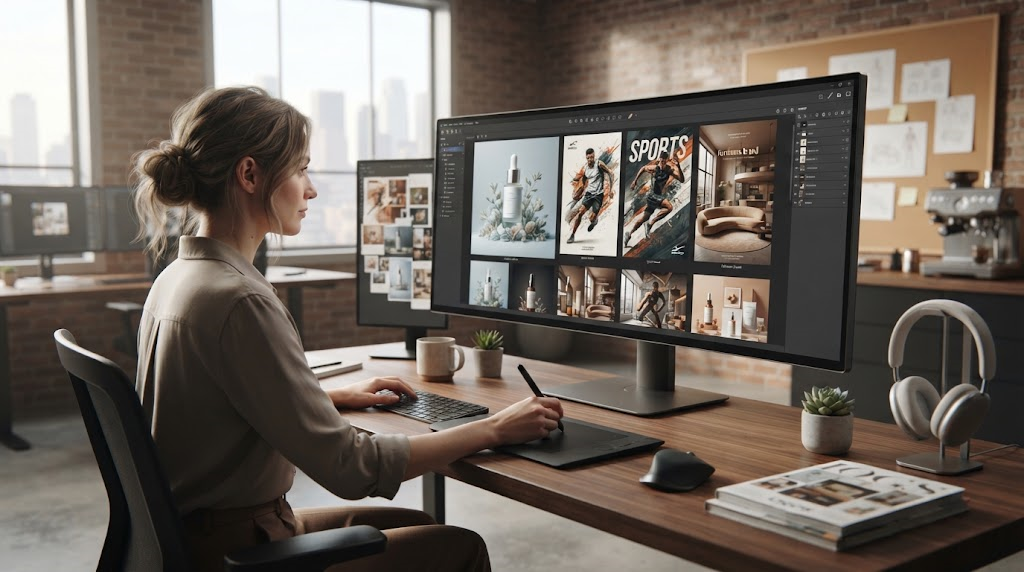
One of the main improvements highlighted by OpenAI is editing precision.
GPT Image 2.5 is designed to preserve important details from a source image while changing the requested area more reliably. OpenAI specifically says the model improves subject preservation and consistency across multiple editing turns.
Edit Without Starting Over
Imagine you generate an ecommerce advertisement that is almost perfect.
The product looks correct.
The background works.
The composition is strong.
But the table needs to be darker.
A less precise model might change the table while also altering the product packaging, camera angle, or lighting.
A better editing workflow aims to modify the requested detail while protecting everything else.
This is valuable for:
- Product photography
- Advertising
- Fashion images
- Interior visualization
- Portrait editing
- Social media campaigns
- Storyboards
Third-party tools such as gptimage25.io also market natural-language editing as part of their workflow, including room redesigns and reference-guided edits.
Better Reference Image Preservation
Reference images are becoming central to AI creative workflows.
Instead of describing a product or character entirely with words, users can upload an example and instruct the model to build around it.
OpenAI says Images 2.5 improves the recognizability of subjects from reference photos and produces more natural lighting and textures when transforming them into new scenes or compositions.
Why Reference Fidelity Matters
Consider a clothing brand creating an advertisement.
The company may want:
- The same jacket
- The same color
- The same model
- A different city
- Different lighting
- A new camera composition
If the AI changes the jacket every time, the generated images become difficult to use commercially.
Better reference preservation allows AI to function more like a controlled creative assistant rather than an unpredictable generator.
Text Rendering Is Becoming More Useful
Historically, AI-generated text inside images was one of the technology’s biggest weaknesses.
Posters often contained misspelled words.
Packaging displayed meaningless letters.
Infographics looked impressive until someone tried to read them.
Modern GPT Image models are designed to handle typography more reliably.
OpenAI’s current prompting guidance even includes examples specifically focused on rendering exact advertising copy. The documentation recommends placing required text in quotation marks and specifying how many times it should appear.
Useful Applications for Better Text
Improved text rendering can support:
- Posters
- Flyers
- Social graphics
- Packaging concepts
- Signage
- Presentation graphics
- Ad mockups
- Infographics
- Menu concepts
Even with improvements, professional users should still proofread every generated word before publishing.
Never assume AI typography is automatically error-free.
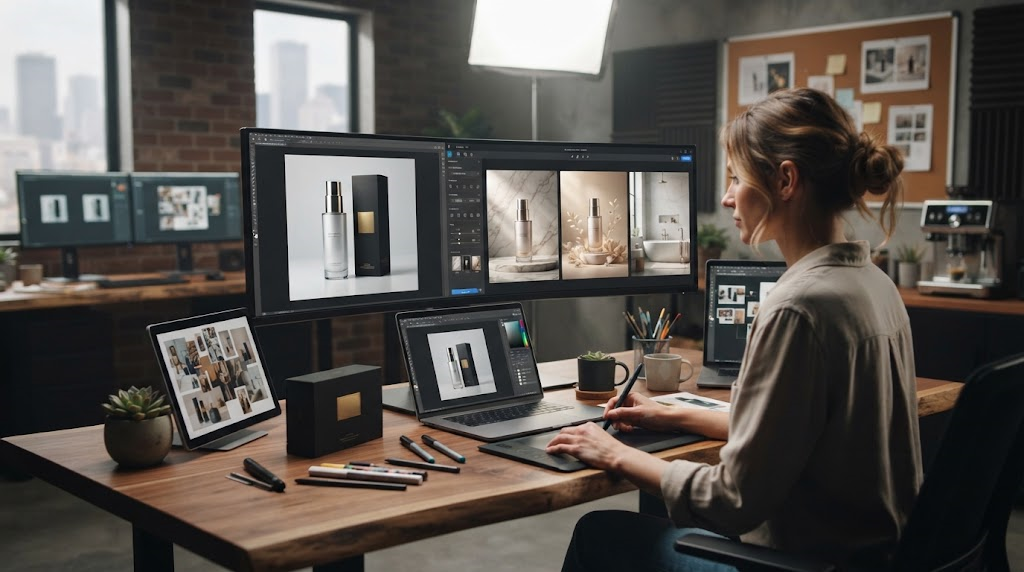
GPT Image 2.5 for Product Photography
Ecommerce is one of the clearest applications.
Traditional product photography may require a studio, photographer, lighting equipment, props, models, retouching, and multiple shoots.
AI can supplement that workflow.
A seller could begin with a clean product photo and ask for:
“Place this exact bottle on a luxury marble bathroom counter with warm morning light. Preserve the label, cap, dimensions, and colors.”
The same source image could then generate:
- White studio shot
- Bathroom lifestyle scene
- Holiday advertisement
- Minimal social post
- Outdoor campaign
- Luxury editorial image
Always Verify Product Accuracy
AI should not be allowed to quietly change important commercial details.
Check:
- Logo
- Label wording
- Packaging dimensions
- Product colors
- Quantity
- Accessories
- Materials
This is particularly important for marketplace listings where images must accurately represent what the customer receives.
AI Images for Marketing and Advertising
Marketing teams often need dozens of image variations.
An Instagram post may use a square composition.
A website hero needs something wider.
A paid ad might require vertical creative.
A promotional email may need another crop entirely.
The ability to generate and edit images through prompts can dramatically shorten the concept-production cycle.
Create Campaign Variations Faster
A marketer could begin with:
“Premium running shoe on a reflective pedestal, dramatic blue studio lighting.”
Then refine it:
“Keep everything identical but make the lighting red.”
Then:
“Create a vertical version with empty space above the shoe for headline copy.”
Then:
“Replace the studio with an urban nighttime background while keeping the shoe unchanged.”
This iterative process is where modern AI editing becomes particularly useful.
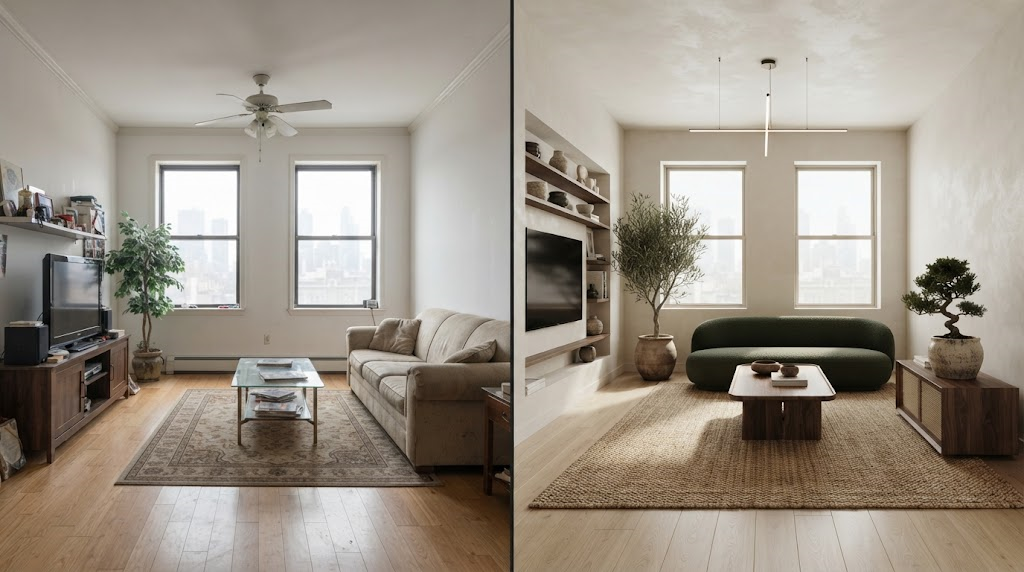
AI Interior and Room Editing
Interior visualization is another strong use case.
Users can upload an existing room and ask the model to restyle it.
For example:
“Keep walls, windows, doors, flooring, perspective, and room dimensions unchanged. Replace the furniture with warm Japandi furniture and add neutral linen curtains.”
gptimage25.io currently showcases room redesign as one of its example editing workflows.
Useful for Planning, Not Construction
An AI room redesign is a concept.
It does not confirm that:
- Furniture fits
- Walls can be moved
- Plumbing can be relocated
- Electrical work is possible
- Building codes are satisfied
Use AI to explore visual directions, then verify dimensions and construction decisions separately.
Transparent Backgrounds and Design Assets
GPT Image 2.5 also supports transparent image backgrounds through OpenAI’s API.
OpenAI’s documentation says transparent outputs are supported for both Flare and Sunburst when compatible formats such as PNG or WebP are used.
That is useful for:
- Product cutouts
- Stickers
- Logos
- Icons
- Game assets
- Presentation graphics
- Website elements
Designers can generate an asset and place it directly into another layout without manually removing a solid background.
High-Resolution Image Generation
Resolution matters when images move beyond casual social posting.
OpenAI’s current API documentation allows custom output dimensions for GPT Image 2.5 up to a maximum edge size of 3,840 pixels, subject to pixel-count and aspect-ratio limits. It also identifies common 4K landscape output such as 3840 × 2160 as supported, with very high-resolution outputs subject to current technical constraints.
The gptimage25.io website also advertises up-to-4K output on supported paid plans.
More Pixels Do Not Guarantee Accuracy
High resolution improves output size, but it does not automatically fix:
- Incorrect anatomy
- Wrong product labels
- Bad composition
- Inaccurate facts
- Poor prompt instructions
Creative quality still depends on the prompt and the model’s interpretation.
How to Write Better GPT Image 2.5 Prompts
A strong prompt should answer a few important questions.
Describe the Subject
Instead of:
“Make a shoe ad.”
Try:
“White premium running shoe with a sculpted foam sole and minimal black accents.”
Describe the Composition
Specify:
- Close-up
- Wide angle
- Top-down
- Centered
- Product left
- Negative space
- Eye-level
- Macro shot
Describe Lighting
Examples include:
- Soft window light
- Golden hour
- Dramatic studio lighting
- Overcast daylight
- Warm interior light
State What Must Not Change
For editing, this is critical.
OpenAI’s own prompting guidance recommends clearly separating what should change from what should remain preserved.
For example:
“Keep the person’s face, hairstyle, pose, clothes, and camera angle unchanged. Replace only the background.”
Flare vs. Sunburst
Developers using the official API have two GPT Image 2.5 choices.
GPT-Image-2.5 Flare
Flare is positioned as the smaller, faster model.
It is suited to workflows where generation speed matters.
Examples might include:
- Rapid concept testing
- Large variation batches
- Social content
- Early-stage ideation
GPT-Image-2.5 Sunburst
Sunburst prioritizes image quality and precision, with longer generation times.
It may be more appropriate for:
- Detailed advertising
- High-end creative work
- Complex edits
- Final production assets
OpenAI recommends choosing the model based on whether speed or demanding quality is the main priority.
GPT Image 2.5 and Third-Party Websites
One point users should understand is the difference between the underlying OpenAI model and websites that provide their own interface around it.
OpenAI’s official announcement and developer documentation are hosted on OpenAI’s domains.
The website gptimage25.io describes itself as a separate image-generation studio built around OpenAI’s GPT Image family. Its homepage currently markets free starting access, paid credit plans, image editing, and higher-resolution output.
Its About page also contains older wording saying the studio was running on GPT Image 2 while waiting for 2.5 API availability. Since OpenAI officially released GPT Image 2.5 in September 2026, that wording appears to be outdated, so users should check the site’s current product information before assuming which model is being used for a particular generation.
Frequently Asked Questions About GPT Image 2.5
What is GPT Image 2.5?
GPT Image 2.5 is OpenAI’s newer image generation and editing technology designed for higher-quality visual creation, more precise edits, improved reference preservation, and faster generation.
Can GPT Image 2.5 edit existing photos?
Yes. It supports image-input workflows and can modify existing images according to natural-language instructions.
Can it generate text inside images?
Yes. GPT Image models are designed to render text more reliably, and OpenAI provides specific prompting guidance for exact text in ads and other visual designs.
Can GPT Image 2.5 create transparent PNGs?
Yes. The official API supports transparent backgrounds for compatible image formats including PNG and WebP.
Does it support 4K output?
OpenAI’s API documentation currently supports custom dimensions up to 3840 × 2160 under specified constraints.
What is the difference between Flare and Sunburst?
Flare prioritizes speed, while Sunburst is designed for higher image quality and more demanding creative requirements.
Is gptimage25.io an OpenAI website?
gptimage25.io describes itself as a web tool built around OpenAI’s GPT Image family. OpenAI’s official GPT Image documentation and announcements are hosted on OpenAI’s own domains, so users should treat third-party services as separate platforms with their own pricing, terms, and privacy policies.
Where can I try a GPT Image 2.5 web tool?
Users can explore gpt image 2.5 through gptimage25.io, which currently presents image generation, natural-language editing, paid credit plans, and higher-resolution export options through its web interface.
Conclusion
GPT Image 2.5 shows how quickly AI image generation is moving beyond basic text-to-picture tools.
The more important capabilities now involve control.
Users want to preserve subjects across edits, modify one detail without destroying the rest of the composition, create readable text, use reference images, produce marketing variations, generate transparent assets, and export visuals at useful resolutions.
OpenAI’s latest image technology is designed around many of those needs. Images 2.5 introduces improved detail, more natural lighting and textures, better reference fidelity, more precise editing, and generation latency reductions of up to 50% compared with Images 2.0.
For creative professionals, these improvements can change the workflow significantly.
A marketer can create campaign concepts more quickly. An ecommerce seller can explore product scenes. An interior designer can visualize room styles. A creator can develop consistent characters. A developer can build automated image-generation workflows through the API.
Third-party services such as gptimage25.io provide another way to access AI-image workflows through a dedicated web interface, although users should distinguish those independent services from OpenAI’s official products and review their current terms, pricing, privacy policies, and model information before subscribing.
The technology is powerful, but the best results still depend on human judgment.
Clear prompts matter.
Accurate references matter.
Proofreading matters.
Commercial images still need review for product accuracy, branding, anatomy, factual correctness, and visual quality.
When those checks are combined with modern AI generation, GPT Image 2.5 can become far more than a novelty image generator. It can become a practical creative tool for moving from an idea to a polished visual much faster than traditional workflows alone.