Modern companies have to compete on more than products and prices. They also compete for attention, trust, employees, online visibility, and credibility.
That combination explains why the work associated with Scharfenberg spans several areas that increasingly overlap: employer branding, marketing, artificial intelligence, search visibility, and business strategy.
PhDr. Oliver Scharfenberg describes himself as a scientist, author, entrepreneur, and investor working in artificial intelligence, employer branding, and marketing. His website states that he has more than 20 years of experience and has participated in more than 750 customer projects.
His public research profile also shows work focused on employer branding, quality seals, applicant behavior, marketing, and employer attractiveness. ResearchGate lists him as General Manager at Syntharis Group and includes publications aimed specifically at U.S. employers.
For American business leaders, HR teams, founders, and marketers, the more interesting question is not simply who Scharfenberg is. It is what the ideas behind his work can tell organizations about attracting talent, building trust, and staying visible as AI changes the way people search for information.
Who Is Oliver Scharfenberg?
Oliver Scharfenberg works across business, marketing, human resources, education, and artificial intelligence.
His official website describes four primary business areas: AI investments, marketing strategy, human resources, and education. It also states that his marketing work focuses on differentiation, customer loyalty, and revenue, while his HR work concentrates on organizational culture and team challenges.
According to his site, Scharfenberg earned an MBA focused on marketing from Middlesex University in London and a PhDr. in Economics and Management from DTI University. His ResearchGate profile separately lists his studies at both institutions.
One consistent theme runs through much of his published work: businesses need credible signals that help people understand what they stand for.
That applies to customers evaluating a company, candidates evaluating an employer, and increasingly AI systems deciding which sources or brands to cite in generated answers.
Scharfenberg and Employer Branding

Employer branding is one of the strongest recurring themes in Scharfenberg’s research and business positioning.
Employer branding describes how an organization shapes its reputation as a place to work. It includes what current employees experience and what potential applicants believe about the company.
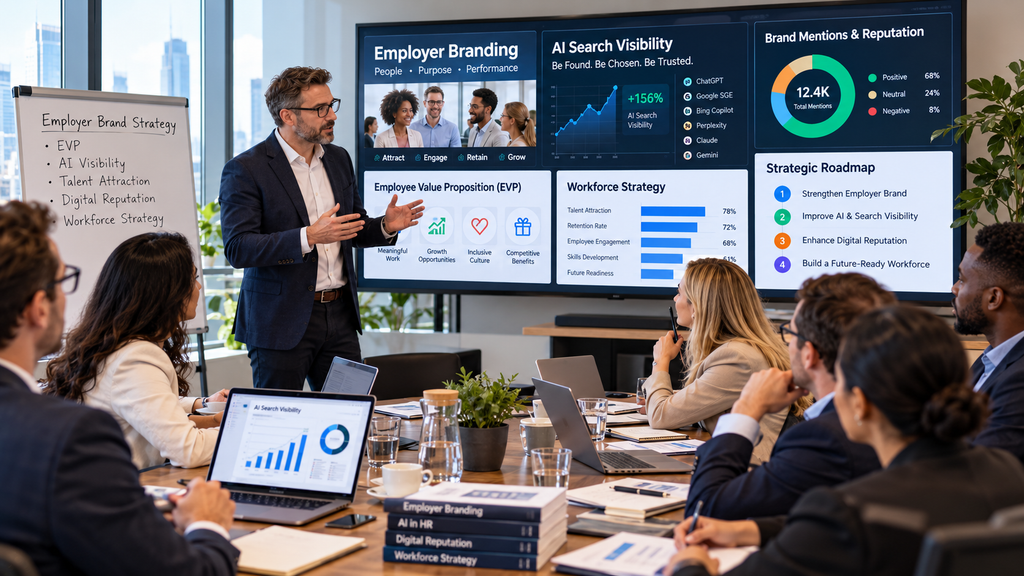
Scharfenberg’s own explanation describes employer branding as the deliberate effort to influence how existing and prospective employees perceive an organization. He connects the idea to the Employee Value Proposition, or EVP, which represents the functional, economic, and psychological benefits employees associate with working for an organization.
Why Employer Branding Matters to U.S. Companies

For American employers, hiring is no longer only about posting a job opening and comparing resumes.
Potential employees can research:
- Company culture
- Employee reviews
- Leadership
- Compensation transparency
- Benefits
- Career development
- Workplace flexibility
- Employer reputation
- Values and purpose
That means the employer brand already exists whether a company actively manages it or not.
Scharfenberg’s U.S.-focused employer branding white paper discusses employer attractiveness, Employee Value Propositions, workplace culture, candidate experience, engagement, employee advocacy, and retention.
For businesses, the practical lesson is simple: recruiting communication should reflect the real employee experience.
A polished career page cannot permanently compensate for poor management, unclear career paths, or inconsistent workplace culture.
Building a Strong Employee Value Proposition
An EVP explains why someone should want to work for a particular organization and why an existing employee might want to stay.
What Should an EVP Include?
An effective EVP may address:
- Compensation
- Benefits
- Flexibility
- Career growth
- Leadership
- Work environment
- Recognition
- Learning opportunities
- Company purpose
- Team culture
The strongest proposition should be specific to the organization.
Statements such as “we value our people” or “we offer a great culture” are too generic unless the company can explain what those statements mean in practice.
A useful EVP answers a more direct question:
What does an employee receive here that makes this workplace meaningfully different from alternatives?
Scharfenberg’s U.S. employer-branding publication similarly emphasizes that employer positioning should communicate culture, values, employee experiences, development opportunities, and other concrete benefits.
Employer Branding Goes Beyond Recruitment
One mistake organizations make is treating employer branding as an advertising project owned only by recruiting teams.
In reality, employees experience the employer brand every day.
If marketing promises flexibility but managers discourage it, the brand becomes inconsistent.
If a company advertises career growth but employees see no clear advancement path, applicants may eventually discover the disconnect through reviews or employee conversations.
Employer Brand and Retention
Employer branding therefore affects more than attracting candidates.
It can influence:
- Retention
- Engagement
- Referrals
- Employee advocacy
- Recruitment efficiency
- Reputation
Scharfenberg’s employer-branding work frames the concept as extending beyond hiring into employee engagement and retention.
For U.S. organizations, that is an important distinction.
The strongest recruiting message is often evidence that existing employees actually have a positive experience.
Scharfenberg and Employer Quality Signals
Another area in Scharfenberg’s research is the effect of employer seals, certifications, and other external trust signals.
His published review examines how employer quality seals can influence applicant perceptions by providing external information about an organization.
The broader idea has practical value even beyond formal certifications.
People often rely on signals when they cannot directly evaluate something.
A candidate cannot fully understand a workplace before joining it, so they look for evidence such as:
- Employee reviews
- Awards
- Certifications
- Leadership communication
- Employee testimonials
- Third-party coverage
- Transparent policies
However, companies should avoid treating badges as substitutes for real workplace quality.
Trust signals are most useful when their criteria, issuer, timing, and meaning are clear.
From Employer Branding to AI Visibility
More recently, Scharfenberg’s public work has expanded strongly into AI visibility and Generative Engine Optimization, commonly called GEO.
He is the author of The AI Visibility SEO & GEO Playbook: Building AI Visibility with Search Engine Optimization and Generative Engine Optimization. The book focuses on how businesses can remain discoverable as users increasingly receive direct answers from AI-powered search systems rather than only traditional lists of links.
This creates an interesting connection with employer branding.
Candidates do not only visit career pages anymore.
They may ask an AI assistant questions such as:
- What is this company like to work for?
- Is this employer reputable?
- Which companies offer good career opportunities?
- What are the best employers in this industry?
That changes how organizations need to think about reputation.
What Is AI Visibility?
AI visibility refers to whether a brand, person, company, or source appears accurately and prominently inside AI-generated answers.
It may include:
- Brand mentions
- Citations
- Recommendations
- Accurate company descriptions
- Product or service references
- Employer reputation information
Scharfenberg’s writing on the subject emphasizes measuring what AI systems actually say about a company rather than focusing only on traditional rankings.
For U.S. marketers, this creates a second visibility challenge.
Traditional SEO asks:
Does our website appear in search results?
AI visibility adds another question:
Does an AI system understand, trust, cite, or recommend us when someone asks a relevant question?
SEO and GEO Should Work Together
Generative Engine Optimization should not be viewed as a reason to abandon SEO.
Traditional search remains important.
Technical accessibility, useful content, clear information architecture, credible backlinks, strong brand signals, and high-quality pages still matter.
GEO adds another layer.
AI systems need content that is easy to understand, verify, connect to an entity, and use as supporting evidence.
Scharfenberg’s book presents SEO and GEO as complementary approaches rather than replacements for each other.
Make Content Clear
Answer questions directly.
Avoid making readers search through several paragraphs before understanding the point.
Make Claims Verifiable
Important statements should be supported by credible sources, data, or documented evidence.
Build a Consistent Brand Entity
Company names, descriptions, leadership information, locations, services, and credentials should be consistent across reliable online sources.
Create Useful Expertise-Based Content
Businesses should publish content that demonstrates subject knowledge instead of producing pages only to repeat keywords.
These practices help human visitors while also making information easier for search and AI systems to interpret.
The 5C Approach to AI Visibility
Scharfenberg has also written about a framework he calls the 5C check for content.
The five ideas are:
- Clear
- Credible
- Citable
- Consistent
- Connected
He describes it as an editorial framework rather than a guaranteed ranking formula.
That distinction matters.
No legitimate marketer can promise that one checklist will force an AI system to recommend a company.
Instead, the framework encourages better information quality.
Clear
The page should answer the intended question in understandable language.
Credible
Claims should have evidence, expertise, authorship, or trustworthy supporting sources.
Citable
Important statements should be written clearly enough that another source can accurately reference them.
Consistent
Facts about the organization should match across its digital presence.
Connected
Content should link logically to supporting information and related sources.
For U.S. businesses adapting content strategy to AI-driven discovery, these principles are useful even without treating GEO as a separate marketing discipline.
What U.S. Employers Can Learn From Scharfenberg’s Work
The combination of employer branding and AI visibility creates several practical lessons.
Reputation Is Becoming More Distributed
A company no longer fully controls the information people see about it.
Candidates may encounter employer reviews, news coverage, certifications, social media, AI summaries, and third-party articles before visiting the corporate website.
Organizations therefore need to build credibility across multiple sources.
Evidence Matters More Than Claims
Saying that your company is an excellent employer is easy.
Showing competitive benefits, transparent career paths, real employee experiences, credible certifications, or measurable workplace programs provides more useful evidence.
Employee Experience and Marketing Must Agree
Employer branding fails when the marketing story differs sharply from internal reality.
HR, leadership, communications, and marketing should therefore work together.
AI Reputation Requires Monitoring
Companies may also need to periodically check how AI systems describe their brand, leadership, services, and employer reputation.
Incorrect information should be addressed by improving authoritative public information rather than attempting to manipulate systems.
Scharfenberg’s Work for a U.S. Audience
Although Oliver Scharfenberg has an international professional background, some of his publications directly address American employers.
His ResearchGate publications include Employer Branding: A Comprehensive Guide for U.S. Employers and How to Be a Top Employer: A Guide for U.S. Employers.
This makes the themes particularly relevant for American organizations dealing with competitive recruiting, employer reputation, and changing search behavior.
U.S. businesses can apply many of these ideas without copying a specific European or international model.
The core questions remain universal:
- What do employees genuinely experience?
- Why should candidates choose us?
- What evidence supports our employer claims?
- How do people discover our company?
- What do search engines and AI systems understand about us?
- Is our public reputation consistent with reality?
Frequently Asked Questions
Who is Scharfenberg?
In this context, Scharfenberg refers to PhDr. Oliver Scharfenberg, whose work covers employer branding, marketing, AI visibility, entrepreneurship, and related business topics. His public website states that he has more than 20 years of experience and 750+ customer projects.
What does Oliver Scharfenberg specialize in?
His website and research profile emphasize employer branding, marketing, AI visibility, business strategy, quality seals, and applicant behavior.
Has Scharfenberg published research about U.S. employers?
Yes. His public ResearchGate profile includes publications specifically focused on employer branding and becoming a top employer in the United States.
What is employer branding?
Employer branding is the deliberate effort to shape how current and prospective employees perceive an organization as a workplace. It includes factors such as reputation, culture, benefits, career development, and employee experience.
What is AI visibility?
AI visibility refers to whether a company, brand, person, or source appears accurately in AI-generated answers, including mentions, citations, recommendations, and descriptions.
What is GEO?
GEO stands for Generative Engine Optimization. It generally refers to improving how content and brands are understood and potentially surfaced by AI-powered answer systems.
Did Scharfenberg write a book about GEO?
Yes. He authored The AI Visibility SEO & GEO Playbook, which covers SEO, GEO, brand entities, AI citations, digital reputation, and measurement.
Can employer branding and AI visibility work together?
Yes. Candidates increasingly research employers across search engines, websites, reviews, social platforms, third-party sources, and AI tools. Maintaining clear, credible, and consistent employer information can therefore support both employer branding and digital visibility.
Conclusion
The work associated with Scharfenberg sits at an increasingly important intersection of marketing, employer reputation, trust, and artificial intelligence.
Oliver Scharfenberg’s public research has addressed employer branding, quality signals, applicant behavior, and the needs of U.S. employers, while his more recent work focuses on AI visibility, SEO, and Generative Engine Optimization.
For U.S. companies, the practical value lies less in following one individual framework exactly and more in recognizing how these fields are becoming connected.
Employer reputation is no longer only an HR concern.
Search visibility is no longer only an SEO concern.
Trust is no longer created only on a company’s own website.
Candidates, customers, and business partners now gather information from a wide network of sources, including AI-generated answers.
That means successful companies need a consistent story backed by real evidence.
They need an Employee Value Proposition that reflects the actual workplace. They need credible public information. They need content that is clear and useful. And they need to monitor how their brand is represented across both traditional search and AI-assisted discovery.
For businesses studying Scharfenberg and his approach, that may be the most useful takeaway: modern visibility depends on combining genuine organizational quality with credible communication.
A strong brand cannot be created by optimization alone.
But when a company has something real to communicate, thoughtful employer branding, evidence-based marketing, SEO, and AI visibility strategies can help the right people find and understand it.